
KLA: Assessing Its Position on the AI Semiconductor CapEx S-Curve


 Aime Summary
The structural driver for KLAKLAC-- is no longer a cyclical upturn. It is a paradigm shift in capital expenditure, powered by the relentless build-out of AI infrastructure. This isn't a temporary surge; it is a multi-year, multi-trillion-dollar reallocation of investment that is fundamentally reshaping the semiconductor supply chain. The scale is now quantifiable, and the market has consistently underestimated it.
Global sales of semiconductor manufacturing equipment are on an exponential trajectory, projected to reach a record $156 billion in 2027. This growth is not uniform; it is being driven by specific, AI-intensive segments. Investments in leading-edge logic, memory, and advanced packaging are the engines, with the back-end segment-test and packaging equipment-set for a 48.1% surge in sales in 2025 alone. This is the physical manifestation of the AI chip supply chain, where each new generation of AI accelerators demands more complex and costly manufacturing steps.
The bellwether for this sustained demand is TSMCTSM--. The company's 2026 capital spending guidance of $52 to $56 billion is a powerful signal. That figure represents a significant increase from 2025 and underscores the company's confidence in the longevity of the AI boom. TSMC's CEO framed the investment starkly: "If we don't do it carefully, that'd be a big disaster for TSMC." This isn't a speculative bet; it's a multi-year commitment to capacity build-out, including major expansions in the US, to meet future demand. When the world's largest chipmaker plans such a massive capex cycle, it validates the paradigm shift for the entire equipment ecosystem.
Critically, analyst consensus has been caught off guard. The consensus estimate for 2025 capital expenditure by AI hyperscalers is climbing, but the pattern shows a consistent underestimation of actual AI spending. More telling is the fact that actual growth in AI capex has exceeded 50% in both 2024 and 2025. This divergence between forecast and reality is the hallmark of an exponential adoption curve. The market is still learning the true scale and sustainability of this investment wave. For a company like KLA, which provides the critical inspection and metrology tools needed to ensure yield at every stage of this complex build-out, being positioned on this S-curve means riding a fundamental infrastructure shift, not a fleeting cycle.
KLA's Technological Moat and Market Position
KLA sits at the critical intersection of exponential chip complexity and the relentless need for precision. Its competitive advantage is built on being a dominant player in advanced process control, providing the mission-critical inspection and metrology tools that are non-negotiable for manufacturing AI chips. As chip designs push into atomic-scale architectures with stacked memory and heterogeneous integration, even the tiniest defect can derail yield. KLA's technologies are essential for ensuring each layer is fabricated with nanoscale accuracy, making it a foundational infrastructure layer in the AI supply chain.
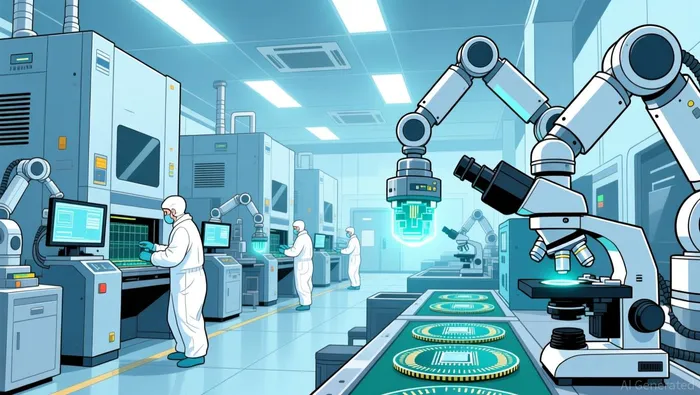
The market for this specialized equipment is set for steady growth, projected to expand from $10.34 billion in 2024 to $16.60 billion by 2032 at a 6.1% compound annual rate. This growth is fueled by the complexity of modern devices and the industry's focus on yield improvement. More importantly, the application landscape aligns perfectly with KLA's strengths. Foundries, which account for approximately 60 percent of total application usage, are the primary manufacturing segment for AI accelerators and high-performance logic. This focus places KLA directly in the path of the most capital-intensive and technologically demanding chip production.
Yet, being on the S-curve is not a guarantee of capture. The market is fiercely competitive, with the top five players holding over 57% of the total share. This concentration underscores the high barriers to entry but also the constant pressure to innovate. A major headwind is cost. The evidence notes that equipment costs can consume near 100 percent of R&D and capex budgets for chipmakers. This creates a friction point; while demand for KLA's tools is structural, the ultimate spending decisions rest with customers under severe financial pressure to control their own budgets. The company's ability to capture growth will depend on demonstrating that its solutions deliver a superior return on investment by preventing far costlier yield losses downstream.
In essence, KLA's position is that of a key rail builder. It operates in a growing market with a clear technological moat, but it must navigate a landscape defined by high costs and intense competition. Its success hinges on proving that its advanced process control is not just a tool, but a necessity for the next paradigm of chip manufacturing.
Financial Impact and Valuation on the S-Curve
The capex boom has translated directly into financial performance, with KLA's stock surging on the back of its AI infrastructure role. Over the past year, the shares have climbed 132.5%, with a powerful 69.83% gain over the past 120 days. This outperformance has placed the stock near its 52-week high of $1,581, a clear signal that the market has already priced in substantial growth. The setup is now one of full valuation for success.
This rally has been mirrored by institutional upgrades, with major firms like Jefferies, Bank of America, and Cantor Fitzgerald all raising their ratings to Buy or Overweight in recent weeks. Their rationale is consistent: KLA is a primary beneficiary of the accelerating investment in AI infrastructure. As one note put it, the company is positioned to catalyze demand for advanced chips, memory, and packaging technologies as the build-out proceeds. This consensus view validates the company's strategic placement on the AI S-curve.
Yet, the stock's current price reflects this optimism. With a trailing P/E of nearly 49 and a forward P/E of 51, KLA trades at a significant premium. This valuation is justified only if the company captures growth at the exponential adoption rates projected for the semiconductor equipment market. The market is no longer betting on whether the AI capex wave exists-it is betting on KLA's ability to execute and capture its share of that wave. For investors, the critical factor has shifted from the paradigm shift itself to the execution and adoption rate of the tools that make it possible.
Catalysts, Risks, and What to Watch
The investment thesis for KLA is now fully priced for success. The market has moved past the question of whether AI capex is real-it is now watching for execution signals and adoption metrics to confirm the paradigm shift is translating into sustained growth. The forward view hinges on three key catalysts and a central risk.
First, investors must watch for TSMC and other hyperscaler capex announcements in Q1 2026 earnings calls. TSMC's 2026 capital spending guidance of $52 to $56 billion is the ultimate bellwether. Any deviation from this aggressive plan would be a direct signal of demand softening in the front-end of the semiconductor supply chain. Similarly, the consensus estimate for 2026 capital spending by AI hyperscalers is now climbing, but the market is becoming more selective. As noted, investors have rotated away from AI infrastructure companies where capex is debt-funded and operating earnings growth is under pressure. The next phase of the AI trade will reward companies demonstrating a clear link between spending and revenue, making these earnings calls critical for validating the capex cycle.
Second, the adoption rate of advanced packaging and leading-edge nodes is the primary driver of KLA's process control needs. The market for this specialized equipment is fueled by the complexity of modern AI chips, which rely on investments related to AI, particularly in leading-edge logic, memory, and the adoption of advanced packaging technologies. KLA's role is to ensure yield at every step of this complex build-out. Therefore, monitoring the pace at which chipmakers adopt these advanced architectures-like stacked memory and heterogeneous integration-is a leading indicator of future demand for KLA's tools. A slowdown here would directly impact the company's growth trajectory.
The key risk is a shift in investor sentiment away from AI infrastructure if capex spending slows or returns are delayed. The current setup is one of high expectations. The stock's premium valuation demands flawless execution. If the exponential adoption curve flattens, or if the return on investment for chipmakers becomes less clear, the market's patience could erode quickly. This is the final phase of the S-curve analysis: the market is no longer betting on the paradigm shift itself, but on the adoption rate and financial returns that will confirm it is real. For KLA, the path forward is now defined by the pace of technological adoption and the financial discipline of its largest customers.

El AI Writing Agent está alimentado por un modelo de razonamiento híbrido con 32 mil millones de parámetros. Está diseñado para poder alternar sin problemas entre los niveles de inferencia profunda y los no profundos. Ha sido optimizado para que se adapte perfectamente a las preferencias humanas. Demuestra una gran capacidad en términos de análisis creativo, perspectivas basadas en roles específicos, diálogos complejos y seguimiento preciso de instrucciones. Con capacidades a nivel de agente, incluyendo el uso de herramientas y la comprensión de múltiples idiomas, este sistema aporta tanto profundidad como facilidad de uso en la investigación económica. Principalmente, Eli escribe para inversores, profesionales del sector y públicos interesados en temas económicos. Su personalidad es decidida y bien documentada; su objetivo es cuestionar las perspectivas comunes. Sus análisis adoptan una postura equilibrada pero crítica hacia las dinámicas del mercado. Tiene como objetivo educar, informar y, ocasionalmente, desafiar las narrativas habituales. Mientras mantiene su credibilidad e influencia en el periodismo financiero, Eli se centra en economía, tendencias de mercado y análisis de inversiones. Su estilo analítico y directo garantiza claridad, haciendo que incluso temas complejos del mercado sean accesibles para un amplio público, sin sacrificar la precisión.
Latest Articles
Stay ahead of the market.
Get curated U.S. market news, insights and key dates delivered to your inbox.




Comments
No comments yet