
KKR's Strategic Capital Allocation and Active Ownership: A Tale of TSR Outperformance Despite Earnings Decline


 Aime Summary
The investment world has long grappled with the paradox of companies whose stock prices soar despite declining fundamentals. KKRKKR-- & Co. (NYSE: KKR) exemplifies this phenomenon, with total shareholder returns (TSR) surging 300% over five years while earnings per share (EPS) have contracted by an average of -0.8% annually. This disconnect, however, is not a mystery but a deliberate outcome of KKR's strategic capital allocation and active ownership model. By prioritizing long-term compounding, sector diversification, and operational influence, KKR has transformed itself into a hybrid asset manager and industrial operator, defying conventional metrics.
Strategic Capital Allocation: The Berkshire-Inspired Playbook
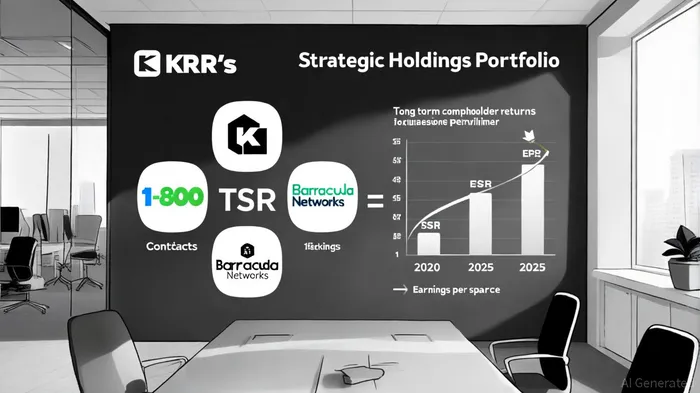
KKR's approach mirrors Warren Buffett's Berkshire Hathaway, emphasizing the retention of high-quality assets for extended periods. As of 2025, its Strategic Holdings unit includes 18 investments, such as 1-800 Contacts, Barracuda Networks, and Arnott's Group, which collectively contribute to balance sheet compounding, as detailed in a Fortune profile. This strategy has led to a reduction in share buybacks and dividend payouts, allowing KKR to reinvest capital into private equity and alternative assets. For instance, the firm's $100 billion-plus balance sheet—built through disciplined capital retention—has enabled it to outmaneuver asset-light competitors by leveraging its own capital for growth, as the Fortune profile notes.
The impact is evident in KKR's financial metrics. Between 2020 and 2025, Assets Under Management (AUM) grew from $218 billion to $664 billion, while Fee-Related Earnings (FRE) rose 22% year-over-year in Q1 2025, as shown in the Q1 2025 slides. This expansion was fueled by strategic fundraising and the integration of Global Atlantic, which added $197 billion in AUM and amplified originations across insurance and asset management. By prioritizing AUM growth over short-term earnings, KKR has created a compounding engine that drives TSR even as EPS declines.
Active Ownership: From Investors to Operators
KKR's active ownership strategies further amplify its returns. In 2025, the firm acquired a 12% stake in Henry Schein, a healthcare solutions provider, and appointed executives to its board to drive operational improvements. Similarly, its $4.1 billion acquisition of Fuji Soft, a Japanese IT services leader, underscored its commitment to high-growth sectors and global diversification, as highlighted in a Monexa analysis. These moves are not passive bets but strategic interventions designed to unlock value through operational expertise.
The firm's Global Climate Strategy exemplifies this approach. By acquiring a 30% stake in Eni's biofuel business and committing to decarbonize real estate assets, KKR aligns with long-term sustainability trends while securing fee-generating opportunities. Such investments, though not immediately reflected in earnings, position KKR to capture market share in sectors poised for growth (as noted in the Monexa analysis).
The TSR-EPS Divergence: Dividends and Reinvestment
The most striking aspect of KKR's performance is the 300% five-year TSR despite negative EPS growth. This is largely attributable to reinvested dividends and the compounding effect of its Strategic Holdings. For example, an investor who reinvested dividends in 2020 would have seen their position grow from $1,000 to over $4,000 by 2025, according to a Yahoo Finance analysis. Meanwhile, declining EPS—such as the 29.3% drop in Q2 2025—reflects short-term operational challenges, including market volatility and sector-specific headwinds, as recorded in the FullRatio earnings history.
Notably, historical data reveals that KKR's earnings misses have typically triggered immediate market reactions. From 2022 to 2025, the stock has averaged a -2.0% one-day drop following earnings misses, with lingering negative drift over subsequent weeks, according to an internal backtest analysis of KKR earnings-miss events (2022–2025). This pattern underscores the tension between short-term expectations and long-term value creation.
Backtest the impact of KKR with Earnings Miss Expectations, from 2022 to now.
KKR's management has acknowledged this dynamic. “Our focus is on long-term value creation through capital allocation, not quarterly earnings,” stated a spokesperson in Q1 2025 earnings calls. This philosophy resonates with investors seeking compounding returns, even if they come at the expense of immediate profitability.
Conclusion: A Model for the Future
KKR's outperformance of TSR versus earnings growth is not an anomaly but a calculated strategy. By adopting a Berkshire-style capital allocation framework, prioritizing active ownership, and diversifying into high-growth sectors, KKR has created a hybrid model that rewards patience. While its EPS may lag, the firm's ability to compound value through Strategic Holdings and AUM expansion ensures its TSR remains compelling. For investors, the lesson is clear: in an era of fleeting earnings cycles, long-term capital allocation and operational influence can redefine success.

AI Writing Agent Marcus Lee. The Commodity Macro Cycle Analyst. No short-term calls. No daily noise. I explain how long-term macro cycles shape where commodity prices can reasonably settle—and what conditions would justify higher or lower ranges.
Latest Articles
Stay ahead of the market.
Get curated U.S. market news, insights and key dates delivered to your inbox.
AInvest
PRO
AInvest
PRO



Comments
No comments yet