
KKR's Strategic Bet on CleanPeak Energy: A Catalyst for Renewable Energy Growth in the Asia-Pacific
 Aime Summary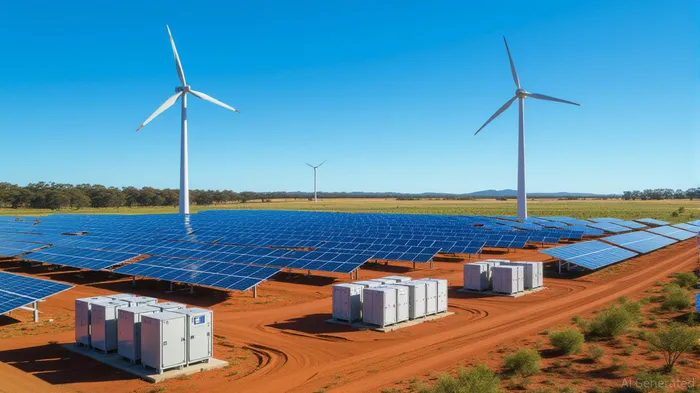
The global energy transition is no longer a distant promise—it's a race against time. As the Asia-Pacific region emerges as a linchpin in this race, private equity giants like KKRKKR-- are doubling down on opportunities that align with both planetary survival and long-term value creation. Their recent $328 million investment in CleanPeak Energy, an Australian renewable energy leader, is a masterclass in strategic capital allocation. This move isn't just about funding clean energy; it's about redefining infrastructure in a world where decarbonization is no longer optional.
Why KKR's Play in CleanPeak Matters
CleanPeak Energy, founded in 2017, has already carved out a niche in Australia's commercial and industrial (C&I) sector by deploying distributed energy solutions. With over 140 megawatts of solar assets and 35 megawatt-hours of battery storage in operation, and another 100 MW of solar and 300 MWh of battery projects in the pipeline, the company is a rare hybrid of engineering prowess and financial agility. KKR's investment—its first in the Asia-Pacific under its Global Climate Transition strategy—targets CleanPeak's ability to scale its distributed energy platform.
This isn't just a bet on solar or storage; it's a bet on the C&I sector's urgent need for reliable, cost-effective, and sustainable energy. As Australian businesses grapple with rising grid costs and regulatory pressures to reduce carbon footprints, CleanPeak's tailored solutions—ranging from rooftop solar to microgrids—position it as a critical player. KKR's backing will accelerate CleanPeak's acquisition strategy, allowing it to bolt on smaller projects and dominate a market that's expected to grow at a compound annual rate of 9% through 2030.
The APAC Renewable Energy Landscape: A Gold Rush with Structure
The Asia-Pacific region is the new frontier for renewable energy. By 2030, the market is projected to hit $711.8 billion, driven by aggressive targets in countries like China ($498.5 billion by 2030), India (500 GW of renewable capacity by 2030), and Japan. Solar energy is the clear winner, with costs plummeting and grid integration improving. Offshore wind and energy storage are also gaining traction, particularly in Japan and South Korea, where grid stability is a premium concern.
Foreign investments are fueling this boom. In Southeast Asia alone, green investments tripled in 2024, with solar and waste managementWM-- leading the charge. CleanPeak's focus on Australia—a market with $118.5 billion in renewable energy potential by 2030—positions it at the intersection of a developed economy and a high-growth sector. KKR's entry here is a signal: institutional capital is moving toward markets where policy, demand, and infrastructure align.
The Long-Term Value Proposition
What makes KKR's investment particularly compelling is its alignment with global decarbonization trends. CleanPeak's ability to design, build, and operate integrated systems—backed by KKR's $34 billion climate portfolio—creates a flywheel effect. As CleanPeak scales, it reduces per-unit costs through economies of scale, while KKR's network of partners and investors ensures a steady flow of capital.
Moreover, the company's unique retail electricity license allows it to bypass traditional utilities and sell directly to end-users. This vertical integration is a game-changer in a sector where margins are often squeezed by intermediaries. With over one million square meters of floorspace already serviced, CleanPeak is proving that renewable energy isn't just about environmental impact—it's about capturing market share in a fragmented industry.
Strategic Allocation in Emerging Markets: Lessons for Investors
For investors, this deal underscores the importance of strategic capital allocation in emerging markets. KKR didn't just write a check; it provided a blueprint for success:
1. Targeting Underserved Sectors: The C&I market in Australia is ripe for disruption. CleanPeak's focus on this segment mirrors the success of companies like TeslaTSLA-- in the EV space—addressing a pain point with a scalable solution.
2. Leveraging Partnerships: CleanPeak's joint venture with Igneo Infrastructure Partners and KKR's global network create a robust ecosystem. This mirrors the synergy between renewable developers and infrastructure funds seen in the U.S. and Europe.
3. Policy Alignment: Australia's aggressive renewable targets (50% of electricity from renewables by 2030) ensure long-term demand. Investors should look for companies aligned with national policies, not just market trends.
The Road Ahead
While regulatory approvals and execution risks remain, the fundamentals are robust. CleanPeak's pipeline includes $200 million in active construction projects, and its recent $465 million debt refinancing demonstrates strong creditor confidence. For KKR, this investment is a test of its ability to replicate its U.S. climate success in the APAC context—a region where the energy transition is both urgent and undercapitalized.
For individual investors, the takeaway is clear: the future belongs to companies that can decarbonize infrastructure while generating returns. CleanPeak's model—combining solar, storage, and direct-to-consumer retail—offers a template for how to do it. And with KKR's backing, this isn't just a local play; it's a harbinger of the global energy transition.
In the end, this investment is about more than money. It's about building a future where clean energy isn't a luxury but a standard—powered by the right capital at the right time.

Stay ahead of the market.
Get curated U.S. market news, insights and key dates delivered to your inbox.
AInvest
PRO
AInvest
PRO



Comments
No comments yet