
KITE Token's Binance Listing: A Tectonic Shift in Crypto Market Structure and Retail Sentiment


 Aime Summary
Market Structure: Liquidity, Speculation, and Institutional Shifts
Binance's decision to list KITE across four pairs-KITE/USDT, KITE/USDC, KITE/BNB, and KITE/TRY-has amplified liquidity options for traders, according to a Bitcoin Exchange Binance Announces Listing of Two Altcoins in USDC Pair! Here Are the Details. However, the token's immediate price drop highlights the fragility of its valuation. With a market cap of $167 million and a fully diluted valuation (FDV) of $929 million, KITE's circulating supply accounts for just 18% of its total 10 billion tokens, according to a Coindesk report. This disparity creates inherent pressure as future unlocks of team and investor allocations loom.
The market structure is further reshaped by platforms like BingX, which integrated KITE into its Xpool pre-listing staking mechanism, according to a PR Newswire report. Users can stake USDT or BNBBNB-- to earn KITE points, convertible 1:1 post-token generation. This model democratizes access but also fuels speculative demand, as early stakers seek to capitalize on listing premiums. Meanwhile, Coinbase's new regulated token launchpad-set to debut with Monad (MON)-signals a broader industry shift toward institutional-grade token sales, according to a CoinEdition report. Such platforms could dilute Binance's dominance by offering retail investors fairer access, potentially altering the trajectory of tokens like KITE.
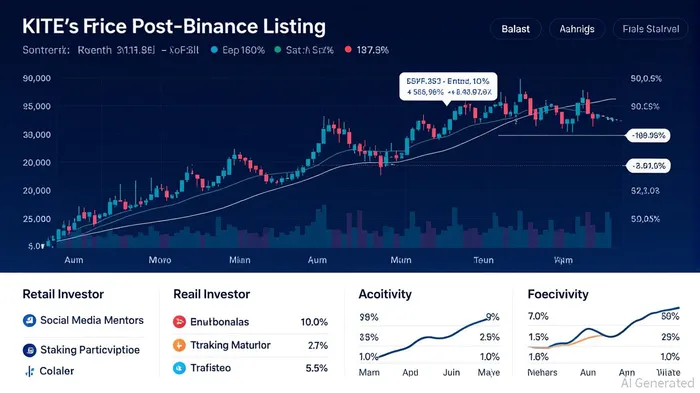
Retail Investor Sentiment: Hype vs. Hurdles
Retail investors have been both a catalyst and a constraint for KITE's momentumMMT--. Binance's AlphaALPHA-- airdrop-offering 500 KITE tokens to users with 237–215 Alpha Points-generated immediate demand, according to a Bitget report. Yet, this enthusiasm contrasts with the token's lack of tangible utility. Unlike Microsoft-backed Nebius Group, which surged 417% in 2025 on institutional support and revenue streams, KITE remains unproven in real-world adoption, according to a Coinotag report.
The rise of pre-listing platforms like Coinbase's launchpad further complicates the landscape. By allowing retail investors to purchase tokens before public listings, these platforms aim to reduce institutional advantages, according to a Investing.com report. While this democratization could stabilize KITE's price by broadening its investor base, it also risks inflating expectations. For instance, Corpay (CPAY) fell 24.5% despite strong Q3 earnings, illustrating how sentiment can override fundamentals, according to a Bitget report.
Fundamentals: Agentic Economy and Technological Ambitions
KITE's core proposition lies in its role as the native token of the Kite AI blockchain, a platform designed to power an "agentic economy" where autonomous AI agents execute transactions, according to a Coindesk report. Built on an EVM-compatible Layer-1 blockchain, KITE supports machine-to-machine interactions and programmable governance. However, the token's utility remains abstract. While 40+ AI agents are active on the platform, their economic impact is yet to materialize, according to a CoinMarketCap price prediction.
Partnerships with BingX and x402 integrations, according to a CoinMarketCap price analysis, suggest incremental progress, but KITE's ecosystem lacks the robustness of established blockchains. The token's FDV of $929 million hinges on achieving widespread adoption in the $4.4 trillion AI agent economy-a lofty goal requiring significant developer traction and enterprise integration.
Price Analysis: Volatility and Valuation Disparity
KITE's post-listing performance reflects the tension between speculative optimism and fundamental skepticism. The token's $263 million trading volume in its first two hours, according to a Coindesk report, was impressive but unsustainable. By November 6, 2025, its price had stabilized near $0.095, with a 7-day SMA of $0.0778, according to a CoinMarketCap price analysis. This suggests a potential floor for the token, though future unlocks of 82% of its supply could exacerbate sell pressure.
Derivatives activity, including 50x leverage on perpetual futures, has further amplified volatility, according to a Coinotag report. While this liquidity attracts traders, it also increases the risk of cascading liquidations during market downturns.
Expert Commentary: A Mixed Outlook
Analysts remain divided on KITE's long-term prospects. Proponents highlight its alignment with AI infrastructure trends and the potential for utility-driven demand, according to a CoinMarketCap price prediction. Critics, however, caution against overreliance on speculative narratives. The token's lack of revenue, institutional coverage, and proven use cases makes it vulnerable to macroeconomic shifts and regulatory scrutiny, according to a Bitget report.
Conclusion: Balancing Momentum and Uncertainty
KITE's Binance listing has injected liquidity and visibility into the token, but its future remains contingent on bridging the gap between hype and utility. Retail investors, emboldened by new platforms, have driven short-term momentum, yet the token's fundamentals must evolve to justify its FDV. As the crypto market matures, KITE's ability to demonstrate real-world adoption-beyond speculative staking and airdrops-will determine its place in the agentic economy.
For now, the token embodies the dual forces reshaping crypto: the democratization of access and the relentless pursuit of AI-driven innovation. Investors must weigh these factors against the risks of volatility and unproven utility.

Combina la sabiduría tradicional en el comercio con los conocimientos más actualizados sobre criptomonedas.
Latest Articles
Stay ahead of the market.
Get curated U.S. market news, insights and key dates delivered to your inbox.






Comments
No comments yet