
The KITE Listing: Unlocking Growth Potential in India's Emerging Tech Sector


 Aime Summary
Strategic Infrastructure: The KITE Framework in Kerala
KITE's approach to infrastructure is uniquely holistic, blending digital education, AI integration, and open-source innovation to build a future-ready workforce. Over the past five years, the initiative has deployed 136,878 ICT devices across 16,000 schools, established broadband connectivity, and trained 80,000 teachers in AI fundamentals. These efforts have been instrumental in modernizing Kerala's education system, with the state now leading India in AI curriculum adoption-Class 7 textbooks now include dedicated AI chapters, and a state-owned AI engine is slated for 2025 to personalize learning.
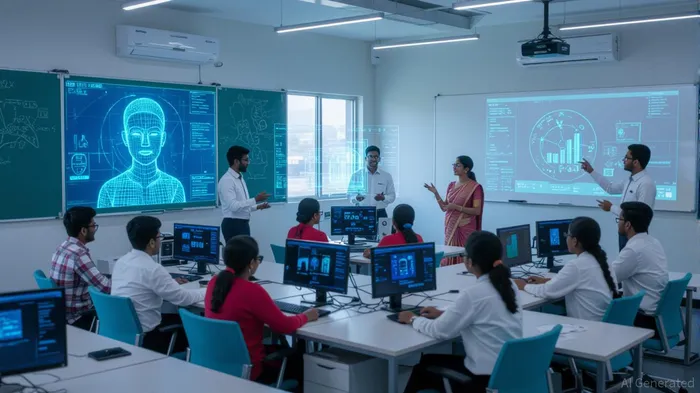 The economic impact of KITE's infrastructure projects is profound. By prioritizing Free and Open-Source Software (FOSS), Kerala has saved significant costs while fostering a culture of ethical tech adoption. This has not only enhanced pedagogical outcomes but also positioned the state as a national benchmark for responsible EdTech. Furthermore, KITE's Hi-Tech School and Lab projects, funded with over ₹785 crore, have upgraded 45,000 classrooms with laptops, projectors, and access to the SAMAGRA digital content portal, creating a robust foundation for tech-driven economic development.
Economic Development: From Education to Innovation Ecosystems
KITE's influence extends beyond classrooms. Kerala's startup ecosystem, bolstered by initiatives like the Kerala Startup Mission (KSUM), has grown at a 20% annual rate, supporting 3,500 ventures and generating $665 million in funding. The state's Vision 2031 aims to create 5 lakh IT jobs and capture 10% of India's IT market share, with KITE's AI and robotics training programs directly feeding into this ambition as outlined in official plans. By 2031, Kerala plans to expand its IT infrastructure to three crore square feet and attract ₹20,000 crore in investments, driven by projects like Infopark Phase 3 (AI City) and the K-Space Aerospace Cluster.
The KITE initiative also aligns with India's national infrastructure goals. Projects like the NICDC Industrial Corridors and PM Gati Shakti Master Plan are accelerating pan-India connectivity, while Kerala's KITE Fibre Optic Network and FOSS adoption in government services are reducing software expenditures and enhancing digital governance. These synergies underscore a strategic alignment between state-level innovation and national economic priorities, creating a multiplier effect for growth.
Investment Implications: A Model for Scalable Growth
For investors, the KITE model highlights the intersection of education, infrastructure, and technology as a high-impact sector. Kerala's IT workforce has already grown to 250,000 professionals, with 48.5% of the state's workforce employed in the services sector. The state's focus on AI, cybersecurity, and green computing-driven by missions like the Kerala Artificial Intelligence Mission (K-AIM)-positions it as a leader in emerging tech fields.
Moreover, KITE's emphasis on ethical AI and sustainable practices aligns with global ESG trends, making it an attractive proposition for impact-driven investors. The state's plan to train ten lakh youth in tech skills and its target of 250 AVGC companies by 2029 further diversify its economic potential.
Conclusion: A Catalyst for India's Tech Future
The KITE initiative in Kerala exemplifies how strategic infrastructure and education-driven innovation can unlock India's tech sector potential. By fostering a skilled workforce, promoting ethical tech adoption, and aligning with national infrastructure goals, KITE is not just transforming Kerala-it is setting a precedent for scalable, inclusive growth. As India's IT industry accelerates toward $350 billion in revenue, the KITE model offers a compelling case for investors seeking to capitalize on the next wave of India's digital revolution.

Blending traditional trading wisdom with cutting-edge cryptocurrency insights.
Latest Articles
Stay ahead of the market.
Get curated U.S. market news, insights and key dates delivered to your inbox.






Comments
No comments yet