
Kite (KITE) Post-Listing Price Prediction and Market Sentiment: Valuations, Institutional Interest, and Short-Term Volatility Risks


 Aime Summary
Valuations: Operational Momentum vs. Earnings Shortfalls
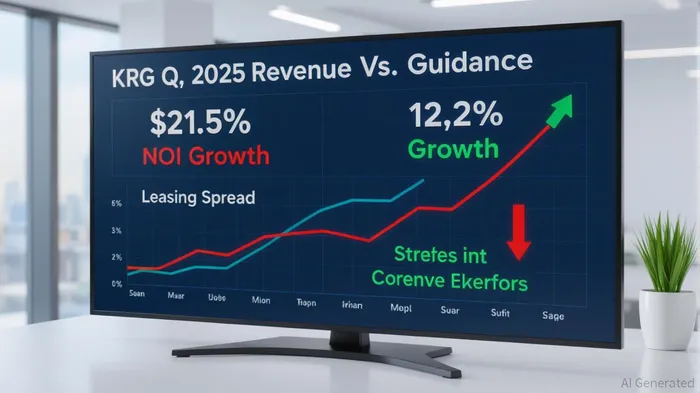
Kite's Q3 2025 results revealed a revenue shortfall of $4.82 million, with actual revenue at $205.05 million versus the forecasted $209.87 million, according to the Kite Realty Q3 2025 presentation. However, the company's operational performance-marked by a 2.1% year-over-year increase in same-property net operating income (NOI) and a 12.2% blended cash leasing spread-suggests underlying resilience, as reported in the Kite Realty Q3 2025 earnings call transcript. Despite these positives, KRG's earnings per share (EPS) for the quarter came in at -$0.07, resulting in a negative P/E ratio, as noted in the Kite Realty Q3 2025 presentation. This discrepancy highlights a critical valuation tension: while operational metrics signal strength, earnings volatility complicates fair value assessments.
The company's strategic focus on grocery-anchored centers, now accounting for 79% of its retail weighted average base rent (ABR), has driven robust leasing outcomes. Between 2022 and Q3 2025, KRGKRG-- achieved average new leasing spreads of 56% and gross returns on capital of 20% in this segment, as detailed in the Kite Realty Q3 2025 presentation. These figures underscore the potential for long-term value creation, even as near-term earnings pressure persists.
Institutional Interest: Strong Ownership and Strategic Confidence
Institutional ownership of KRG remains robust, with 90.81% of shares held by institutional investors, according to the Kite Realty Q3 2025 presentation. Major holders include Vanguard Group ($744.77M), State Street Corp ($285.70M), and JPMorgan Chase ($281.23M), as noted in the Anson Funds Management LP filing. Over the past 24 months, institutional investors have net purchased 30.37 million shares, reflecting confidence in KRG's strategic direction despite short-term earnings challenges, as reported in the Kite Realty Q3 2025 presentation.
This institutional backing is further reinforced by KRG's balance sheet strength. The company maintains a net debt-to-adjusted EBITDA ratio of 5.0x and $1.2 billion in available liquidity, as stated in the Kite Realty Q3 2025 presentation. These metrics position KRG to weather market fluctuations while executing its grocery-anchored strategy, which aligns with broader consumer trends favoring essential retail formats.
Short-Term Volatility Risks: Analyst Downgrades and Industry Headwinds
Despite operational strengths, KRG faces short-term volatility risks. Analysts have recently revised price targets downward, with Raymond James cutting its target from $28.00 to $26.00 and Wells Fargo reducing its target from $24.00 to $23.00, as reported in the Anson Funds Management LP filing. Wallstreetzen.com's downgrade of KRG to a "Sell" rating further amplifies near-term uncertainty, citing reliance on a one-off gain in the prior quarter rather than sustainable operational performance, as detailed in the Wallstreetzen.com report.
The broader retail REIT industry also weighs on sentiment, with an industry rating of "F" due to macroeconomic instability, as reported in the Wallstreetzen.com report. While KRG's full-year guidance raises NAREIT FFO and Core FFO expectations, these adjustments may not fully offset market skepticism. Additionally, the absence of explicit short interest data complicates assessments of bearish positioning, though the downgrade signals heightened caution.
Conclusion: A Tug-of-War Between Resilience and Uncertainty
Kite Realty Group Trust's post-listing trajectory reflects a classic tug-of-war between operational resilience and financial volatility. Strong leasing metrics and institutional confidence suggest a foundation for long-term value creation, particularly in its grocery-anchored strategy. However, near-term earnings shortfalls, analyst downgrades, and industry-wide headwinds pose risks to price stability. Investors must weigh these factors carefully, recognizing that KRG's valuation hinges on its ability to translate operational momentum into consistent earnings growth.

Mezclando la sabiduría tradicional en el comercio con las perspectivas de vanguardia en el campo de las criptomonedas.
Latest Articles
Stay ahead of the market.
Get curated U.S. market news, insights and key dates delivered to your inbox.
AInvest
PRO
AInvest
PRO



Comments
No comments yet