
KITE Binance Listing Surge and Crypto Market Implications


 Aime Summary
Short-Term Speculation: A Volatile Ride
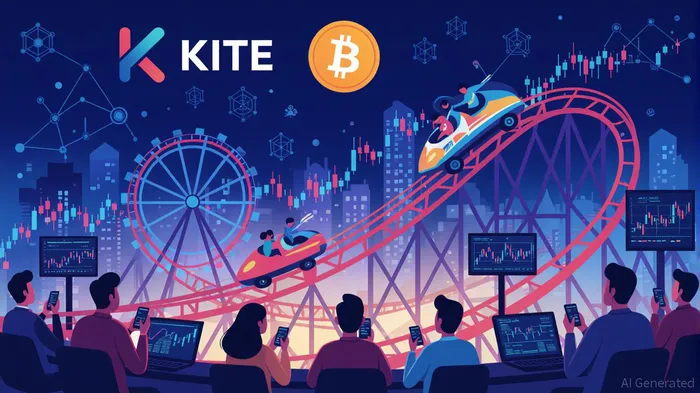
Here's the deal: KITE's Binance listing on November 3, 2025, was a textbook case of "buy the rumor, sell the news." The token opened at $0.11 but plummeted to $0.095 within hours, a 13.6% drop that left many scratching their heads. This immediate sell-off was followed by a 38.75% rebound, only to face a 19.83% pullback, exposing the fragility of retail-driven momentum. The volatility isn't just noise-it's a reflection of fragmented liquidity and the emotional pendulum swings typical of crypto's retail crowd.
Data from Bitget highlights the speculative gap: KITE's fully diluted valuation (FDV) of $929 million dwarfs its current market cap of $167 million, creating a stark disconnect between hype and fundamentals. This chasm is a red flag for investors. As one expert put it, "The key is to balance technical tools like stop-losses with psychological discipline-crypto's not for the faint of heart."
Long-Term Utility: Building the Agentic Economy
But let's not dismiss KITE just yet. The token's economic model is designed to fuel what's called the "agentic economy," where value is tied to the adoption of AI-powered services on its network. With a capped supply of 10 billion tokens, 48% allocated to community development and 20% to AI infrastructure, KITE's roadmap is ambitious. The remaining 40% is split between team incentives and investors, creating a structure that theoretically aligns stakeholders with long-term growth.
What's more, KITE is doubling down on AI. Its AI Agent Subnet and Data Subnet projects aim to decentralize AI commerce, enabling trustless transactions and programmable payments. Institutional partnerships, like the one with Pieverse and Coinbase's x402 standard integration, are critical milestones. These moves position KITE not just as a speculative asset but as a foundational layer for AI-based economies.
The Binance Effect: Liquidity, Exposure, and Risks
Binance's Seed Label program gave KITE a shot in the arm, listing it across multiple pairs (USDT, USDCUSDC--, BNBBNB--, TRY) and boosting liquidity. However, the listing also amplified retail FOMO, with $263 million in trading volume across platforms like Upbit and Bithumb within days. While this liquidity is a double-edged sword-fueling both growth and volatility-it underscores Binance's role as a catalyst for tokens with strong narratives but unproven use cases.
What's the Takeaway?
For the average investor, KITE is a high-stakes proposition. The short-term volatility offers opportunities for nimble traders, but the risks are palpable. On the flip side, the long-term vision-anchored in AI infrastructure and institutional partnerships-could justify patience for those willing to ride out the turbulence.
Bottom line: KITE's Binance listing is a microcosm of crypto's duality. It's a speculative frenzy masking a potentially transformative use case. But as always, the devil is in the execution. Investors should hedge their bets, use stop-losses, and keep a close eye on adoption metrics. In this market, hype is a headwind; fundamentals are the only tailwind that matters.

Blending traditional trading wisdom with cutting-edge cryptocurrency insights.
Latest Articles
Stay ahead of the market.
Get curated U.S. market news, insights and key dates delivered to your inbox.




Comments
No comments yet