
KITE's Binance Listing and Its Implications for Altcoin Momentum: Strategic Entry Points and Risk Management in Emerging Crypto Listings


 Aime Summary
The KITE Listing: A Catalyst for Altcoin Momentum
KITE's official listing on Binance was preceded by a high-profile Launchpool event, where users staked BNBBNB--, FDUSD, and USDCUSDC-- to farmFARM-- KITE tokens according to Binance's announcement. The token's pre-market price on platforms like Bybit and OKX ranged between $0.17 and $0.18 as reported by Coinspot, with analysts forecasting a post-listing price target of $0.25–$0.30 within 2–3 months per analysis. However, the reality was more turbulent: KITE opened at $0.11 but plummeted 14% to $0.095 within days according to market data, underscoring the inherent volatility of speculative crypto assets.
This volatility, while daunting, reflects broader trends in altcoin markets. 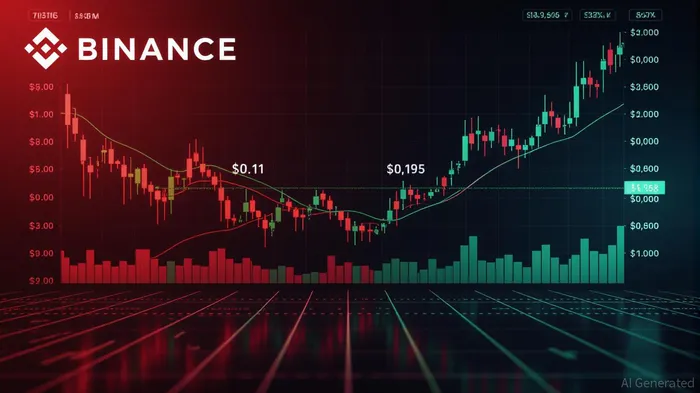 KITE's inclusion in a $8,000 trading competition by BiconomyBICO-- and its cross-chain partnerships-such as integration with Pieverse for multi-chain agent payments as detailed on CoinMarketCap-have bolstered its narrative as a foundational layer for AI-driven commerce. Yet, its market cap of $167 million and fully diluted valuation (FDV) of $929 million according to Superex highlight structural risks, particularly given that only 18% of its total supply is currently circulating per CoinMarketCap analysis.
Strategic Entry Points: Technical Indicators and Market Dynamics
For traders seeking to capitalize on KITE's potential, technical analysis offers critical insights. The Relative Strength Index (RSI) and Moving Average Convergence Divergence (MACD) are particularly useful in identifying overbought or oversold conditions according to ZeroDha. For instance, KITE's RSI of 67 suggests bullish momentum but nearing overbought territory per CoinMarketCap, while its MACD crossovers could signal trend reversals. Bollinger Bands, which track volatility through 20-day moving averages, also provide actionable signals: shorting opportunities when prices hit upper bands and long positions when they touch lower bands as explained on ZeroDha.
Intraday traders might also leverage the Central Pivot Range (CPR), a tool that derives key price levels from the previous day's high, low, and close as described on ZeroDha. For KITE, strategic entry points could include the $0.111 level, where stop-loss orders and leverage management become essential to mitigate risks per Binance's post.
Risk Management: Position Sizing and Leverage Discipline
Given KITE's volatility, disciplined risk management is paramount. Position sizing strategies such as the Fixed Percentage approach-allocating 1% of total capital per trade as recommended by Altrady-help preserve capital during drawdowns. For leveraged traders, volatility-based position sizing adjusts capital allocation dynamically, reducing exposure during high-volatility periods as detailed on Delta Exchange.
Advanced traders might also consider the Kelly Criterion, a mathematically driven method that optimizes position sizes based on win rates and average gains/losses as explained by Flipster. However, this strategy requires a robust trading history and is best suited for experienced participants. Automated tools and position size calculators as provided by Altrady can further aid in balancing risk and reward, particularly in fast-moving markets like KITE's.
Broader Implications for Altcoin Momentum
KITE's listing underscores a broader trend: the growing intersection of AI and blockchain. Its partnerships with Coinbase Ventures and the x402 protocol as reported on CoinMarketCap position it as a potential backbone for autonomous AI economies. Yet, the token's ability to sustain gains hinges on institutional adoption and the resolution of technical challenges. Listings on Coinbase, KuCoin, and AvalancheAVAX-- according to CoinMarketCap have improved liquidity, but stable price appreciation remains elusive.
Institutional interest, such as BingX's Xpool program as noted by Superex, could provide a more stable foundation for KITE's long-term value. However, retail-driven volatility-exacerbated by high leverage and speculative trading-remains a double-edged sword. As KITE's roadmap for 2026 includes subnet expansions and dApp ecosystem growth as detailed on CoinMarketCap, its success will depend on developer adoption and interoperability solutions.
Conclusion
KITE's Binance listing exemplifies the opportunities and risks inherent in emerging crypto assets. While its AI-driven narrative and strategic partnerships offer long-term potential, traders must remain vigilant about volatility and structural risks. By leveraging technical indicators like RSI and MACD, adopting disciplined position sizing strategies, and prioritizing risk management, investors can navigate KITE's post-listing turbulence more effectively. As the altcoin market evolves, projects like KITE will likely play a pivotal role in shaping the next phase of blockchain innovation-provided they can balance speculative fervor with sustainable growth.

Blending traditional trading wisdom with cutting-edge cryptocurrency insights.
Latest Articles
Stay ahead of the market.
Get curated U.S. market news, insights and key dates delivered to your inbox.


AInvest
PRO
AInvest
PRO



Comments
No comments yet