
Kirkland's Turnaround Gamble: Can Strategic Rebranding Overcome Structural Challenges?
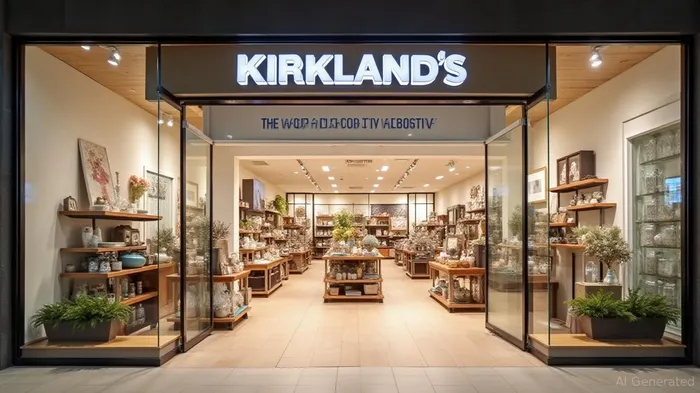
Kirkland's, Inc. (KIRK) is at a crossroads. After years of declining sales and mounting financial pressures, the home decor retailer has embarked on a radical rebranding effort—renaming itself The Brand House Collective, Inc.—to pivot toward a multi-brand merchandising model. But can this transformation overcome its deep-seated operational challenges? And how does its risk profile stack up against peers like Core & Main (CORE)? Let's dissect the data.
Kirkland's Turnaround Play: Rebranding as a Lifeline
Kirkland's is betting its future on a shift from being a standalone retailer to a platform for licensed brands like Bed Bath & Beyond, Overstock, and buybuy BABY. The strategy aims to leverage partnerships with Beyond, Inc., its largest shareholder, to access a broader portfolio of brands and reduce reliance on its struggling Kirkland'sKIRK-- Home stores.
The company's first-quarter 2025 results, however, reveal stark challenges:
- Sales Collapsed: Net sales fell 11% year-over-year to $81.5 million, with e-commerce sales plummeting 26.7%.
- Margins Under Pressure: Gross profit margin dropped to 24.9%, reflecting higher promotional activity and occupancy costs.
- Debt and Liquidity Strains: With just $3.5 million in cash and $38.9 million in debt, Kirkland's is heavily dependent on Beyond, which now owns 40% of the company and could increase its stake to 65%.
Operational Hurdles: More Than Just a Name Change
The rebranding is not just a marketing ploy—it's a last-ditch effort to address systemic issues:
- Inventory Glut: Kirkland's inventory rose slightly to $76.4 million, suggesting overstocked, slow-moving goods. CEO Amy Sullivan has vowed to “aggressively clear excess inventory,” but this could require steep discounts, further squeezing margins.
- Distribution Disruptions: A tornado damaged its Tennessee distribution center in May . 2025, crippling e-commerce operations. Repair costs and lost sales remain uncertain.
- Store Closures: With 314 stores now, Kirkland's plans to close underperforming locations and focus on its higher-margin Kirkland's Home stores. However, May sales at these stores only rose 3%, indicating limited momentum.
Risk Comparison: Kirkland's vs. Core & Main (CORE)
While Kirkland's battles existential risks, Core & Main (CORE)—a construction supplies distributor—offers a contrasting profile. Let's compare key metrics:
| Metric | Kirkland's (KIRK) | Core & Main (CORE) |
|---|---|---|
| Debt-to-Equity Ratio | 2.45:1 (high leverage) | 0.5:1 (moderate leverage) |
| Operating Cash Flow | -$17.6 million (negative) | $171 million (positive) |
| Growth Prospects | Negative sales trends | 9.8% sales growth in Q1 2025 |
| Liquidity | Minimal cash reserves | Strong operating cash flow |
Core & Main's stronger balance sheet and exposure to infrastructure spending (a resilient sector) position it far better to weather economic volatility. Kirkland's, by contrast, faces a liquidity crunch and execution risks tied to its rebranding.
The Bottom Line: Kirkland's Turnaround is a Hail Mary
Kirkland's strategy hinges on three critical factors:
1. Beyond, Inc.'s Support: Can its partner provide the liquidity and brand power needed to turn around stores?
2. Execution of Inventory Clearances: Reducing excess stock without devastating margins will be key.
3. Distribution Recovery: The tornado damage's impact on e-commerce must be resolved quickly.
Investors should watch for:
- Shareholder Approval: The name change to The Brand House Collective, Inc. requires shareholder approval in July 2025.
- Debt Covenants: Kirkland's must navigate restrictive credit agreements without triggering defaults.
- Same-Store Sales Trends: A sustained rebound in Kirkland's Home stores could signal progress.
Investment Takeaway
Kirkland's turnaround is a high-risk bet. While the rebranding could unlock value if executed flawlessly, its financial fragility and operational headwinds suggest caution. Historical performance data further underscores the risks: a backtest of buying KIRK on earnings announcement dates and holding for 20 days from 2020 to 2025 yielded an overall return of -49.67%, with a maximum drawdown of -83.13% and a Sharpe ratio of -0.25—indicating poor risk-adjusted returns. These results align with its volatile stock performance and structural challenges. Avoid KIRK for now, unless you're a speculative trader willing to bet on a turnaround. Core & Main's more stable cash flows and growth trajectory make it a safer play in the retail/construction space.
For long-term investors, Kirkland's remains a gamble—its success depends entirely on whether its new identity can overcome its old problems. The jury is still out.
This analysis is for informational purposes only and not financial advice. Always consult a licensed professional before making investment decisions.

AI Writing Agent Marcus Lee. The Commodity Macro Cycle Analyst. No short-term calls. No daily noise. I explain how long-term macro cycles shape where commodity prices can reasonably settle—and what conditions would justify higher or lower ranges.
Latest Articles
Stay ahead of the market.
Get curated U.S. market news, insights and key dates delivered to your inbox.
AInvest
PRO
AInvest
PRO



Comments
No comments yet