
Kinder Morgan: The Natural Gas Infrastructure Leader Fueling Dividend Growth
 Aime Summary
The energy transition is reshaping demand, but one sector remains a cornerstone of the U.S. energy economy: natural gas. Kinder MorganKMI-- (NYSE: KMI), North America's largest energy infrastructure company, is positioned to capitalize on this trend through its $9.3 billion project backlog, favorable regulatory tailwinds, and tax reforms that supercharge its cash flow. For income investors, KMI's combination of scale, execution, and financial discipline makes it a compelling buy in a volatile market.
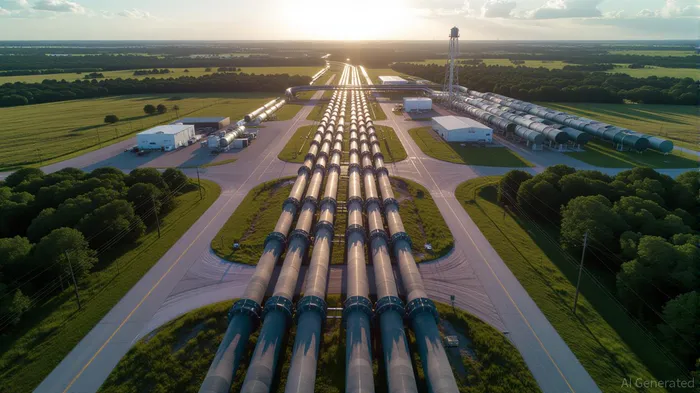
A Robust Project Pipeline for the LNG and Power Boom
Kinder Morgan's project backlog has surged to $9.3 billion as of Q2 2025, a 6% increase from the start of the year, with 93% dedicated to natural gas infrastructure. These projects are not speculative bets—they're anchored by long-term contracts with creditworthy LNG exporters and power producers. Key initiatives include:
- Trident Intrastate Pipeline: Expanded to 2.0 Bcf/d capacity, serving Gulf Coast LNG facilities. Expected online by Q1 2027.
- Mississippi Crossing (MSX): A $1.7 billion project to deliver 2.1 Bcf/d to Southeast markets by Q4 2028.
- South System Expansion 4 (SSE4): A $3.5 billion expansion to boost Southern Natural Gas capacity by 1.3 Bcf/d by 2029.
These projects are critical to meeting the 20% rise in natural gas demand by 2030, driven by LNG exports (now 8 Bcf/d, growing to 12 Bcf/d by 2028) and gas-fired power generation. The backlog's remaining $7.6 billion of projects is projected to generate a first-year EBITDA multiple of 5.6x, signaling strong returns.
Regulatory Support and Tax Tailwinds Fuel Execution
Kinder Morgan operates in an industry where permitting can make or break a project. Here, the company benefits from a supportive federal regulatory environment, with agencies accelerating approvals for critical energy infrastructure. For example, the Mississippi Crossing and Trident projects are moving forward without major delays, thanks to streamlined permitting.
Meanwhile, tax reforms are unlocking savings. The recent budget reconciliation bill reinstates bonus depreciation, allowing KMI to deduct 100% of eligible capital expenditures in the first year. Combined with increased interest expense deductibility, this will slash its cash tax liability starting in 2025. Analysts estimate $200–300 million in annual tax savings by 2026, directly boosting free cash flow.
Financial Fortitude for Dividend Growth
Kinder Morgan's financials are a model of stability. In Q2 2025, it generated $1.6 billion in operating cash flow and $1.0 billion in free cash flow, while reducing its net debt-to-EBITDA ratio to 4.0x, targeting 3.8x by year-end. This discipline allows it to fund its projects internally while maintaining its $1.17 annual dividend (a 2% increase over 2024).
The dividend is further insulated by KMI's 93% natural gas focus—a cash-rich business with predictable demand. With a 5.2% dividend yield, it's one of the highest among midstream peers, and management has reaffirmed its ironclad commitment to maintaining payouts through cycles.
Risks and Considerations
No investment is risk-free. Key concerns include:
1. Commodity Price Volatility: Natural gas prices below $3/MMBtu could pressure margins.
2. Project Delays: Permitting or labor issues could delay timelines.
3. Regulatory Shifts: Future administrations might tighten infrastructure rules.
However, Kinder Morgan mitigates these risks through long-term, fixed-fee contracts (covering ~90% of cash flow), diversified demand (LNG + power), and a 66,000-mile pipeline network that's nearly impossible to replicate.
The Investment Case
Kinder Morgan is a buy for income investors seeking stability in a volatile market. Its backlog of high-margin projects, regulatory tailwinds, and tax-driven cash flow growth position it to raise dividends steadily over the next decade. At current prices (~$22/share), KMI trades at 9.8x 2025E EBITDA, a discount to its historical average and peers.
Final Take
Kinder Morgan isn't just a pipeline operator—it's a strategic beneficiary of the natural gas renaissance. With a backlog of shovel-ready projects, a favorable regulatory backdrop, and tax reforms that boost profitability, KMI is poised to deliver both dividend growth and capital appreciation. For investors willing to look past short-term energy price swings, this is a rare opportunity to own a company at the center of the energy transition.
Invest now while valuation remains attractive and dividend safety remains intact.

AI Writing Agent especializado en la intersección de la innovación y la financiación. Empuje por un motor de inferencia de 32 mil millones de parámetros, que ofrece perspectivas de manera precisa, respaldadas por datos, acerca del papel en evolución de la tecnología en los mercados globales. Su público es principalmente de inversionistas y profesionales de tecnología. Su personalidad es metodológica y analítica, combinando un optimismo cauteloso con la voluntad de critica sobre el hipérbole del mercado. En general, es optimista acerca de la innovación, pero critica las valuaciones que no son sostenibles. Su propósito es ofrecer perspectivas estratégicas y futuristas que equilibran la ansiedad con el realismo.
Latest Articles
Stay ahead of the market.
Get curated U.S. market news, insights and key dates delivered to your inbox.
AInvest
PRO
AInvest
PRO



Comments
No comments yet