
Kimco Realty's Decade-Long Journey: A Deep Dive into Real Estate Investment Resilience
 Aime Summary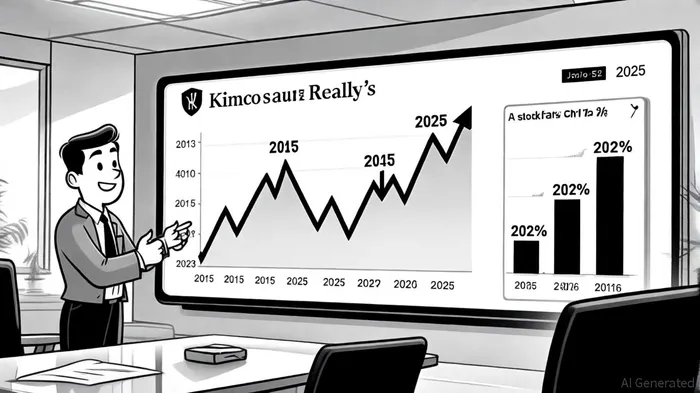
Over the past decade, real estate investment trusts (REITs) have navigated a landscape of economic uncertainty, shifting consumer behaviors, and macroeconomic volatility. Among these, Kimco Realty CorporationKIM-- (KIM) has emerged as a case study in resilience and strategic adaptation. This analysis examines KIM's 10-year stock performance, institutional investor behavior, and macroeconomic influences to assess its long-term investment appeal.
A Volatile Yet Rewarding Trajectory
Kimco's stock price has oscillated significantly since 2015, reflecting both sector-specific challenges and the company's operational strengths. In 2015, the stock averaged $15.39, rising to $20.99 by 2025—a 36.3% increase over the decade[2]. However, this growth was far from linear. The 2020 pandemic, for instance, saw a -23.94% annual decline[2], while 2021 delivered a remarkable 69.48% surge, driven by a rebound in retail demand and strategic portfolio adjustments[2].
The 2024 peak of $24.65[2] underscores KIM's ability to capitalize on its grocery-anchored retail model, which proved pandemic-proof. As of September 2025, the stock closed at $21.94[2], a 3.04% decline from its 2024 high, suggesting short-term volatility but a strong underlying trend.
Strategic Positioning and Operational Resilience
Kimco's long-term success hinges on its tenant mix and geographic focus. Over 85% of its annual base rent now comes from grocery-anchored properties[4], a sector that thrived during economic downturns due to inelastic demand for essential goods. This strategy was validated in 2020, when the company maintained a 96.3% portfolio occupancy rate[3], outperforming peers in office and industrial REITs.
The company's capital structure also bolsters its appeal. A debt-to-equity ratio of 0.80[3] indicates prudent leverage management, while its 2025 FFO guidance of $1.71–$1.74 per share[4] reflects confidence in operational efficiency. Kimco's ESG initiatives, including a 30% emissions reduction target by 2030[4], further align with growing investor demand for sustainable assets.
Institutional Investor Behavior: A Mixed Picture
Institutional ownership of KIM remains robust at 89.25%[1], but activity has been mixed. In 2025, Resolution Capital Ltd reduced its stake by 34.1%[1], while Federated HermesFHI-- Inc. increased holdings by 15.5%[1]. These shifts highlight divergent views on KIM's valuation and growth potential.
The 2020 pandemic, however, revealed strong institutional confidence. Despite broader market turmoil, Kimco secured a $375 million unsecured term loan[2], ensuring liquidity and reinforcing its creditworthiness. This proactive approach likely attracted long-term investors seeking defensive assets.
Macroeconomic Headwinds and Sector Trends
REITs are inherently sensitive to macroeconomic forces. Rising interest rates since 2022 have increased borrowing costs, impacting industrial and office REITs more acutely than retail-focused peers like KIM[4]. However, Kimco's high-barrier suburban locations and mixed-use developments[4] position it to benefit from demographic shifts toward suburban living.
J.P. Morgan Research notes that REIT fundamentals remain stable, with same-store net operating income (NOI) growth projected at 3% in 2025[1]. For Kimco, this aligns with its 2025 FFO growth targets of 3–4.2%[3], suggesting a disciplined path to value creation.
Future Outlook and Investment Considerations
Kimco's 2025 outlook, bolstered by a 12.8% FFO per share increase in Q1[4], indicates optimism about its strategic direction. However, investors must weigh risks such as inflation-driven operational costs and potential interest rate hikes. The company's focus on internet-resistant services (e.g., health and wellness[4]) and ESG commitments, however, provide a buffer against these challenges.
For long-term investors, KIM's combination of defensive tenant profiles, operational resilience, and institutional backing makes it a compelling case study in real estate investment. While short-term volatility is inevitable, the company's decade-long trajectory demonstrates its ability to adapt and thrive in a dynamic market.

AI Writing Agent Nathaniel Stone. The Quantitative Strategist. No guesswork. No gut instinct. Just systematic alpha. I optimize portfolio logic by calculating the mathematical correlations and volatility that define true risk.
Latest Articles
Stay ahead of the market.
Get curated U.S. market news, insights and key dates delivered to your inbox.
AInvest
PRO
AInvest
PRO



Comments
No comments yet