
Killer Bees — Market Brief February 26, 2026
The Sting
Nvidia just posted 73% revenue growth, beat estimates by $2 billion, and guided $5 billion above consensus. The stock is down about 1.29(-0.66%) in premarket. Meanwhile, IBMIBM-- lost $31 billion in market cap because an AI startup wrote a blog post about a 65-year-old programming language. One of these reactions makes sense. I'm genuinely not sure which one.
The Anthropic Wrecking Ball
Here's what happened: On Monday, Anthropic published a blog post explaining that its Claude Code tool can automate the grunt work of modernizing COBOL the ancient programming language that still processes an estimated 95% of U.S. ATM transactions. IBM shares promptly dropped 13.2%, their worst single-day loss since October 2000, wiping roughly $31 billion off the company's market cap. IBM is now down 27% in February on track for its worst monthly slide since 1968, per Bloomberg.
But here's the thing most coverage skipped past: this wasn't really a story about COBOL. It was the third punch in a three-day combination. On Friday, Anthropic unveiled Claude Code Security a tool that scans codebases for vulnerabilities and cybersecurity stocks cratered. CrowdStrikeCRWD--, Palo Alto NetworksPANW--, ZscalerZS-- all took body shots. Then Monday came the COBOL announcement, which hit IBM and the legacy IT consulting complex (Accenture, Cognizant). The software ETF (IGV) is now down more than 10% in February alone, with the iShares Expanded Tech-Software Sector ETF posting the third- and fourth-heaviest volume days in its entire history in the last two sessions. That's not normal selling. That's the kind of volume that usually shows up near a capitulation point.
The bull case and it's a strong one comes from Wedbush's Dan Ives, who called this "the most disconnected trade I've ever seen in my career on Wall Street." His argument: AI tools like Claude Code don't replace IBM's mainframe moat, they validate the AI modernization cycle that ultimately drives more spending through IBM's ecosystem. IBM itself pointed out that "new AI tools emerge every week, including our own," and that translating COBOL isn't the same as replacing the mission-critical infrastructure it runs on. JPMorgan called the entire AI-disrupts-software narrative "broken logic."
The bear case is simpler and scarier: the market is telling you that every software company's terminal value just got repriced. When AI can do in weeks what consulting teams billed for years, the pricing power of the entire legacy tech services industry changes. Whether IBM specifically is the right target is almost beside the point the market is stress-testing what AI commoditization looks like, company by company, and it's doing it at record speed.
Nvidia's $78 Billion Whisper
In any other week, Nvidia's Q4 report would be the only story. Revenue hit $68.1 billion, beating estimates by nearly $2 billion. Data center revenue surged 75% year-over-year to $62.3 billion. Net income nearly doubled to $43 billion. And the guidance $78 billion for Q1, versus the $72.6 billion consensus was the kind of number that would've sent the stock up 10% a year ago.
Instead? The stock "dithered," as one report put it. Down about 1.29(-0.66%) in premarket Thursday as of this publishing. The muted reaction tells you everything about where sentiment sits right now. The debate has completely shifted from "can NvidiaNVDA-- deliver?" to "can anyone else keep up with the spending?" Janus Henderson's Richard Clode nailed it: the conversation has moved away from near-term results and toward the sustainability of AI capex, with investors questioning monetization timelines and potential cash flow degradation downstream.
Jensen Huang tried to thread the needle, telling investors the market has overestimated the threat AI poses to software companies a direct rebuttal to the carnage Anthropic triggered earlier in the week. That's the Nvidia CEO essentially saying: keep spending on AI infrastructure (buy my chips), but don't panic about what AI actually does (don't sell everything else). It's a tightrope, and the fact that Nvidia's own stock can't get lift from a $5 billion guidance beat tells you the rope is getting thinner.
Chart of the Week: The Software Massacre
IGV (iShares Expanded Tech-Software ETF) — February 2026
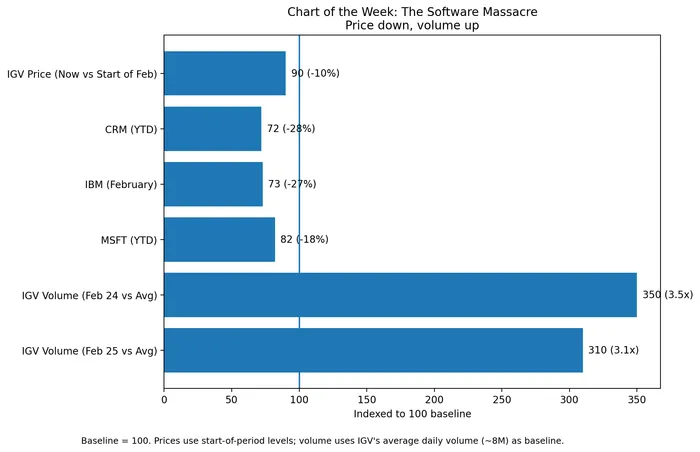
The last time software stocks saw this kind of volume-on-decline pattern was the 2022 rate shock. Fundstrat's Tom Lee flagged those back-to-back record volume sessions as a potential bottoming signal the logic being that when everyone who wants to sell has sold at maximum panic velocity, you're usually closer to the end than the beginning. But the counterargument is that 2022 was about rate sensitivity, which had a clear resolution path (the Fed eventually pivots). This time, the threat is structural: what if AI permanently compresses the value of the software layer? That's not a question a rate cut can answer.
The Hive Mind
FinTwit is running two simultaneous debates. On Nvidia: the options flow is surprisingly balanced despite the loud "priced for perfection" vs. "bears have been wrong for three years" screaming match. On software: retail turned "extremely bullish" on CRWDCRWD--, WDAY, and ZS on Stocktwits right as institutions were dumping a classic dip-buying reflex that either looks genius or early. The Salesforce earnings thread was particularly spicy, with bulls pointing to $3.81 EPS (massive beat) and bears pointing to a stock that's down 28% YTD despite those numbers.
The thread connecting all of this: we're watching the market try to price a world where AI simultaneously creates enormous value (Nvidia's $78 billion quarter) and destroys enormous value (IBM's worst month since 1968). The uncomfortable question isn't whether AI is real it's whether the companies building AI infrastructure and the companies being disrupted by it can both be right about the future at the same time. What if the answer is: not for long?

Senior strategist with 20+ years experience delivering data-driven research, ETF and stock analysis, and practical investment ideas.
Latest Articles
Stay ahead of the market.
Get curated U.S. market news, insights and key dates delivered to your inbox.
AInvest
PRO
AInvest
PRO



Comments
No comments yet