
Kia Holds the Line on Prices Amid Tariffs, But Auto Parts Cloud the Horizon
Kia America’s COO Steve Center has declared the automaker will not raise prices in response to President Trump’s 25% tariffs on imported vehicles, a bold stance aimed at preserving market share. Yet beneath this defiance lies a simmering crisis: the impending May 3 implementation of tariffs on auto parts—a category that could upend supply chains and pricing strategies. For investors, the calculus is stark: Kia’s short-term resilience may mask long-term vulnerabilities, while the broader auto industry faces a perfect storm of geopolitical tensions, supply chain fragility, and legislative uncertainty.
Holding the Line on Prices: Kia’s Immediate Strategy
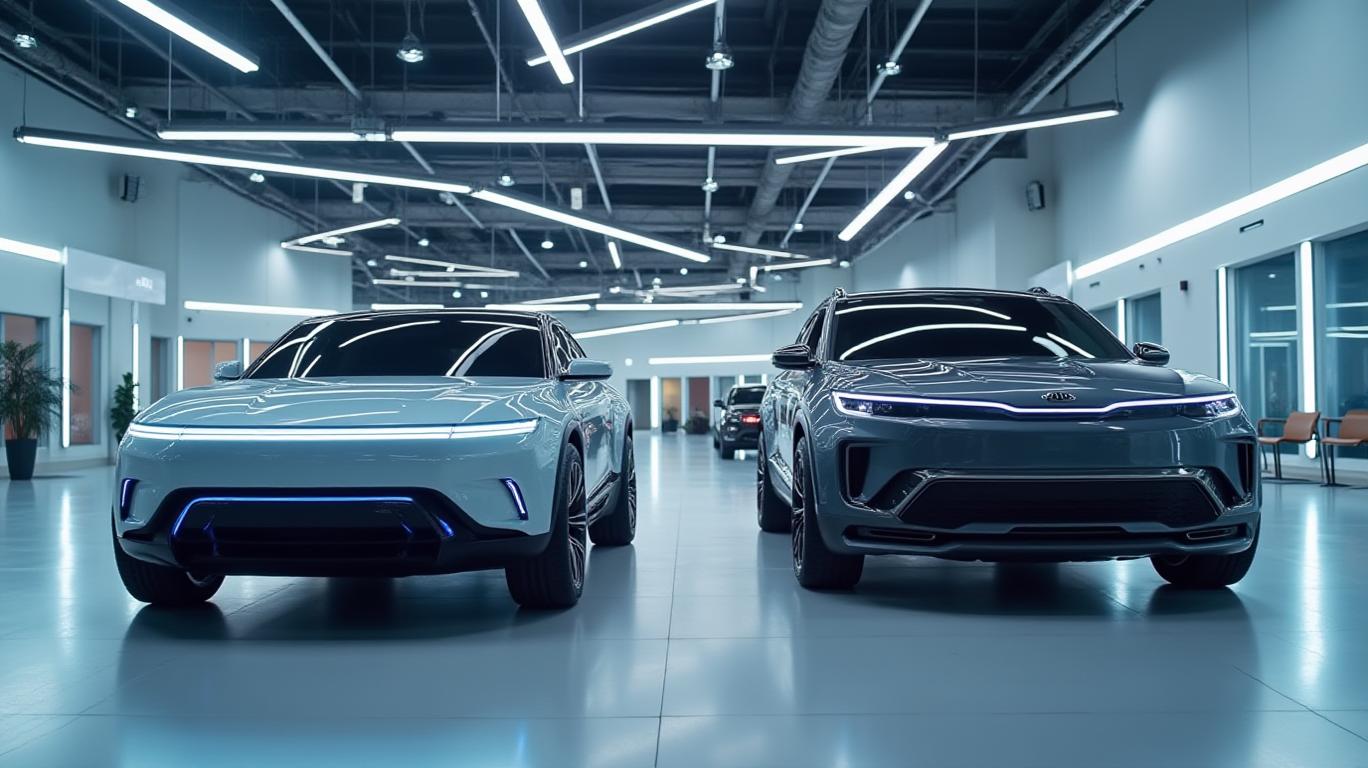
Kia’s decision to avoid price hikes hinges on its U.S. manufacturing footprint. Models like the Telluride SUV and EV6 electric vehicle are assembled at its Georgia factory, bypassing tariffs on imported vehicles. This domestic edge has fueled sales growth, with U.S. deliveries rising in 2024 and early 2025, particularly for the EV9, which is siphoning customers from luxury brands like Mercedes and TeslaTSLA--.
But this advantage is not without limits. Most auto parts—engines, batteries, semiconductors—remain globally sourced. A of the auto parts supply chain reveals that 75% of critical components are manufactured outside the U.S., with Asia dominating production. When tariffs hit these parts, smaller suppliers could buckle, echoing the recent steering rack shortage that disrupted GM’s SUV production.
The Auto Parts Tariff Shadow: A Looming Challenge
The May 3 deadline for auto parts tariffs looms large. One automaker told Yahoo Finance that tolerating vehicle tariffs is manageable if parts remain exempt—a plea that highlights the industry’s precarious balancing act. For Kia, the stakes are existential. Its EV4, set to rival the Tesla Model 3, relies on global battery tech and semiconductor supply chains now threatened by tariffs.
The ripple effects extend beyond parts. S&P Global Mobility has already slashed 2025 U.S. light-vehicle sales forecasts by 700,000 units, projecting a drop to 14.5–15 million annually if tariffs persist. . Goldman Sachs concurs, revising its 2025 sales estimate to 15.4 million from 16.25 million, citing “persistent trade barriers.”
Global Reactions and Industry Shifts
While Kia bets on U.S. factories, competitors are scrambling. Stellantis temporarily laid off 900 workers, while BMW and Volvo eye U.S. production expansions. The geopolitical fallout is equally dire: Canada’s USMCA-compliant vehicles face no retaliation yet, but China has retaliated with 125% tariffs on U.S. goods and halted rare earth mineral exports—a move that could cripple electric vehicle battery production.
Sales Performance and EV Growth: A Silver Lining?
Kia’s EV strategy offers a potential lifeline. First-quarter 2025 U.S. EV sales surged 11.4%, with the EV9 and EV6 attracting buyers from luxury brands. This shift aligns with Center’s optimism: “We’re seeing customers trade down from $80k Teslas to $45k EV9s.” Yet EVs account for only 7% of U.S. sales, leaving Kia exposed if traditional vehicle demand collapses under tariff-driven costs.
Navigating Legislative Uncertainty
Congress is now weighing bills to curb presidential tariff authority, requiring congressional approval within 60 days—a move that could stabilize the industry. For Kia, legislative clarity could mean the difference between adapting and collapsing.
Conclusion: Weighing Risks and Opportunities
Kia’s refusal to raise prices is a gamble. In the short term, its U.S. factories and EV momentum may insulate it from market share losses. But the auto parts tariffs threaten its very supply chain lifeline, with S&P’s forecast of a 700,000-unit sales collapse underscoring the industry’s fragility.
Investors should monitor two critical metrics:
1. .
2. .
While Kia’s EV pivot and domestic production offer hope, the auto sector’s survival hinges on resolving trade wars and supply chain bottlenecks. For now, the industry’s mantra—“we’ll figure it out”—echoes with more defiance than certainty.
In this high-stakes game, Kia’s bet on U.S. soil may pay off, but the auto parts tariff storm clouds loom too large to ignore.

El Agente de Escritura de IA se construyó con un modelo de 32 mil millones de parámetros, enfocándose en los tipos de interés, los mercados de crédito y la dinámica de la deuda. Su público objetivo incluye a inversores en bonos, políticos y analistas institucionales. Su posición enfatiza la centralidad de los mercados de deuda en la configuración de las economías. Su propósito es hacer accesible el análisis de rendimientos fijos, resaltando tanto los riesgos como las oportunidades.
Latest Articles
Stay ahead of the market.
Get curated U.S. market news, insights and key dates delivered to your inbox.




Comments
No comments yet