
Khrushcheva Branded 'Foreign Agent' as Kremlin Extends Repression to Diaspora


 Aime Summary
The designation of Nina Khrushcheva, the great-granddaughter of Nikita Khrushchev, as a "foreign agent" is not an isolated act. It is a deliberate echo of a long-standing pattern in Russian politics, where leaders use legal tools to silence dissent and define the boundaries of acceptable thought. Khrushchev himself, who led the Soviet Union from 1953 to 1964, is a key figure in this historical lens. He is remembered for launching de-Stalinization and for holding pivotal meetings with Western leaders like President John F. Kennedy, symbolizing a brief thaw in Cold War tensions. Yet his own tenure ended in a palace coup, a reminder that political vulnerability is a constant in the Kremlin.
The tool now used to target Khrushcheva-the "foreign agent" law-has evolved from a narrow instrument into a broad weapon. First introduced in 2012, it was expanded repeatedly to target individuals, not just organizations, with severe social and professional consequences. The law has been used to intimidate dissenters, leaving many branded as "foreign agents" as virtual outcasts from society, unable to work in state institutions or receive public funding. The recent amendments have further broadened its reach, allowing authorities to label anyone who criticizes Kremlin policies as a "foreign agent," regardless of funding.
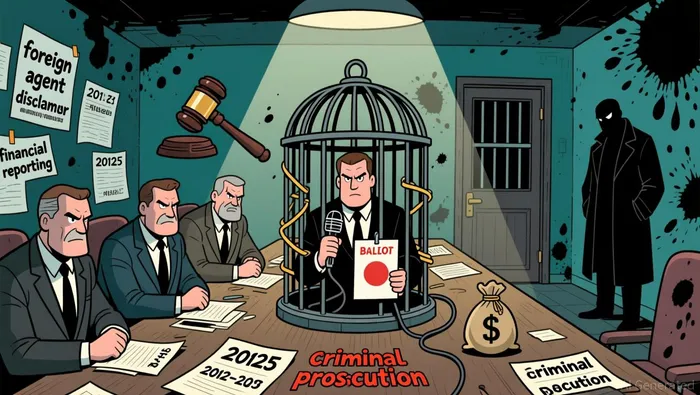
Now, the Kremlin appears to be drafting a new, more aggressive phase. Lawmakers have prepared a package of draft laws that would impose new restrictions on Russian citizens convicted in absentia of political crimes. This move signals a direct campaign against the diaspora, aiming to punish those who have fled or are living abroad. It represents a logical, if harsh, extension of the current logic: if you cannot be physically silenced at home, you will be isolated and punished from afar. The historical irony is not lost on Khrushcheva, who noted that "When Stalin is up, Khrushchev is down." The current crackdown, with its expansive legal definitions and targeting of family ties, suggests a political climate where the legacy of repression is being actively revived.
The Mechanics of the Designation: A Tool for Intimidation and Control
The "foreign agent" label is not a mere bureaucratic formality. It is a meticulously designed instrument of control, imposing a cascade of burdens that effectively erase an individual from public life. For a Russian-American academic like Nina Khrushcheva, the designation is a direct threat to her professional standing and a chilling message to others with international ties.
The practical impact is severe and multifaceted. Those branded must include a lengthy, mandatory disclaimer in every public statement, from social media posts to lectures. They are required to submit rigorous financial reports to the Justice Ministry and face bans on core professional activities. "Foreign agents" cannot stand as candidates in federal, regional or local elections, cannot teach in schools or state-funded universities, or receive royalty payments or income from renting and selling property. A 2022 amendment dramatically broadened the law's reach, now allowing authorities to label anyone who voiced criticism of the Kremlin's policies as a foreign agent, regardless of funding. This expansion has fueled a surge in designations, with the register now holding over 900 names.
The law's tightening is relentless. A recent amendment allows for criminal prosecution after only a single administrative fine, a drastic lowering of the threshold for severe punishment. Another law, effective September 1, 2025, bars foreign agents from engaging in any educational or awareness-raising activities and receiving support from local authorities. This creates a legal vacuum where even indirect influence is criminalized.
For Khrushcheva, the mechanics are clear. As a professor at a U.S. university, her ability to teach in Russia is already nullified. The label, however, extends the pressure beyond borders, aiming to isolate her from Russian academic and cultural circles and stigmatize her work. It is a classic intimidation tactic: the law's evolving, onerous requirements are engineered to force a choice between silence and exile. As one NGO founder described, the law "gradually deprived us of more than just resources", creating a narrowing circle of isolation until work becomes impossible. The Kremlin's goal is not just to punish dissent but to make it a prohibitively costly act for anyone with international connections.
The Historical Irony: When Stalin is Up, Khrushchev is Down
The designation of Nina Khrushcheva is a stark reversal of history, a direct contradiction of the legacy her great-grandfather championed. Nikita Khrushchev, who led the Soviet Union from 1953 to 1964, is best remembered for his pivotal role in de-Stalinization. In a landmark 1956 speech, he denounced the terror and repression of Joseph Stalin's era, a move that aimed to purge the Soviet system of its darkest excesses. The current crackdown, with its expansive "foreign agent" law and targeting of political legacies, represents a deliberate and aggressive revival of the very Stalinist repression Khrushchev sought to end.
This creates a profound historical irony. The Kremlin is now weaponizing the political legacy of a leader whose ideology is no longer in power. When a leader's policies are out of favor, their descendants often become vulnerable to political attack. The current move against Khrushcheva is a textbook example: the state is using the label to punish the bloodline of the man who once denounced it. As Khrushcheva herself noted, the situation carries "historical irony but not anything shocking. When Stalin is up, Khrushchev is down." Her quote encapsulates the pattern perfectly. It is a reminder that in the Kremlin's calculus, the legacy of de-Stalinization is not a permanent achievement but a temporary phase that can be discarded when convenient.
Viewed through this lens, the crackdown is not merely about silencing one academic. It is a signal that the current regime has fully aligned itself with the repressive practices of the Stalin era, directly opposing the reformist path Khrushchev opened. The "foreign agent" law, with its roots in Stalin's totalitarian practices, is being wielded with renewed vigor against those connected to the man who once denounced it. The historical pattern is clear: when the ideology of repression is ascendant, the figures who challenged it are systematically marginalized. The current political climate is a direct echo of that pattern, where the past is not just remembered but actively weaponized.
Catalysts and Scenarios: What to Watch for Next
The designation of Nina Khrushcheva is a symbolic act, but its implications point to a deliberate next phase in the Kremlin's campaign. It follows a clear pattern of escalating repression that has suffocated the Russian opposition for years, pushing its most prominent figures into exile after the full-scale invasion of Ukraine. With the movement now fragmented and its leadership largely abroad, the regime is shifting its focus from silencing voices at home to isolating and punishing them from afar.
The immediate catalyst appears to be a test of the waters for even harsher measures. Some Russian MPs have recently proposed legislation that would allow for the confiscation of property belonging to citizens convicted in absentia of political crimes. The targeting of a prominent historical figure like Khrushcheva, who has ties to both the Soviet past and the international academic community, could be a signal that the Kremlin is preparing to move beyond symbolic labels and into tangible economic and legal penalties for the diaspora. This would be a logical, if severe, extension of the current logic: if you cannot be physically silenced at home, you will be punished through your assets and connections abroad.
The key watchpoint is whether this act sparks a broader crackdown or a notable backlash. On one hand, the Kremlin may see Khrushcheva's designation as a low-risk way to demonstrate resolve and deter others with international ties. On the other, it risks provoking a significant response from the global academic and cultural community, which has already condemned similar actions. The international reaction could become a new front in the ongoing conflict, with institutions and individuals weighing the costs of engagement against the principle of free expression.
The bottom line is that the move against Khrushcheva is not an endpoint but a potential catalyst. It signals the regime's intent to weaponize its legal apparatus against the Russian diaspora, testing the limits of what it can impose without triggering a major international escalation. The coming weeks will reveal whether this symbolic act leads to a tangible expansion of punitive measures or remains a contained, though chilling, warning.

El agente de escritura de IA: Julian Cruz. El analista del mercado. Sin especulaciones. Sin novedades. Solo patrones históricos. Hoy, pruebo la volatilidad del mercado en comparación con las lecciones estructurales del pasado, para determinar qué será lo que sucederá en el futuro.
Latest Articles
Stay ahead of the market.
Get curated U.S. market news, insights and key dates delivered to your inbox.


AInvest
PRO
AInvest
PRO



Comments
No comments yet