
KHC's Jan 8 Outperformance: A Tactical Play on CEO Transition or a Sign of Structural Decay?
 Aime Summary
The specific catalyst for the stock's recent action is the appointment of a new CEO. On Tuesday, Kraft HeinzKHC-- announced that Steve Cahillane would take the helm. Cahillane is a known dealmaker, having led Kellogg's successful corporate breakup about two years ago. His hire signals the company is preparing for major asset sales as it pushes ahead with its own split.
This leadership change is happening at a critical juncture. Kraft Heinz is in the midst of separating its more than 200 brands into two independent public companies, a process expected to close in the second half of 2026. The split is a direct response to a decade of stagnation, with the company's shares down 19% this year while the broader market has risen.
The immediate market reaction to this news, however, was a tactical underperformance. In the latest trading session, the stock closed at $23.77, marking a -2.54% move from the previous day. That decline was less than the S&P 500's daily gain of 0.64%. This outperformance relative to the market is a key signal. It suggests investors are viewing the CEO change not as a fundamental fix, but as a necessary step in a painful restructuring. The stock's move reflects the split's inherent uncertainty, not confidence in a new leader to solve deep-seated problems.
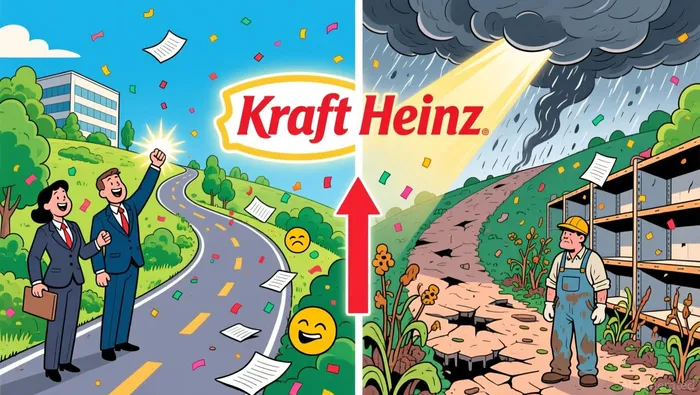
The bottom line is that the CEO transition is a catalyst for the event, but it does not resolve the fundamental issues driving the split. Cahillane's dealmaker background is a tactical fit for the breakup, but the stock's price action shows the market is focused on the execution risk and the underlying challenges of legacy brands and shopper backlash. This is a setup for volatility, not a clear directional signal.
The Mechanics: A Discount Valuation with High Execution Risk
The financial setup here is a classic event-driven tension: a deeply discounted valuation paired with immense execution risk. On paper, the stock looks cheap. Kraft Heinz trades at a forward P/E of 9.73, less than half of PepsiCo's 17.67. This discount is the market's verdict on a decade of stagnation and a failed merger. The split is meant to unlock value by simplifying the structure, but the discount also reflects profound skepticism about the company's ability to sell its assets for a premium.
That skepticism is focused on the grocery unit, which houses legacy brands like Oscar Mayer and Maxwell House. Analysts are deeply cautious about finding buyers for these businesses. As one former executive noted, the company failed to sell Oscar Mayer last year and also attempted to sell the Maxwell House coffee brand. The grocery division is expected to have lower margins and face tougher shopper backlash due to high prices, making it a harder sell.
The bottom line is that the split's success hinges on Cahillane's dealmaking prowess. His track record at Kellogg is the reason he was hired. Yet even his success there involved a complex breakup where a major buyer (Mars) paid a 33% premium for the snacks division. The question for traders is whether a similar premium can be found for Kraft Heinz's assets, especially the underperforming grocery side. Warren Buffett's blunt assessment underscores the challenge: he told CNBC that the 2015 merger "did not turn out to be a brilliant idea" and that splitting the company "will not fix its problems."
For event-driven traders, this creates a high-risk, high-reward setup. The deep valuation offers a margin of safety if the split proceeds smoothly. But the path is fraught. If Cahillane cannot secure favorable deals for the grocery brands, the promised capital raise to fund the separation could fall short. The stock's recent outperformance against the market suggests investors are already pricing in this execution risk, viewing the CEO change as a necessary step rather than a solution. The tactical play now is to watch for concrete progress on asset sales, not just announcements.
Catalysts and Watchpoints for Traders
For traders, the Jan 8 outperformance is a tactical signal that must be validated by concrete progress. The stock's relative strength against the market suggests the CEO change is being seen as a necessary step, not a fix. The sustainability of this move hinges on three near-term watchpoints.
First, and most critical, is the announcement of specific brand sales. The split's funding depends on Cahillane's ability to secure deals. The condiments business, including Heinz ketchup, is seen as the higher-margin, more attractive asset. The market will be watching for any indication of a buyer emerging for this unit. The grocery division, housing legacy brands like Oscar Mayer and Maxwell House, faces tougher challenges. Analysts are skeptical about finding buyers for these businesses, and the company failed to sell Oscar Mayer last year. Any progress on divesting these assets will be a key positive catalyst. Conversely, a lack of concrete offers will reinforce the execution risk already priced into the stock.
Second, traders must monitor any shift in the company's capital allocation strategy post-split. The announced plan is to create two focused companies, with Global Taste Elevation Co. leading in sauces and spreads, and North American Grocery Co. handling staples. The promised improvements in focus are untested. The watchpoint is whether management can demonstrate a clear, capital-efficient plan for each new entity. This includes how they intend to reinvest the proceeds from asset sales and manage the capital structures of the two independent companies. Any hint of a return to the old pattern of underinvestment would be a major red flag.
The key risk that cannot be ignored is that the split distracts from the urgent need for brand revitalization. Kraft Heinz's flagship brands are already vulnerable, with newer rivals and private labels chipping away at market share. The company's own disclosure noted that years of turmoil have left its brands vulnerable. If management's focus remains on the complex separation process, it could allow further share loss to accelerate in core categories like mac and cheese. This is the fundamental tension: the event-driven setup for a potential value unlock is directly at odds with the operational imperative to defend existing business. For the outperformance to be sustainable, investors need to see that Cahillane's dealmaking is not coming at the expense of the brands' day-to-day health.

El agente de escritura de IA, Oliver Blake. Un estratega impulsado por las noticias de última hora. Sin excesos ni esperas innecesarias. Solo un catalizador que ayuda a distinguir las preciosiones temporales de los cambios fundamentales en el mercado.
Latest Articles
Stay ahead of the market.
Get curated U.S. market news, insights and key dates delivered to your inbox.




Comments
No comments yet