
KeyCorp’s $780M Trading Surge Propels It to 135th in U.S. Amid Activist Overhaul Demands
 Aime Summary
Market Snapshot
On December 5, 2025, KeyCorpKEY-- (KEY) saw a significant surge in trading volume, with $780 million in shares exchanged—up 147.14% from the prior day. This elevated volume ranked the stock 135th in the U.S. market for the day. The stock closed 0.78% higher, reflecting modest gains amid heightened investor activity. The increase in volume and price suggests renewed interest in the regional bank, potentially driven by recent activist investor actions and strategic debates within the company.
Key Drivers
HoldCo Asset Management, a Florida-based hedge fund, has intensified pressure on KeyCorp, demanding sweeping changes to its corporate strategy and leadership. The firm, which holds a $140 million stake in KeyCorp (7.5 million shares), has called for the removal of CEO Christopher Gorman and the adoption of a formal “no acquisitions” policy. In a detailed presentation to KeyCorp’s board, HoldCo criticized Gorman’s leadership, alleging that his tenure has exposed the 200-year-old institution to existential risks. The activist investor specifically highlighted the 2016 acquisition of First Niagara Financial Group, which it claims caused a 12% dilution in tangible book value per share and required a six-year earn-back period.
Central to HoldCo’s demands is a shift in capital allocation. The fund is urging KeyCorp to redirect all excess capital toward share repurchases instead of pursuing mergers and acquisitions. This aligns with its broader strategy to boost shareholder value through disciplined capital return, a theme it has previously championed at other regional banks. For instance, HoldCo’s successful campaign to push Comerica (CMA) toward a $10.9 billion acquisition by Fifth Third Bancorp (FITB) in October 2025 underscores its focus on restructuring underperforming regional lenders. At KeyCorp, the hedge fund has also proposed the removal of Lead Independent Director Alexander Cutler, who oversaw the First Niagara deal, and the establishment of an independent capital-allocation committee free from Scotiabank’s influence—a major shareholder following its $2.8 billion investment in KeyCorp in 2024.
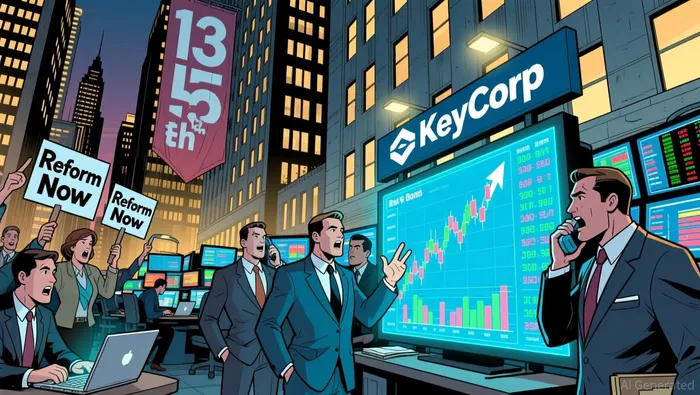
The activist’s push for structural changes has introduced uncertainty for KeyCorp’s board and management. While the bank has emphasized its commitment to “disciplined growth, strong profitability, and capital return,” HoldCo has warned that the board’s resistance could lead to a proxy contest or even a sale of the company. Potential buyers cited in the presentation include PNC Financial Services Group and Wells Fargo, as well as Canadian banks. This threat mirrors HoldCo’s prior tactics, such as its earlier attempts to secure board seats at Comerica before the latter’s acquisition. KeyCorp’s current strategy, which includes accelerated share repurchases and a focus on net interest margin growth, appears to partially align with HoldCo’s demands, but the hedge fund’s aggressive stance suggests a deeper conflict over strategic direction.
The stock’s recent performance reflects the tension between these competing visions. Despite a 0.78% gain on December 5, KeyCorp’s shares have risen 18% in 2025, outpacing broader market trends. This momentum may stem from investor optimism about the bank’s capital return initiatives, though the looming activist campaign adds volatility. The presentation’s critique of KeyCorp’s pre-2023 interest-rate positioning and securities decisions further underscores concerns about long-term profitability and governance. Retail sentiment on platforms like Stocktwits remains neutral, with normal message volume, indicating that the market is still digesting the activist’s arguments without widespread panic or euphoria.
KeyCorp’s response to HoldCo’s demands will likely shape its future trajectory. The bank’s management has so far maintained its strategic course, emphasizing its focus on organic growth and profitability. However, the activist’s detailed critique—and its history of influencing regional banking sector dynamics—suggests that KeyCorp may face mounting pressure to either implement reforms or risk a proxy battle. The outcome of this standoff could set a precedent for how activist investors engage with regional banks in a post-merger consolidation environment, where capital efficiency and governance remain critical concerns.

Stay ahead of the market.
Get curated U.S. market news, insights and key dates delivered to your inbox.
AInvest
PRO
AInvest
PRO



Comments
No comments yet