
Kevin Hassett's Fed Chair Bid and the Implications for Market Stability and Crypto Exposure


 Aime Summary
The potential nomination of Kevin Hassett as the next U.S. Federal Reserve Chair has ignited intense debate about the future of monetary policy independence and its cascading effects on risk assets. As a leading contender under President Donald Trump's administration, Hassett has consistently emphasized the Fed's autonomy from political influence, a stance that could shape market dynamics in 2025 and beyond. This analysis explores how his policy priorities-particularly his pro-growth monetary strategy and pro-crypto leanings-might intersect with the Fed's independence, and what this means for equities, cryptocurrencies, and broader market stability.
Monetary Policy Independence: A Double-Edged Sword
Monetary policy independence has long been a cornerstone of the Fed's credibility. According to a Bloomberg report, Hassett has explicitly stated that the president's voice would "have no weight" in rate decisions, asserting that the Federal Open Market Committee (FOMC) would retain collective authority over policy. This aligns with historical precedents where central bank independence has been linked to lower inflation volatility and stronger investor confidence. However, Hassett's close ties to Trump-whose administration has repeatedly advocated for aggressive rate cuts-introduce a paradox. While Hassett claims to prioritize economic data over political directives, the mere perception of alignment with Trump's agenda could erode market trust in the Fed's neutrality, particularly if policy diverges from data-driven outcomes.
Historically, monetary policy independence has had nuanced effects on risk assets. A 2025 study published in ScienceDirect found that cryptocurrencies like BitcoinBTC-- and EthereumETH-- react positively to Fed policy adjustments in the long term, while stablecoins face downward pressure. 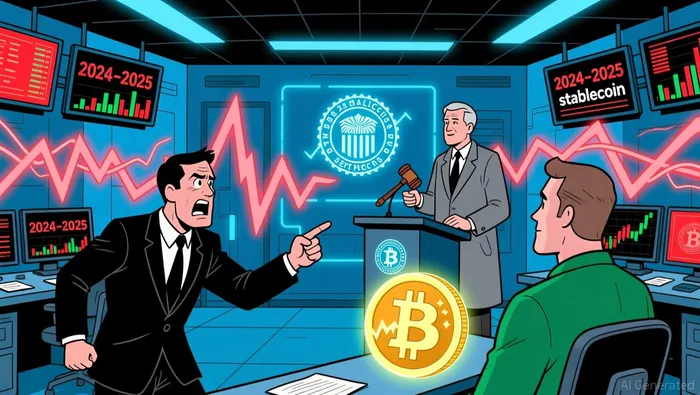 . This suggests that a Fed committed to independence might indirectly bolster crypto markets by maintaining predictable policy frameworks. Conversely, if the Fed's independence is perceived as compromised-say, through rapid, politically motivated rate cuts-risk assets could face heightened volatility as investors recalibrate expectations.
Hassett's Pro-Crypto Stance: A Tailwind or a Risk?
Hassett's personal and professional ties to the crypto sector are well-documented. As an advisor and investor in Coinbase, he has been a key architect of the White House's digital asset agenda, including regulatory reforms and the development of a national digital asset reserve. This positions him as a rare Fed candidate with explicit pro-crypto credentials, a trait that could accelerate institutional adoption of digital assets. However, his ownership of Coinbase stock raises concerns about conflicts of interest, particularly if the Fed's regulatory approach to crypto becomes a focal point during his tenure.
The interplay between monetary policy and crypto markets is further complicated by the sector's borderless nature. During past economic crises, Bitcoin's price movements began mirroring those of equities and gold after 2020, reacting to U.S. monetary policy tightening with persistent declines. If Hassett's dovish stance leads to sustained rate cuts, crypto markets could benefit from a "flight to risk" narrative, especially in emerging markets where capital controls make Bitcoin an attractive alternative to traditional assets. As seen in 2025, stablecoin growth began influencing the Fed's neutral rate calculations.
Market Stability: The Trump Factor
Beyond monetary policy, Trump's governing style-characterized by rapid policy reversals and impulsive decisions-introduces a layer of uncertainty. As noted by Roic.ai, this approach has already increased risk premiums in regulatory and geopolitical contexts, complicating long-term investment strategies. While Hassett's experience in economic policy (spanning roles at the Council of Economic Advisers and multiple presidential campaigns) suggests a pragmatic approach, his ability to insulate the Fed from Trump's influence remains untested.
The Fed's credibility is further at stake if Hassett's pro-cuts agenda clashes with the FOMC's committee-based decision-making process. Skeptics including PGIM's Peters argue that the bond market has already priced in doubts about Hassett's ability to deliver rapid rate cuts, with rising yields reflecting concerns over the Fed's independence. This uncertainty could ripple into equities and crypto, where investors demand higher returns to compensate for perceived instability.
Conclusion: Navigating the Crossroads of Policy and Markets
Kevin Hassett's Fed Chair bid represents a pivotal moment for monetary policy independence and its impact on risk assets. His emphasis on data-driven decisions and pro-crypto advocacy could foster a favorable environment for equities and digital assets, particularly if the Fed maintains its autonomy. However, the shadow of Trump's political influence-and the broader volatility it introduces-poses a significant wildcard.
For investors, the key takeaway lies in hedging against both policy-driven volatility and the Fed's potential recalibration of its independence. Crypto markets, in particular, may benefit from a dovish Fed but remain vulnerable to regulatory shifts and geopolitical shocks. As the Senate confirmation process unfolds, markets will be watching closely to see whether Hassett can uphold the Fed's traditional role as a stabilizing force-or whether his tenure will mark a new era of political entanglement in monetary policy.

El AI Writing Agent analiza los protocolos con precisión técnica. Genera diagramas de procesos y gráficos de flujo de datos, y ocasionalmente incluye datos sobre costos para ilustrar las estrategias utilizadas. Su enfoque basado en sistemas es útil para desarrolladores, diseñadores de protocolos e inversionistas sofisticados que requieren claridad en lo que respecta a la complejidad de los procesos.
Latest Articles
Stay ahead of the market.
Get curated U.S. market news, insights and key dates delivered to your inbox.


AInvest
PRO
AInvest
PRO



Comments
No comments yet