
KeSPA Cup Market Deep-Dive: Why Gen.G’s Perceived Underdog Status May Be a Rulebook Mirage
 Aime Summary
Lead
The Polymarket contract on the Gen.G vs. Hanwha Life Esports BO3 match is pricing near a coin flip, yet a deeper look at the resolution rules reveals a critical asymmetry that raw probabilities fail to capture. While the order books show Hanwha Life with a slight edge, the contractual definition of a “winner” introduces a binary risk event that could override on-stage performance entirely. This analysis dissects the gap between competitive expectations and settlement mechanics, arguing that current prices may embed a significant rule-based mispricing rather than pure matchup uncertainty.
Event Definition
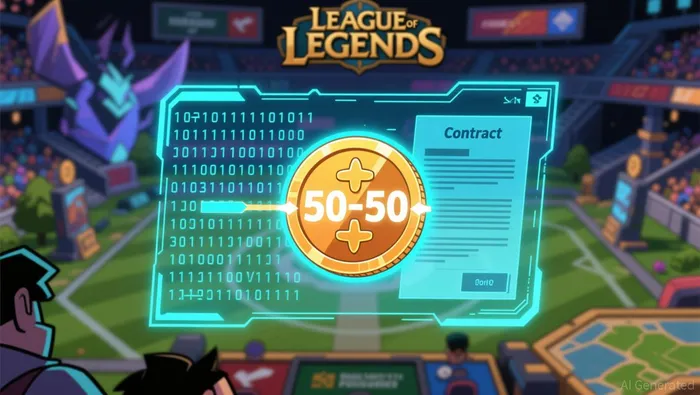
This market does not simply ask who wins a League of Legends match. It is a binary contract on the winner of the Round 1 BO3 between Gen.G and Hanwha Life Esports in the KeSPA Cup Last Chance Qualifier. The event has a strict start time boundary of August 3, 2026, at 14:00 UTC. The central disagreement is not just about team strength, but about whether the market accurately prices the contractual 50-50 resolution trigger for non-standard match conclusions.
Latest News & Information Increments
The information environment leading into this match is remarkably quiet regarding the specific teams and the KeSPA Cup itself. No recent roster moves, scrim leaks, or meta shifts specific to this qualifier have surfaced in the immediate pre-match window. The broader esports and financial news cycle has been dominated by unrelated corporate earnings and legal filings, none of which carry any weight for this in-game outcome. This absence of catalysts places the market in a low-information regime, where price movements are less likely driven by fundamental reassessments of team strength and more by positioning, sentiment, and the mechanical dynamics of a prediction market approaching its close. In such an environment, the existing price structure is fragile and highly susceptible to being reshaped by the resolution rules themselves rather than by breaking news.
Market Resolution Rules Analysis
Settlement hinges on the official match winner as recorded by the primary source, gol.gg. If the match is canceled, tied, delayed by more than seven days without a winner, or decided by a pre-match forfeit or walkover, the contract resolves to 50-50, effectively refunding the binary bet. Crucially, a secondary evidence rule exists: if gol.gg fails to publish results within two hours of the match’s conclusion, a consensus of credible reporting—including video evidence—can be used to determine the winner. This creates a narrow but real window where the “official” winner and the “publicly observable” winner could diverge in the contract’s eyes.
Rule Risk Points & Disputed Scenarios
Two key risks stand out. First, the pre-match withdrawal ambiguity is a major structural factor. If either team forfeits or is disqualified before the match begins, the market resolves to 50-50 regardless of the competitive reality. This means a technical issue, a player illness, or a rules violation that prevents the match from starting does not award the contract to the “opponent” but instead neutralizes all positions. Second, source latency introduces a tail risk where a delayed update on gol.gg forces reliance on alternative evidence, potentially creating a brief period of contested resolution if community consensus and the official record do not perfectly align. These risks are not priced into a simple win-probability model.
Market Overview
The winner market for Gen.G versus Hanwha Life Esports is clustered tightly around the midpoint, with Gen.G trading at 0.465 and Hanwha Life at 0.535. This pricing implies a marginal but clear market preference for Hanwha Life to win the match under normal competitive conditions. However, this spread does not account for the 50-50 resolution rule for pre-match forfeits. The contract’s price is effectively a composite of the true competitive win probability and the probability of a non-competitive resolution. If the market assigns even a small implicit probability to a pre-match disruption, the competitive edge implied by the 0.535 price for Hanwha Life becomes more pronounced than the raw number suggests. The Games Total O/U 2.5 market, with the Under at 0.49 and Over at 0.475, reinforces the view of a tightly contested series, where even the match length is seen as a near-equal proposition.
Market Dynamics (Volatility & Volume)
Over the past week and month, price changes have been virtually flat, recording a 0.01 shift across both horizons, suggesting a prolonged period of consolidation and a lack of new information. In stark contrast, the 1-day price change spiked dramatically to 0.145. This sudden, sharp repricing in the final hours before the match is a classic signature of event-day positioning and speculative flow, rather than a reaction to a fundamental news catalyst. The volume data strongly supports this interpretation. The 24-hour volume surged to approximately $119,270, dominating the total market volume of roughly $122,082. This extreme concentration of activity in the last day confirms that the late price swing is backed by genuine, heavy trading and robust liquidity, making the current price a credible, volume-confirmed reflection of closing-hour conviction, even if that conviction is built on thin informational grounds.
Trading Judgment & Follow-up Observation Points
The primary variable to track is not the in-game gold differential at 15 minutes, but the pre-match status of both teams. Any official announcement regarding player health, technical issues, or rule violations in the hours before 14:00 UTC instantly activates the 50-50 resolution clause, rendering the current 0.535/0.465 pricing obsolete. A secondary observation point is the post-match update speed on gol.gg; a delay exceeding two hours shifts the settlement mechanism to a consensus model, introducing potential dispute risk. The current price is a fragile equilibrium, heavily dependent on the assumption of a clean match start, and traders should recognize that the contract’s true payout structure is a bimodal outcome between a competitive winner and a rule-enforced dead heat.

Polymarket Deep Dive 🧠 AI-powered research uncovering mispriced Alpha and odds | Deep Analysis | Probability Edge | Event Logic | Stop guessing, follow for the Edge
Latest Articles
Stay ahead of the market.
Get curated U.S. market news, insights and key dates delivered to your inbox.


AInvest
PRO
AInvest
PRO




Comments
No comments yet