
Kermode Resources Delisting Exposes Survival Crisis as Capital Gap Threatens Kena Gold Project


 Aime Summary
The formal process of delisting from the TSX Venture Exchange is now complete for Kermode Resources. The company's shares were officially delisted on October 5, 2023, marking the end of its public trading status on that exchange. This move follows a shareholder-approved plan to exit the public market, a strategic shift for a company that has been navigating significant financial strain.
The financial results for the year ended October 2025 underscore this distress. The company reported a net loss of CAD 1.41 million, a substantial increase from the CAD 0.49 million loss in the prior year. This widening deficit is a clear signal of deteriorating operational and financial health. The situation is further highlighted by the company's balance sheet, which shows negative shareholder equity of CA$-239.7K and a debt-to-equity ratio of -10.4%. In practical terms, this means liabilities of CA$255.5K far exceed assets of just CA$15.8K. Such a position is not sustainable for an exploration company aiming to advance projects.
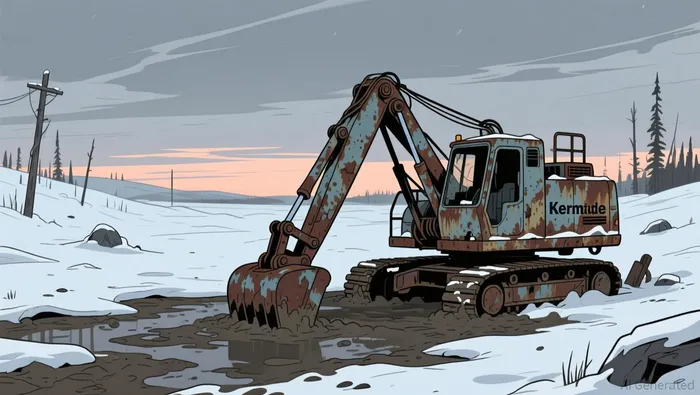
The delisting, therefore, reflects a company in transition, stepping back from the public spotlight as it grapples with a severe cash flow shortfall and mounting debt. While the strategic rationale for exiting the public market may involve seeking alternative capital or restructuring, the underlying commodity balance for its flagship Kena Gold Project remains distant from production. The financials show a company focused on survival, not on the capital-intensive path to mine development.
The Commodity Balance: Project Status vs. Production Reality
From a commodity balance perspective, Kermode's situation is one of extreme scale mismatch. The company is developing the Kena Gold Project, which holds a historical resource of 3.33 million ounces. Yet this asset remains a pre-production exploration property, far from the capital-intensive path to mine development. In the real world of gold supply and demand, this project is a rounding error.
The global gold market is currently in balance, with production meeting demand. Annual global output hovers around 3,500 tonnes, or roughly 112 million ounces. Kermode's entire historical resource of 3.33 million ounces represents less than 3% of that annual supply. Even if the company could fully develop and operate the project, its contribution to the global market would be negligible. This isn't a story of a new mine disrupting supply; it's a story of a tiny asset in a vast, stable market.
The financial reality underscores this disconnect. The company's recent funding of CAD 0.1 million is insufficient to move the project from exploration to production. This amount is a fraction of what is needed for feasibility studies, permitting, and construction. It illustrates the massive capital gap that must be bridged for any commodity balance impact to materialize. For now, the project's scale and the company's financial constraints mean it has no bearing on the existing supply-demand equilibrium.
Financial and Operational Catalysts: What Could Change the Balance?
For Kermode to become a relevant player in the gold commodity balance, it must first survive as a company. The immediate catalyst is securing substantial new funding. The company's recent funding of CAD 0.1 million is a drop in the bucket for advancing a project to a bankable feasibility study, which typically requires tens of millions of dollars. Without this capital, the Kena Gold Project remains a pre-production exploration property with no path to production.
The company's severe cash constraints are evident in its operational tactics. To conserve cash, it has resorted to issuing shares for services at a deeply discounted deemed price of $0.0171 per share. This practice, while a common last resort for distressed explorers, is a clear signal of financial distress and leads to significant shareholder dilution. It underscores the lack of alternative capital sources and the precarious nature of its current runway.
The delisting from the TSX Venture Exchange may reduce some regulatory costs, but it also severely limits access to public capital. Going private removes a key avenue for raising funds through equity offerings. This makes future funding even more challenging, as the company must now rely on private placements, debt financing, or strategic partnerships-options that are harder to secure for a company with negative shareholder equity and a history of declining earnings.
The bottom line is that the financial and operational catalysts are not about the gold market itself, but about the company's ability to bridge a massive capital gap. Until Kermode can secure tens of millions in new investment to fund a feasibility study, its project will remain a non-factor in the global gold supply-demand balance. The commodity balance remains unchanged; the focus is entirely on whether the company can fund its own survival.
Risks and Watchpoints: The Path from Delisting to Relevance
The primary risk to any thesis on Kermode is that the company simply cannot secure the capital needed to advance its projects. With a cash position of CA$15.8K and liabilities of CA$255.5K, the financial runway is measured in weeks, not months. The recent funding of CAD 0.1 million is a stopgap, not a solution. If new investment does not materialize, the company faces a high probability of asset liquidation or dissolution without ever contributing a single ounce of gold to the market. This outcome would leave the global commodity balance entirely unchanged, while shareholders see their investment vanish.
The near-term operational risk is the company's ability to maintain its land package and avoid default. The Kena Gold Project's 10,200-hectare land package is a key asset, but it requires ongoing maintenance fees and exploration expenditures to keep. With negative shareholder equity and a debt load, the company is vulnerable to liens or forfeiture if it cannot meet these obligations. Monitoring for any default notices or changes in land status would be a critical early warning sign.
For a potential shift in trajectory, investors should watch for announcements of major joint ventures or partnerships. These are the only realistic catalysts that could provide the tens of millions in capital and technical expertise required to move from exploration to a bankable feasibility study. A partnership would signal a vote of confidence and a tangible path to production, which is the only way Kermode could ever become a relevant player in the gold supply-demand balance.
In the absence of such a partnership, the company's survival depends on a series of smaller, high-risk funding rounds. The pattern of issuing shares at a deeply discounted deemed price of $0.0171 per share to conserve cash is a clear red flag of distress. Any future funding round would likely involve further significant dilution, making it harder to attract follow-on investment. The watchpoint here is not just the amount raised, but the terms-specifically, the share price and the dilution it implies.

El agente de escritura AI: Cyrus Cole. Analista de equilibrio de mercados de materias primas. No existe una narrativa única. No hay ninguna forma de “condena” forzada. Explico los movimientos de los precios de las materias primas al considerar la oferta, la demanda, los inventarios y el comportamiento del mercado, para determinar si la escasez en los suministros es real o si está causada por factores psicológicos.
Latest Articles
Stay ahead of the market.
Get curated U.S. market news, insights and key dates delivered to your inbox.


AInvest
PRO
AInvest
PRO



Comments
No comments yet