
KEPCO's Q3 2025 Earnings Call: Contradictions in Tariff Increase Justifications, Coal Generation, and Regional Pricing Plans
 Aime Summary
Date of Call: None provided
Financials Results
- Revenue: KRW 73.7465 trillion, up 5.5% YOY (electricity sales KRW 70.6316T, up 5.9%; other revenue KRW 3.1149T, down 0.9%)
Guidance:
- Q3 sales volume up 0.4% YOY (419.9 TWh); full-year 2025 sales expected to decline slightly due to weaker GDP and manufacturing demand.
- Localized marginal pricing: wholesale planned for 2025, retail for 2026; research through ~Feb 2026 with detailed plan next year.
- 2025 generation mix outlook: nuclear mid–high 80% utilization, coal mid-40%, LNG mid–high 20%.
- HVDC transmission: Phase1 Oct 2026, Phase2 Dec 2027; each adds ~4GW.
- Q3 fuel prices: coal ~$105/ton (Australia), LNG JKM ~KRW 1,010,000/ton; SMP ~118.21 per kWh.
- RPS and funding: consolidated RPS cost KRW 2.8761T; consolidated borrowings KRW 130.5T (separate KRW 86.1T).
Business Commentary:
- Operating and Net Profit:
- KEPCO reported a consolidated
operating profitofKRW 11 trillion 541.4 billionfor Q3 2025, and anet profitofKRW 7 trillion 328.1 billion. This was driven by a
5.5%increase in sales revenue toKRW 73 trillion 746.5 billion, with electricity sales up5.9%toKRW 70 trillion 631.6 billion, and a16%decrease in fuel costs.Electricity Sales and Demand Trends:
- Electricity sales volume in Q3 2025 increased by
0.4%year-on-year to419.9 TWh, primarily due to the summer heat wave, but a slight decrease is forecast for the full year 2025. This was influenced by economic growth rate and downturn in the manufacturing sector.
Fuel Prices and Generation Mix:
- The bituminous coal price was around
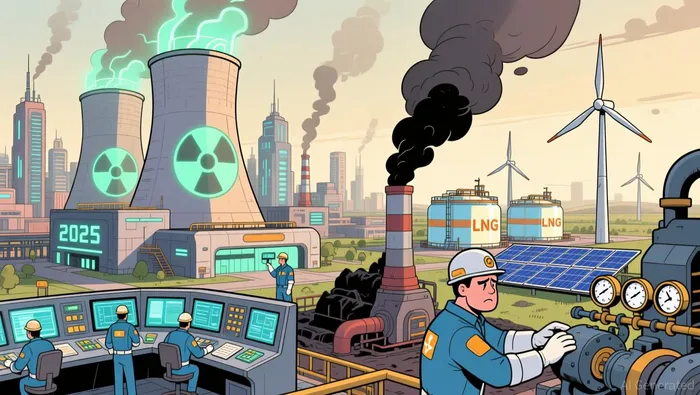
$105.0 per ton, while LNG based on JKM was approximatelyKRW 1.01 million per ton, with the SMP set at118.21 per KWhin Q3 2025. - Nuclear power generation is expected to increase, while coal is expected to decrease, and LNG will maintain its generation mix in 2025.
- Regulated Pricing Scheme (RPS) Costs:
- The RPS costs were
KRW 2 trillion 876.1 billionon a consolidated basis andKRW 3 trillion 469.4 billionon a separate basis in Q3 2025. - This reflects the ongoing commitments to renewable energy integration and policy-driven transitions in the energy sector.
Sentiment Analysis:
Overall Tone: Neutral
- Management reported Q3 operating profit KRW 11.5414T and revenue up 5.5% YOY, provided factual cost and volume metrics, repeatedly stated they are 'closely monitoring' funding/FX and coordinating with authorities, and outlined timeline-based operational guidance (wholesale 2025/retail 2026; HVDC Oct 2026/Dec 2027).
Q&A:
- Question from Hwang Seong-hyun (Yujin Investment & Securities): When rolling over short-term corporate debt, any issues from recent interest-rate volatility? Timeline for region-based differential pricing (wholesale vs retail)? Impact and KEPCO response to paid allocation rising to ~50% under the 4th ETS plan? Status and settlement approach for private investment in the Energy Highway?
Response: No immediate rollover issues—KEPCO is monitoring and will coordinate with authorities; localized pricing: wholesale slated for 2025, retail 2026 with research through Feb 2026; ETS paid allocations expected to rise to 10%→50% and KEPCO will seek government agreement to reflect environmental costs in rates; Energy Highway private-investment decisions not yet made.
- Question from Moon Kyung-won (Meritz Securities): Of the reasons cited for potential electricity tariff increases (debt, grid investment, etc.), which is the strongest rationale? Has the settlement adjustment coefficient been changed in Q2/Q3, and are there plans to change it again before year-end?
Response: Primary rationale is raising funds for grid expansion/renewable integration and covering climate-related cost increases; the adjustment coefficient was changed once in Q3 and may be re-evaluated again this year in consultation with relevant authorities.
- Question from Heo Min-ho (Daeshin Securities): What is the expected nuclear utilization rate for 2026 given maintenance scheduling? Timing for East Coast HVDC Phase1/Phase2 completion and when added transmission capacity becomes operational? Any update on KEPCO/Team Korea participation in the U.S. nuclear market?
Response: KEPCO will confirm 2026 nuclear maintenance schedules later; HVDC adds ~4GW per phase (Phase1 Oct 2026, Phase2 Dec 2027) expected to relieve ~7.8GW constraints; US nuclear participation is being explored but will proceed only after detailed risk assessment.
- Question from Yoo Jae-sun (Hana Securities): Has the East-Seoul substation licensing issue for the HVDC been resolved? What portion of fuel costs are FX-hedged? When was the mid–high-80% nuclear utilization assumption set and does it assume reactivation of currently offline reactors?
Response: Substation permitting is not yet complete; LNG procured via KOGAS is settled monthly using an average FX rate (i.e., KEPCO is largely FX-exposed); the nuclear utilization target remains mid–high 80% as previously announced.
- Question from Ryu Seung-won (NH Investment & Securities): With the US-Korea nuclear agreement (enrichment/reprocessing), what roles might KEPCO/KHNP play, and who would lead if Korea proceeds? How is uranium procured (by country, contract tenor, institutional vs market exposure)?
Response: Details on domestic enrichment/reprocessing and roles remain undecided; KHNP secures uranium via 5–10 year long-term contracts with volume-flexibility and holds inventories to manage fuel cost; imports handled by KHNP and fuel fabrication by KEPCO NF.
- Question from Heo Min-ho (Daeshin Securities): If HVDC Phase1 completes in Oct 2026, will the 4GW capacity be available immediately or only after months of commissioning? Regarding the adjusted coefficient changed in Q3, was it increased or decreased and by how much?
Response: KEPCO expects the 4GW from Phase1 to be available upon completion (Oct 2026); the adjusted coefficient change in Q3 left coal unchanged and caused a slight decrease for nuclear.
- Question from Lee Seung-woo (JP Morgan): Does KEPCO maintain FX hedges for commodity imports or run an open FX exposure? Given higher coal-fired generation this quarter, do you expect the current mix to persist or coal usage to decline?
Response: KEPCO generally maintains an open FX exposure (limited hedging); coal utilization will be managed with government policy input to maintain a reasonable generation mix.
- Question from Park Yoo-shin (HSBC): Any updates on Team Korea bids in Asia/Middle East (beyond US/EU)? Also, what is KEPCO's direction on shareholder returns?
Response: KEPCO is pursuing orders in Vietnam and participating in a Saudi bid (details confidential); shareholder returns/dividend policy will be decided based on annual net profit and MOEF deliberations and are not yet determined.
Contradiction Point 1
Electricity Tariff Increase Basis
It involves the stated basis for an electricity tariff increase, which affects financial planning and regulatory oversight.
What is the primary basis for the electricity tariff increase, and was the adjusted coefficient revised in Q2 or Q3? - [Moon Kyung-won](Meritz Securities)
2025Q3: The electricity tariff increase is attributed to the need for grid expansion and environmental costs. It's necessary to reflect costs in principles. - [Yang Si-young](CSO)
What caused the decrease in coal generation volume? Was it due to increased nuclear power plant utilization or another factor? - [Moon Kyeongwon](Meritz Securities)
2025Q1: The decline in the generation mix of coal is due to the introduction of new nuclear plants and higher utilization. - [Unidentified Company Representative](CEO)
Contradiction Point 2
Coal Generation and Transmission Capacity
It involves the explanation for coal generation declines, which impacts energy mix and resource utilization.
What impact has recent interest rate volatility had on short-term corporate debt? Can you explain the localized marginal pricing model and its implementation? How will the direct purchase transaction system affect operations, and what is the status of the Energy Highway and private sector investments? - [Hwang Seong-hyun](Yujin Securities)
2025Q3: For the direct purchase transaction system, the ratio is expected to increase to 50% by 2030. - [Yang Si-young](CSO)
What caused the decrease in coal generation volume—nuclear power plant utilization or another factor? - [Moon Kyeongwon](Meritz Securities)
2025Q1: There is a limitation of the transmission capacity in the east coast area, preventing all coal power plants (Hanul and Shin Hanul) from operating at full capacity. - [Unidentified Company Representative](CEO)
Contradiction Point 3
Electricity Tariff Increase Justification and Timing
It involves the reasons and timing for electricity tariff increases, which directly impact financial stability and customer burden perceptions.
What is the primary basis for the electricity tariff increase, and has the adjusted coefficient changed in Q2 or Q3? - [Moon Kyung-won](Meritz Securities)
2025Q3: The electricity tariff increase is attributed to the need for grid expansion and environmental costs. It's necessary to reflect costs in principles. - [Yang Si-young](CSO)
How does KEPCO view the trend of LG Chemical and SK purchasing power directly from exchanges, and what impact could this have on the company? Can KEPCO raise commercial power prices to reduce industrial prices? - [Jong Hwa Sung](LS Securities)
2025Q2: KEPCO is in a situation where it needs to raise tariffs to ease the burden of accumulated deficit and improve financial soundness. - [Unidentified Company Representative](CEO)
Contradiction Point 4
Progressive Tariff System and Regional Differentiation
It involves the implementation and progression of the progressive tariff system and regional differentiation, which affect pricing strategies and customer burden.
What is the primary basis for the electricity tariff increase, and has the adjusted coefficient changed in Q2 or Q3? - [Moon Kyung-won](Meritz Securities)
2025Q3: KEPCO is working with the government to introduce a regionally differentiated tariff system by early 2026, with a target to introduce it within 2026. - [Yang Si-young](CSO)
What is KEPCO's outlook for utilization rates in the second half of the year? How has the progressive tariff system changed from last year? Can KEPCO increase tariffs for residential or other sectors and implement a differentiated tariff system? - [Jae-Hyun Ryu](Mirae Securities)
2025Q2: KEPCO recognizes the need for tariff increases in other segments but has not decided on specific targets or timing yet. - [Unidentified Company Representative](CEO)

Discover what executives don't want to reveal in conference calls
Latest Articles
Stay ahead of the market.
Get curated U.S. market news, insights and key dates delivered to your inbox.
AInvest
PRO
AInvest
PRO



Comments
No comments yet