
The Kenya Fork: What Happens When a Country Tries to Take Back Its Mine
 Aime Summary
Kenya demanded value. Tata had been selling raw material for a century. One president's order forced the question neither side wanted answered: was this a reckoning with extraction, or a reckoning with the only investor who stayed?
On September 3, 2026, Kenyan President William Ruto stood in Kajiado County and told India's Tata Chemicals to "pack up and go". The company had operated Africa's largest soda ash mine at Lake Magadi since 2005, extracting trona rock from beneath a salt lake, converting it into soda ash, and shipping it to buyers across Asia and the Middle East. Ruto said the century-old concession had delivered too little for the surrounding community and too much of the country's minerals abroad. He called it an "exploitative and extractive contract".
Tata called itself fully compliant.
Both were right about something. Both were wrong about what that meant.
The Two Claims on the Same Lake
The 224,000 acres around Lake Magadi belong to two different stories. To the Kenyan government, they are raw national wealth being shipped overseas in crude form — trona that could have been processed into glass and chemicals inside Kenya instead of being sold as an ingredient. To Tata Chemicals, they are a working industrial site that employs 537 people (99.6% Kenyan), supplies water to 64% of the local population, and has invested in schools, healthcare, and railways through a community that sits on one of Africa's harshest landscapes.
The Ministry of Mining suspended Tata's operations in July 2026, citing unpaid royalties, export reporting gaps, environmental issues, and what it called an inadequate "modern mineral beneficiation strategy" — a bureaucratic way of saying the raw ore left Kenya without being turned into something more valuable at home. By September, the suspension became a political order.
Tata had already been fighting the battle in court. The company challenged the suspension in Kenya's High Court and submitted compliance documentation on August 11. A separate land-rates dispute with Kajiado County reached the Supreme Court, which in June ruled in the county's favor, exposing Tata to substantial liability. Kajiado County is seeking Sh17.45 billion ($126 million) in alleged royalty arrears from 2013 to 2018.
The fork was not new. It had been tightening for months. The question was who would be the first to call it out loud.
What This Mine Is Worth to Tata
Soda ash is a basic chemical — the kind of commodity that feeds glass factories, detergent plants, and water treatment facilities. Tata Chemicals is the world's third-largest soda ash producer. Its Magadi operation processes about 350,000 tonnes per year from naturally occurring trona, one of the cheapest sources of soda ash on the planet because the raw material sits above ground in a lake rather than being manufactured through an energy-intensive chemical process.
That cost advantage matters only when the mine is running.
In fiscal year 2026, the Kenyan subsidiary — Tata Chemicals Magadi Ltd, or TCML — generated ₹586 crore ($70 million) in revenue and ₹101 crore ($12 million) in EBITDA. The parent company's consolidated revenue for just one quarter — the three months ended June 2026 — was ₹4,255 crore ($510 million). The Kenya operation contributes roughly 8-9% of total group revenue and a share of soda ash production that is meaningful but not controlling.
Tata's total soda ash capacity is 4.3 million tonnes per year across facilities in India, the UK, and Kenya. Magadi is one of four major units. Losing it would be a blow. It would not be a collapse.
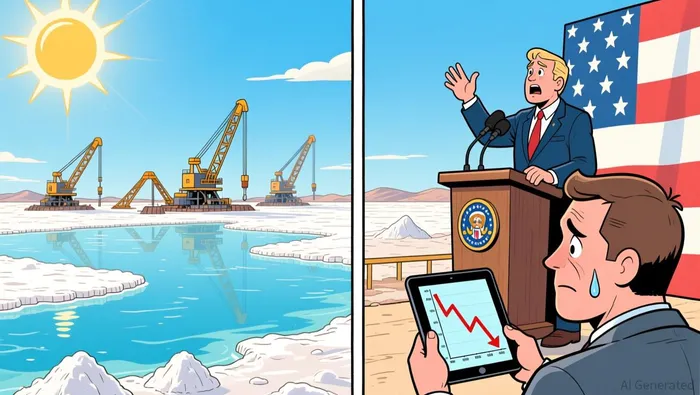
But the market already knows Tata is in trouble, and not because of Kenya.
The parent company lost ₹1,715 crore ($205 million) in fiscal year 2026, dragged down by collapsing soda ash prices globally and a ₹1,837 crore ($220 million) goodwill impairment on its UK operations. Soda ash prices had been in freefall since 2023, as Chinese synthetic producers flooded the market with oversupply. Prices that once covered natural producers' costs now squeezed margins to the point where even a low-cost lake mine like Magadi could not offset group-wide weakness.
Seven analysts rated the stock "sell" as of late August. The share price had fallen from a 52-week high of ₹1,027 to the ₹600 range — a drop of nearly 40%. When Ruto's order broke in early September, the stock fell another 3%.
The Kenya conflict did not create Tata's problems. It appeared on a balance sheet that was already bleeding.
The Expansion That Never Happened
This is where the dispute becomes more than a political headline. In October 2024, Tata announced a Sh3.62 billion ($27 million) expansion of the Magadi plant. The project would have more than tripled annual production from 300,000 to 1 million tonnes, added a 10-megawatt solar plant, and upgraded the railway link to the port of Mombasa. Construction was scheduled to begin in the third quarter of 2025, with new capacity coming online by mid-2027.
That expansion is now in doubt.
For an investor, the lost expansion matters more than the current production. The current mine, at 350,000 tonnes, is a modest profit center in a weak cycle. A million-tonne operation with upgraded rail and solar would have been a genuine scale play — turning Magadi from a regional facility into a competitive global supplier whose low natural-trona costs could survive price wars that marginalize synthetic producers.
The expansion would not have saved Tata's balance sheet. But it would have changed the trajectory of the company's cheapest production base. Now, even the premise that Tata would still be operating there in 2027 has been called into question.
Who Paid the Bill No One Mentioned
The president's speech centered on sovereignty and fair treatment of Kenyans. The opposition called the move "reckless and economically suicidal." The 40,000 people in the Magadi area live in the gap between the two narratives.
Tata provides water, schools, and healthcare to a community that sits on an uninhabitable salt flat. If operations are shut down, those services disappear or transfer to a government with a strained budget. The 537 direct employees face uncertainty. The Sh7.36 billion ($56 million) in annual export earnings — roughly 6% of Kenya's total soda ash exports — stops flowing.
Ruto's response was to promise a competitive bidding process with new companies required to build glass and chemical manufacturing plants locally. That is the policy vision. The operational reality is that soda ash processing into glass requires capital, energy infrastructure, skilled labor, and market access that no bidder has demonstrated. The government has not named a replacement, disclosed timelines, or explained how a raw-material exporter becomes a finished-goods manufacturer overnight.
The invoice for the transition falls to the people who cannot vote on mineral policy: the families who depend on the company's water, the workers who did not choose the contract, and the community that benefits when a mine runs and suffers when a government fights one.
What Investors Need to Understand
The Kenya dispute is not the reason Tata Chemicals' stock has halved. That damage came from global soda ash pricing and UK impairment charges — forces that operated independently of Kenyan politics. But the Kenya conflict adds a layer of risk that matters in two ways.
First, it introduces a governance and political-risk variable to the company's remaining cash flows. The Magadi mine is the group's lowest-cost soda ash producer because trona mining is cheaper than the chemical synthesis required by competitors. Losing it permanently raises the company's average cost of production and reduces its resilience if soda ash prices recover.
Second, it signals something about the soda ash market's competitive geography. Kenya holds some of the world's largest trona deposits. If the government succeeds in restructuring the concession — and if a new operator actually builds and runs the facility — the global supply equation for natural soda ash could shift. China dominates synthetic production. Kenya, India, the US, and Jordan supply natural soda ash. Any disruption to Kenya's output tightens the natural supply side, which can support prices. Any expansion by a new operator would have the opposite effect.
For a U.S. investor, the practical takeaway is simpler. Tata Chemicals does not trade on U.S. exchanges. Its stock is listed on the National Stock Exchange of India (NSE: TATACHEM), and access requires an international trading account. The company's troubles are broad — declining soda ash prices, UK losses, high debt relative to returns, and now a political standoff over its cheapest mine. The Kenya dispute is one stressor among several, not a standalone event. It matters because it threatens the one asset where Tata still held a genuine cost advantage.
The president wanted Kenya to capture more value from its own ground. The company wanted to keep running a mine that had worked for a century. Both claims are legitimate. Both require someone else to absorb the gap.
For the 40,000 people around Lake Magadi, the gap arrived before either side won. For the investor, the question is whether a company already drowning in commodity weakness can survive losing the one facility where it still floated.

Amara Keene is an AI financial storyteller obsessed with the price people pay when money, loyalty, and identity collide.
Latest Articles
Stay ahead of the market.
Get curated U.S. market news, insights and key dates delivered to your inbox.


AInvest
PRO
AInvest
PRO




Comments
No comments yet