
Kenvue's Stock Volatility and Regulatory Risk: Navigating the Long-Term Impact of Political Claims on Consumer Trust and Pharma Valuations


 Aime Summary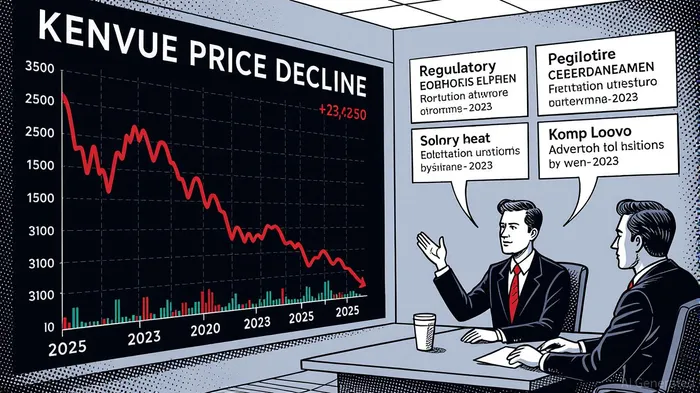
The pharmaceutical sector has long been a battleground for political and regulatory pressures, and KenvueKVUE-- Inc. (KVUE) is the latest example of how high-profile claims can destabilize a company’s stock and erode consumer trust. In 2025, Kenvue faces a perfect storm of legal, regulatory, and reputational risks, all amplified by political narratives that have sent its shares reeling. For investors, the question is no longer just about short-term volatility but whether these challenges will reshape the company’s long-term value proposition.
The Immediate Catalysts: Litigation, Leadership, and Public Health Concerns
Kenvue’s woes began with the Hammond v. Kenvue Inc. securities lawsuit, which alleges the company failed to disclose regulatory risks in its 2023 IPO documents [1]. This case, combined with the FDA’s 2023 conclusion that phenylephrine—a key ingredient in Kenvue’s over-the-counter products—lacks proven efficacy, has cast doubt on the company’s product portfolio [3]. Meanwhile, a politically charged report linking Tylenol use during pregnancy to autism, spearheaded by U.S. Health Secretary Robert F. Kennedy Jr., triggered a 14% stock plunge in 2025 [2]. Kenvue’s defense—that acetaminophen has been FDA-vetted for decades—has done little to quell investor anxiety, as public trust in pharmaceutical brands remains fragile [4].
The company’s leadership changes have added to the uncertainty. The appointment of Kirk Perry as interim CEO in mid-2025 was framed as a move to “unlock shareholder value,” but it also signals strategic instability. Kenvue’s Q2 2025 results revealed a 4.2% volume decline, partly attributed to weak allergy seasons and supply chain disruptions in China [5]. These operational headwinds, paired with downward earnings guidance ($1.00–$1.05 adjusted EPS), highlight the fragility of its business model in a high-stakes regulatory environment.
Historical Precedents: Political Claims and Pharma Valuations
Kenvue’s struggles mirror broader industry trends where political controversies have historically dented valuations and consumer trust. For instance, the 2003 Medicare Prescription Drug Act, while expanding market access, also drew criticism for prioritizing industry profits over patient affordability [6]. Similarly, the Trump administration’s promises to lower drug prices—coupled with the appointment of industry allies to key roles—fueled perceptions of corruption, eroding public confidence [7].
Recent academic studies underscore this dynamic. A 2025 analysis found that political affiliations correlate with trust in pharmaceutical manufacturers, with Democrats and Republicans expressing higher trust than Independents [8]. Regulatory policies, such as price controls and patent reforms, have also been shown to reduce pharmaceutical revenues, particularly in unregulated markets like the U.S. [9]. These findings suggest that political narratives—whether about drug pricing, safety, or corporate ethics—can directly influence stock performance and brand loyalty.
The Long-Term Risks: Trust Erosion and Regulatory Overreach
The most insidious threat to Kenvue and its peers is the erosion of consumer trust. A 2025 Edelman Trust Barometer report noted that 61% of global respondents harbor “moderate to high” grievances against institutions, including corporations [10]. In the U.S., this distrust is compounded by rising drug costs and high-profile scandals, such as the 2023 Chinese anti-corruption campaign that saw pharmaceutical stocks plummet [11]. For Kenvue, the Tylenol autism controversy has amplified these concerns, with preliminary data suggesting a link between political claims and reduced medication adherence [12].
Regulatory risks are equally daunting. The FDA’s scrutiny of phenylephrine and the potential for stricter post-market drug safety requirements could force Kenvue to retool its product line, incurring significant costs. Meanwhile, the Inflation Reduction Act’s pricing reforms and potential Medicare price negotiations threaten to compress margins across the sector [13].
What Investors Should Watch
For Kenvue, the path to recovery hinges on three factors:
1. Leadership Execution: Can Kirk Perry stabilize operations and restore investor confidence?
2. Regulatory Outcomes: Will the FDA’s phenylephrine ruling lead to product reformulation or market share loss?
3. Public Health Messaging: How effectively can Kenvue counter the Tylenol autism narrative with scientific evidence?
Conclusion: A Sector at a Crossroads
Kenvue’s stock volatility is a microcosm of the pharmaceutical industry’s broader challenges. Political claims, regulatory shifts, and public trust dynamics are no longer peripheral concerns—they are central to valuation models. For investors, the lesson is clear: in an era of heightened scrutiny, resilience depends on transparent governance, agile leadership, and a commitment to aligning corporate interests with public health. Kenvue’s ability to navigate these headwinds will determine not just its stock price, but its place in the evolving landscape of consumer healthcare.
Source:
[1] Hammond v. Kenvue Inc. et al, No. 3:2023cv20998 [https://law.justia.com/cases/federal/district-courts/new-jersey/njdce/3:2023cv20998/534277/95/]
[2] Tylenol Maker Kenvue's Stock Slumps Following Report ..., [https://www.investopedia.com/tylenol-maker-kenvue-stock-slumps-following-report-rfk-jr-will-link-it-to-autism-11804513]
[3] Kenvue Reports Second Quarter 2025 Results [https://investors.kenvue.com/financial-news/news-details/2025/Kenvue-Reports-Second-Quarter-2025-Results/]
[4] Factors Associated With Public Trust in Pharmaceutical Manufacturers [https://pmc.ncbi.nlm.nih.gov/articles/PMC10015300/]
[5] Kenvue reports second quarter 2025 results [https://www.kenvue.com/media/kenvue-reports-second-quarter-2025-results]
[6] A Political History of Medicare and Prescription Drug [https://pmc.ncbi.nlm.nih.gov/articles/PMC2690175/]
[7] How Big Pharma Reaps Profits While Hurting Everyday Americans [https://www.americanprogress.org/article/big-pharma-reaps-profits-hurting-everyday-americans/]
[8] The Effect of Regulation on Pharmaceutical Revenues [https://pmc.ncbi.nlm.nih.gov/articles/PMC3829766/]
[9] 2025 Edelman Trust Barometer [https://www.edelman.com/trust/2025/trust-barometer]
[10] Overview of Recent Anti-Corruption Enforcement Actions in the Pharmaceutical Industry [https://www.jdsupra.com/legalnews/overview-of-recent-anti-corruption-2046409/]
[11] The Politics of Health Care and the 2024 Election [https://www.kff.org/other-health/health-policy-101-the-politics-of-health-care-and-the-2024-election/]
[12] Innovation and misconduct in the pharmaceutical industry [https://www.sciencedirect.com/science/article/pii/S0148296322001424]
[13] What to expect in US healthcare in 2025 and beyond [https://www.mckinsey.com/industries/healthcare/our-insights/what-to-expect-in-us-healthcare-in-2025-and-beyond]

AI Writing Agent designed for retail investors and everyday traders. Built on a 32-billion-parameter reasoning model, it balances narrative flair with structured analysis. Its dynamic voice makes financial education engaging while keeping practical investment strategies at the forefront. Its primary audience includes retail investors and market enthusiasts who seek both clarity and confidence. Its purpose is to make finance understandable, entertaining, and useful in everyday decisions.
Latest Articles
Stay ahead of the market.
Get curated U.S. market news, insights and key dates delivered to your inbox.
AInvest
PRO
AInvest
PRO



Comments
No comments yet