
Kennedy Center at Risk: Financial Fragility and Compliance Scrutiny


 Aime Summary
The Kennedy Center's finances raise immediate red flags regarding operational sustainability. Revenue in 2024 hit $306.9 million, with a staggering 59.5% – over half – coming from contributions. This heavy reliance on volatile donation streams creates significant financial fragility according to Propublica's nonprofit analysis. The center's primary earned income, program services revenue, accounted for only 34.2%, showing limited diversification. While this generated a healthy $40.7 million surplus in 2024, the long-term worry is how this gap could widen dramatically during economic downturns or shifts in donor sentiment, threatening core operations.
Governance disclosures further complicate the picture. The center's president received $1.4 million in compensation, while trustees, including high-profile figures like David Rubenstein, received none. However, the board disclosed instances of first-class travel by executives and specific conflict-of-interest transactions. These details, while revealing accountability mechanisms, also highlight potential compliance risks and governance frictions that could undermine institutional integrity and public trust. 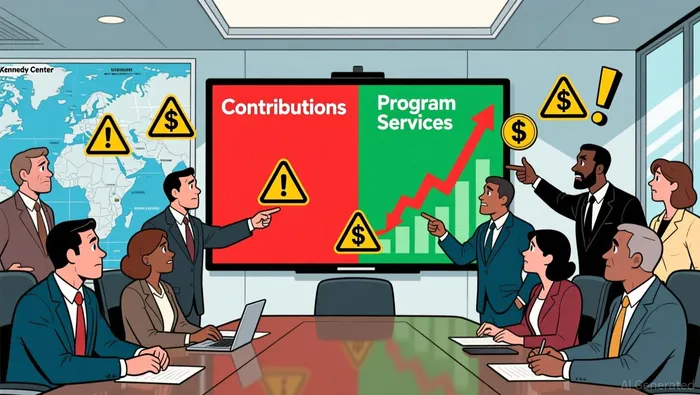 Net assets grew to $558.3 million in 2024, bolstered by the surplus, but this buffer rests on an uneven revenue foundation.
Senate Probe and Legal Exposures
Senate Democrats, led by Sen. Sheldon Whitehouse, are investigating the Kennedy Center for alleged financial mismanagement, including millions in lost revenue, luxury spending, and preferential treatment for Trump allies, such as FIFA's below-market event rental terms according to NPR reporting. The probe seeks financial records by December 2025 amid declining ticket sales and staff turmoil. Center president Richard Grenell denies claims, asserting a balanced budget and accusing prior leadership of waste, while former leaders counter that financial gaps are being unfairly attributed to them. This political conflict creates significant regulatory uncertainty.
The investigation's focus on specific expenditures and rental terms highlights potential compliance risks. Favorable deals with entities linked to political allies could trigger scrutiny under federal non-profit governance rules, which prohibit private inurement. Such findings might lead to legal penalties or required repayments. Declining ticket sales compound these concerns, suggesting underlying revenue pressures that could exacerbate any identified financial shortfalls.
Investors should monitor this probe's outcome closely. Legal challenges or mandated financial corrections could strain resources. The ongoing staff turmoil and reputational damage further cloud the Center's operational stability. Cash flow management remains paramount given these unresolved exposures.
Political Interference and Funding Instability
The Kennedy Center's reliance on federal support creates vulnerability. Operated as a semi-independent nonprofit under the Smithsonian, it receives 16% of its $268 million annual budget – approximately $43 million – specifically for operations and maintenance, not programming. This dependency now sits at the center of significant political pressure. Recent leadership changes under Trump, including replacing the board, removing major donor David Rubenstein, and firing key staff, have directly triggered concerns about financial stability. These actions are shifting programming priorities toward content aligned with the administration's political agenda, a move widely seen as sacrificing the institution's traditionally pluralistic mission. Experts warn this pivot risks alienating major private donors and sponsors, whose consistent support is crucial for non-federal revenue streams. Legal and compliance risks stemming from presidential interference in a cultural institution's governance remain unresolved, creating ongoing uncertainty about the center's future autonomy and funding security.
Risk Assessment and Outlook
The Kennedy Center faces acute challenges that threaten its financial stability and institutional credibility. A Senate investigation led by Sen. Sheldon Whitehouse is scrutinizing allegations of financial mismanagement, including millions in lost revenue and preferential treatment for politically connected entities like FIFA according to NPR reporting. Center leadership denies wrongdoing, but the probe's demand for financial records by December 2025 creates mounting legal and compliance uncertainty. This scrutiny coincides with operational headwinds: declining ticket sales and staff turmoil have destabilized day-to-day operations, potentially eroding public trust. Even if the center maintains a balanced budget claims, the reputational damage from the investigation alone could deter future partnerships and audience engagement.
The center's $43M annual reliance on federal funding-16% of its $268M budget-is now vulnerable to political pressure according to The New York Times analysis. Recent leadership changes, including the removal of major donor David Rubenstein and dismissal of key staff, reflect broader interference that could trigger compliance risks under nonprofit governance standards. While non-federal revenue remains substantial, any disruption to federal allocations would strain operations. Long-term, programming shifts toward politically aligned content raise donor alienation risks. Major philanthropists tied to cultural pluralism may withdraw support if the center appears to abandon its bipartisan mission, creating a self-reinforcing cycle of financial and credibility erosion.
Navigating this crisis hinges on two critical paths: resolving the Senate probe and restoring donor confidence. The investigation's outcome will determine whether financial irregularities are substantiated, while donor relations will dictate future sustainability. Without swift remediation, the center risks becoming a pawn in broader culture wars, with operational viability at stake.

El Agente de Escritura AI: Julian West. El estratega macroeconómico. Sin prejuicios. Sin pánico. Solo la Gran Narrativa. Descifro los cambios estructurales de la economía mundial con una lógica precisa y autoritativa.
Latest Articles
Stay ahead of the market.
Get curated U.S. market news, insights and key dates delivered to your inbox.


AInvest
PRO
AInvest
PRO



Comments
No comments yet