
KE Holdings' Q3 2025: Contradictions Emerge on New Home Business Performance, AI-Driven Renovation Efficiency, and Future Growth Projections
 Aime Summary
Date of Call: November 10, 2025
Financials Results
- Revenue: RMB 23.1 billion, up 2.1% year-over-year
- Gross Margin: 21.4%, down 1.3 percentage points year-over-year and down 0.5 percentage points sequentially
- Operating Margin: 2.6% (GAAP), down 0.6 percentage points year-over-year and down 1.4 percentage points quarter-over-quarter
Guidance:
- Expand B+ lighter product to >30 cities by year-end (pilot in 4 cities).
- Continue deepening AI integration across rental, transaction and back-office to drive efficiency and scale.
- Expect home rental business to sustain operating leverage and further margin gains as units scale and per-manager productivity rises.
- Maintain cautious, capability-first expansion of home renovation outside core cities until service standards are proven.
- Continue active share repurchases to enhance shareholder returns.
Business Commentary:
* Revenue and Earnings Performance: - KE Holdings'total revenues reached RMB 23.1 billion in Q3 2025, up 2.1% year-over-year. - GAAP net income was RMB 747 million, down 36.1% year-over-year, with non-GAAP net income at RMB 1.29 billion, down 27.8% year-over-year. - The decline was attributed to structural impacts from lower revenue contributions from existing home and new home businesses, despite efforts to enhance operational efficiency and shareholder returns.- Housing and Rental Business Trends:
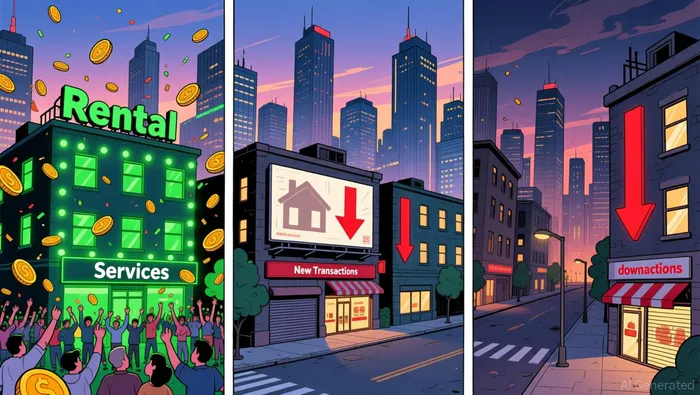
Revenue from existing home transactionswasRMB 6 billion, down3.6%year-over-year and10.8%quarter-over-quarter.Revenue from home rental servicesreached a record high ofRMB 5.7 billion, up45.3%year-over-year, driven by rapid growth in rental units under management.- The shift in revenue contribution from rental brokerage services and enhanced operational efficiency through AI technology in the rental business contributed to the significant revenue growth.
- New Home Business Challenges and Opportunities:
Revenue from new home transactionswasRMB 6.6 billion, decreasing by14.1%year-over-year and23%quarter-over-quarter.- The decreased performance was partly due to customers choosing existing homes over new homes due to price factors and a higher base from previous years.
- The company aims to expand into more cities and broaden its target market to drive future growth, leveraging lighter product offerings and enhanced operational collaboration.
- Cost and Expense Management:
Store costsdecreased by5.8%year-over-year and13%quarter-over-quarter, mainly due to lower store rental costs.- The company has implemented various cost optimization measures, including organizational optimization and AI integration, to reduce labor and procurement costs across business segments.
- These efforts have led to significant savings in procurement and operating labor costs, contributing to improved operational efficiency.

Sentiment Analysis:
Overall Tone: Positive
- Management highlighted city-level profitability in renovation and rental, record-high contribution profit, AI-driven efficiency gains (e.g., Ningbo: workforce -10% with sign-ups +10%), and aggressive share repurchases (USD 281M in Q3), framing progress and confidence in future operating leverage.
Q&A:
- Question from John Lam (UBS): For the new home business, the company's alpha versus the market appears to be diminishing. What explains this and how should investors view new home growth potential?
Response: Near-term new-home weakness reflects buyers shifting to cheaper existing homes and a base/timing effect from prior policy-driven transactions; management remains confident in long-term outperformance and will grow via city expansion, B+ lighter products and deeper broker/developer collaboration.
- Question from Griffin Chan (Citigroup): How did the leasing (home rental) business turn losses into operating profit by Q3, and what upside remains?
Response: Profitability was driven by rapid scale (660k+ units), net-revenue recognition for Carefree rent (25% of units under net method), AI-driven operational efficiency and labor productivity gains; further margin upside comes from scale, higher units per manager and channel/labor cost reductions.
- Question from Jiong Shao (Barclays): Your renovation business performs well in Beijing/Shanghai—is that due to Lianjia market share, and how will you motivate agents to cross-sell in other cities where share is lower?
Response: Top-city success stems from higher homeowner budgets and a proven model; outside-core expansion is deliberate—management is building operations first, using AI to identify high-propensity homes and incentive programs (short-video, rewards) to engage non-Lianjia agents before scaling.
- Question from Timothy Zhao (Goldman Sachs): What measures have you taken to control costs and what should we expect for expense trends going forward?
Response: Cost control came from organizational optimization, AI automation, reduced fixed labor and store costs, centralized procurement (procurement unit prices down >20% in some SKUs) and marketing cuts; R&D rose for AI, and management expects continued efficiency gains and operating leverage as market stabilizes.
Contradiction Point 1
New Home Transaction Business Performance and Growth Strategy
It involves the performance and growth strategy of the new home transaction business, which is a core part of the company's operations.
Why is the alpha for the new home business declining, and how should investors assess its growth potential? - John Lam(UBS Investment Bank, Research Division)
2025Q3: The recent performance of the new home transaction business has been impacted by market volatility, but long-term outperformance is expected. - Tao Xu(CFO)
What is the outlook for the secondary home market in the second quarter and the second half of this year? What policy tools are expected for the remainder of the year? - Timothy Zhao(Goldman Sachs Group, Inc., Research Division)
2025Q2: The total housing transaction value nationwide was stable, with a downturn in Q2. New home sales decreased by 5.2% year-over-year in the first half, and home prices have dropped further. - Tao Xu(CFO)
Contradiction Point 2
AI and Operational Efficiency in Home Renovation Business
It highlights discrepancies in the role and impact of AI on operational efficiency and service quality within the home renovation business, which is important for assessing the company's technological advancements and cost-saving strategies.
Is high market share in cities like Beijing and Shanghai key to the renovation business's success, and how can agents outside these cities be motivated to cross-sell? - Jiong Shao(Barclays Bank PLC, Research Division)
2025Q3: AI has been deployed throughout the renovation value chain, from demand analysis to construction quality evaluation, and internal management. AI has notably reduced the time from store visit to contract signing and improved construction quality evaluation by 2 percentage points. - Tao Xu(CFO & Executive Director)
Could you provide details on the home renovation and furnishing business's operations and margin outlook? How is Beike using AI to drive business and improve service quality? - Jizhou Dong(Nomura)
2025Q1: AI has extensive applications in this segment, including contract conversion, construction process, and internal management. Projects in Beijing, Guangzhou, and Zhengzhou each saw over 50% year-over-year revenue growth. AI tools have reduced the time from store visit to contract signing and improved construction quality evaluation by 2 percentage points. - Tao Xu(Executive Director & CFO)
Contradiction Point 3
New Home Business Growth and Performance
It involves differing perspectives on the performance and growth potential of the new home transaction business, which is crucial for understanding the company's strategic direction and financial expectations.
Why is the alpha declining in the new home business, and how should investors assess its growth potential? - John Lam(UBS Investment Bank, Research Division)
2025Q3: The recent performance of the new home transaction business has been impacted by market volatility, but long-term outperformance is expected. Factors affecting Q3 performance included customer preference for existing homes due to lower prices, a base effect from Q2 policy-driven transactions, and high brokerage penetration. - Tao Xu(CFO & Executive Director)
What is your outlook for the property market given macro dynamics and U.S. tariffs? - Timothy Zhao(Goldman Sachs Group, Inc., Research Division)
2025Q1: For Q1, the existing home market rebounded after Chinese New Year, with nationwide existing home GTV growing by 16% year-over-year. New home sales were flat year-over-year, down 0.4%. - Tao Xu(Executive Director & CFO)
Contradiction Point 4
Future Growth Expectations for New Home Transaction Business
It involves differing expectations for the growth potential of the new home transaction business, impacting investor perceptions and strategic decision-making.
Why is the alpha declining in the new home business, and how should investors assess its growth potential? - John Lam(UBS Investment Bank, Research Division)
2025Q3: We believe the new home business will continue to outperform the market, albeit at a slower pace than what we achieved in the past few quarters. The key factors affecting the growth of our new home transaction business in Q3 were somewhat different from our expectations. - Tao Xu(CFO)
How sustainable is the market rebound and what is the 2025 outlook for transaction volume and market optimism? - Timothy Zhao(Goldman Sachs Group, Inc., Research Division)
2024Q4: We expect the new home market to decline by mid to high teens in 2025 following a decline of 24% in 2024. - Tao Xu(CFO)

Discover what executives don't want to reveal in conference calls
Latest Articles
Stay ahead of the market.
Get curated U.S. market news, insights and key dates delivered to your inbox.
AInvest
PRO
AInvest
PRO



Comments
No comments yet