
KB Home's Q2 Earnings Miss Highlights Structural Challenges in a Cooling Housing Market
The U.S. housing market, once fueled by record-low mortgage rates, has entered a period of prolonged turbulence. Rising interest rates, affordability strains, and shifting consumer preferences have left homebuilders scrambling to adapt. KB Home's Q2 2025 earnings report, which revealed a 7.16% revenue miss against estimates and a 4.49% EPS shortfall, underscores the sector's vulnerability to these headwinds. This article examines how KB Home's strategic decisions—particularly its inventory management, land acquisition costs, and liquidity—are shaping its resilience amid a cooling market. For investors, the findings highlight both risks and opportunities in a sector facing a prolonged reckoning.
Q2 Results: A Mirror of Sector-Wide Weakness
KB Home reported Q2 2025 revenue of $1.39 billion, below the $1.50 billion consensus estimate, marking a 12% year-over-year decline. The miss reflects broader industry trends: weaker demand, reduced net orders (down 17% to 2,772 units), and a 21% drop in backlog value to $2.20 billion. These metrics signal a market where buyers are increasingly price-sensitive, especially as mortgage rates remain elevated.
The company's adjusted EPS of $1.49 also lagged behind expectations, driven by margin pressures. Homebuilding operating income fell to $127.3 million, with margins compressing to 9.2% from 10.8% a year earlier. This decline stems from rising land costs, which now account for 57% of total inventory investments year-over-year, and increased buyer concessions to stimulate sales.
Inventory and Land Costs: A Double-Edged Sword
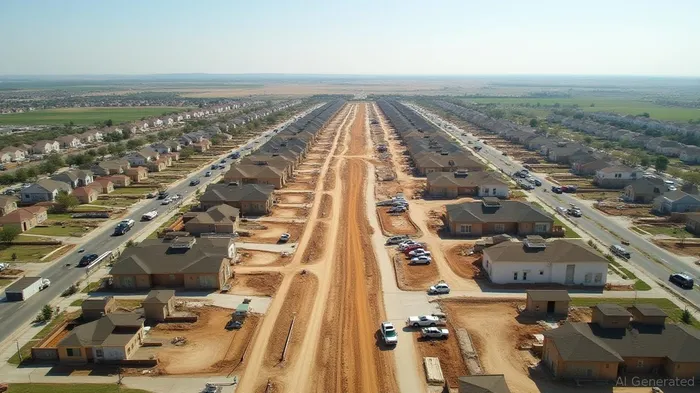
KB Home's inventory strategy has grown more aggressive, with total inventories rising 7% quarter-over-quarter to $5.94 billion and 13% year-over-year. This reflects a deliberate focus on securing land in growth markets like Texas and the Carolinas, where population trends and job creation are stronger. However, this approach carries risks.
While land investments—up 57% year-over-year to $920.3 million—position KB HomeKBH-- for a future recovery, they also expose the company to valuation risks if demand remains subdued. The 17% drop in net orders suggests buyers are not yet returning to pre-pandemic levels, raising concerns about overstocking. Analysts will scrutinize whether these land positions can be monetized profitably or if impairments may become necessary as the market resets.
Liquidity: A Shield, Not a Silver Bullet
KB Home's liquidity remains a relative bright spot, with $1.25 billion in total liquidity as of Q2 2025. Cash balances, however, fell 55% sequentially to $267.8 million, reflecting share repurchases and operational cash outflows. The company retains $650 million in remaining buyback capacity, signaling confidence in its stock's undervaluation.
Debt metrics, too, remain manageable: a debt-to-capital ratio of 30.5% leaves room for borrowing if needed. Yet, with interest rates at multi-decade highs, refinancing costs could rise, squeezing margins further. The company's reliance on land purchases—often financed through debt—adds another layer of financial risk if housing demand fails to rebound.
The Mortgage Rate Conundrum: A Sector-Wide Threat
The Federal Reserve's aggressive rate hikes since 2022 have reshaped the housing landscape. The 30-year fixed mortgage rate, now hovering around 6.5%, has priced many first-time buyers out of the market. For KB Home, which targets affordable housing, this is particularly problematic. Its average selling price rose 4% year-over-year to $500,700, but this may deter cost-conscious buyers.
The company's guidance for 2025—projecting a 9.4% operating margin and $6.60 billion in revenue—assumes a stabilization in demand. Yet with economists predicting a prolonged period of elevated rates, this optimism may be misplaced. Competitors like Lennar, which also reported sales declines, face similar challenges.
Investment Implications: Proceed with Caution
KB Home's Q2 results reveal a company navigating a treacherous path between growth and prudence. Investors must weigh its strong liquidity and strategic land positions against the risks of overexposure to a slowing market. Key considerations include:
- Demand Recovery Timing: If mortgage rates ease or stabilize, KB Home's inventory could prove advantageous. But with the Fed's “higher for longer” stance, this scenario remains uncertain.
- Margin Resilience: The company's ability to offset land costs through operational efficiencies will be critical. A further decline in gross margins below 20% could trigger downgrades.
- Peer Performance: Lennar's recent 4.4% revenue decline and KB Home's similar trajectory suggest the sector is in a prolonged slump. Investors may prefer to wait for clearer signals of stabilization.
Conclusion: A Test of Strategic Fortitude
KB Home's Q2 earnings miss is not an isolated misstep but a symptom of systemic challenges facing homebuilders. While its liquidity and land strategy offer some resilience, the company must navigate rising costs, stagnant demand, and macroeconomic uncertainty. For investors, KB Home presents a high-risk, high-reward proposition: its valuation (trading at 9.3x trailing EPS vs. a $65.83 analyst target) suggests optimism about a recovery, but the path to profitability remains fraught.
In this environment, investors seeking exposure to homebuilders should prioritize balance sheet strength and flexibility. KB Home's current position may offer value for long-term holders, but near-term volatility remains inevitable. As the housing market recalibrates, patience—and a close eye on mortgage rates—will be essential.

Stay ahead of the market.
Get curated U.S. market news, insights and key dates delivered to your inbox.




Comments
No comments yet