
KASPA Leverages BlockDAG Architecture to Scale Proof-of-Work Payments
 Aime Summary
- Kaspa employs a BlockDAG architecture and GHOSTDAG protocol to process 10 blocks per second with roadmap targeting 100+ throughput.
- The network operates with a 330.55 PHs hashrate, reflecting strong miner engagement and robust security for its proof-of-work consensus.
- Fair-launch tokenomics with a 28.7 billion cap and no premine position Kaspa as a community-managed digital cash settlement layer.
- Expanding programmability via Kasplex layer-2s and covenant scripts supports a growing decentralized application ecosystem.
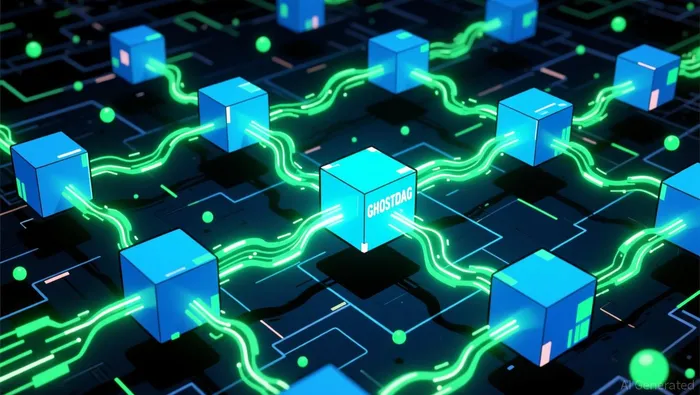
Kaspa is establishing itself as a high-throughput settlement layer for everyday transactions by combining the security of proof-of-work with unprecedented scalability. The network utilizes a BlockDAG (Directed Acyclic Graph) architecture to create and confirm multiple blocks in parallel every 0.1 seconds . This structure is governed by the GHOSTDAG consensus protocol, which orders these parallel blocks to eliminate orphaning and maintain network integrity . The design aims to solve the blockchain trilemma by balancing security and decentralization with the speed required for internet-age payments .
The network currently processes 10 blocks per second and has a clear roadmap to reach 100 blocks per second . By positioning itself as a fast proof-of-work network, Kaspa seeks to serve as a global sequencer for both traditional and decentralized finance markets . This approach differentiates it from slower legacy chains while maintaining the hard money principles associated with BitcoinBTC-- . The goal is to provide a digital medium of exchange where confirmation times are limited primarily by internet latency rather than network bottlenecks .
How Does the BlockDAG Architecture Improve Throughput?
Traditional blockchains often face limitations where only one block can be added to the chain at a time, leading to delays and orphaned blocks during periods of high activity. Kaspa addresses this by allowing multiple blocks to be created simultaneously . The GHOSTDAG protocol ensures that these parallel blocks are securely ordered without compromising the chain's consistency . This innovation allows the network to achieve sub-second transaction finality, a critical feature for everyday commercial payments .
The architecture also supports advanced scalability features such as block data pruning and subnetwork support . These technical upgrades facilitate easier integration of layer-2 solutions, which can further offload transaction processing from the base layer . Subprotocols like Reachability enable efficient DAG topology queries, enhancing the network's ability to manage complex data structures . By eliminating orphaned blocks, the network ensures that all valid work contributes to the security of the system .
What Are the Security and Tokenomics Implications for Investors?
Kaspa was fair-launched in November 2021 with no premine, presale, or coin allocations . All 28.7 billion KAS tokens are distributed through open mining, ensuring a decentralized and community-managed network . This fair-launch model is designed to attract miners who value equal access and long-term security . The network's security is directly tied to its hashrate, which currently stands at approximately 330.55 PHs .
Fluctuations in hashrate are driven by mining profitability, which depends on electricity costs, hardware efficiency, and market prices . An increase in hashrate typically signals growing miner confidence and capital injection into the ecosystem . Conversely, a decrease may indicate reduced profitability or operational challenges at major mining pools . The distribution of block rewards is proportional to a miner's contribution to the total hashrate, creating a competitive environment that drives efficiency . Understanding these dynamics is essential for assessing the long-term viability and security of the network .
How Is the Ecosystem Expanding Beyond Simple Payments?
While the base layer is optimized for fast payments, Kaspa is actively expanding its programmability through various upgrades . The Toccata hard fork introduced covenant-like scripts, which allow for more complex transaction logic and enhanced security features . These upgrades lay the groundwork for a broader decentralized application ecosystem . Layer-2 solutions like Kasplex enable Ethereum-compatible smart contracts, fostering the development of dApps .
The network also implements block header pruning and SPV proofs to improve scalability and accessibility . These technical improvements support the vision of a global sequencer that can handle the demands of both crypto and traditional finance . By integrating these features, Kaspa aims to prevent fragmented liquidity and provide a unified settlement layer . The ongoing development of subnetworks and layer-2 integrations suggests a future where Kaspa supports a wide range of financial applications .
The combination of high throughput, fair tokenomics, and expanding programmability positions Kaspa as a unique player in the digital asset space. Its focus on usability and security aligns with the growing demand for reliable proof-of-work networks . As the ecosystem matures, the network's ability to scale and support diverse applications will be key to its long-term success .

Blending traditional trading wisdom with cutting-edge cryptocurrency insights.
Latest Articles
Stay ahead of the market.
Get curated U.S. market news, insights and key dates delivered to your inbox.


AInvest
PRO
AInvest
PRO




Comments
No comments yet