
KASPA (KAS) Expands Ecosystem with Covenant Hardfork and Igra Network Launch
 Aime Summary
- Kaspa (KAS) is preparing for a May 5 hardfork that will enable smart contract capabilities and support for native assets on its proof-of-work blockchain, significantly expanding its utility beyond high-speed transaction processing according to reports.
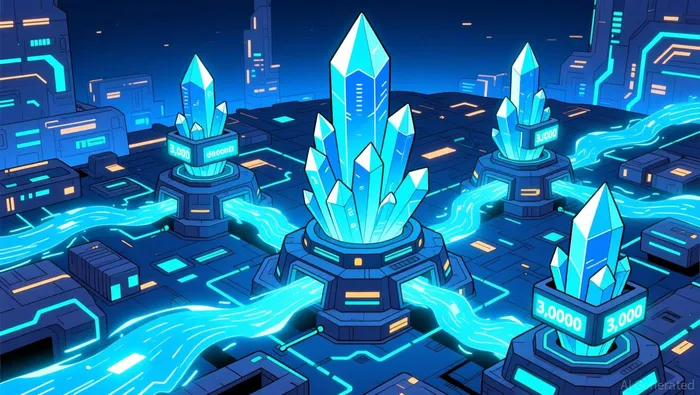
- The project has launched the Igra Network, an EVM-compatible layer designed to allow developers to build decentralized applications while leveraging Kaspa's infrastructure. This layer supports over 3,000 transactions per second and includes a full DeFi stack with lending protocols and DEXs as detailed.
- A recent stress testTST-- on Kaspa's live network processed 179 million transactions, demonstrating the system's high throughput and scalability under heavy load, a significant achievement compared to major competitors like BitcoinBTC-- and EthereumENS-- according to test results.
Kaspa's upcoming hardfork and ecosystem developments represent a pivotal step in the project's evolution. The May 5 Covenant Hardfork introduces smart contract functionality and native asset support, which will allow for more complex use cases such as DeFi and dApp development according to project documentation. This update is built on Kaspa's proof-of-work consensus mechanism, which has already demonstrated robust performance in terms of speed and capacity.
The Igra Network, an EVM-compatible layer, is one of the key components of this expansion. It allows developers to deploy decentralized applications without needing to build from scratch on Kaspa's native architecture. This compatibility with Ethereum Virtual Machine (EVM) standards is a strategic move to attract developers already familiar with Ethereum-based tools and workflows as reported. The network aims to handle over 3,000 transactions per second, a rate that would make it competitive with some of the more established layer-1 blockchains.
The recent stress test of Kaspa's live network underscored the platform's ability to handle massive transaction volumes without compromising stability or decentralization. The test processed 179 million transactions, a significant achievement that showcases the Directed Acyclic Graph (DAG) architecture's efficiency in managing high-frequency activity according to performance data. This performance is critical for potential enterprise applications involving AI agents and machine-to-machine payments, where speed and reliability are essential.
What are the implications of the May 5 hardfork for Kaspa's future roadmap?
The May 5 Covenant Hardfork is more than just a technical upgrade—it is a foundational step toward broader adoption of Kaspa as a platform for decentralized applications and financial services. By introducing smart contract functionality, Kaspa enables developers to create more sophisticated and user-friendly applications that go beyond simple value transfers according to project analysis. The hardfork also includes the release of SilverScript, a high-level programming language designed to complement vProgs by enabling local UTXO state validation without the need for shared global state or external VMs as described. This approach enhances security by reducing vulnerabilities such as reentrancy attacks.
The hardfork is part of a broader strategy to position Kaspa as a scalable and secure alternative to existing blockchains. The project's DAG architecture allows for parallel block validation, which contributes to its high throughput while maintaining decentralization according to technical specifications. This combination of speed, security, and scalability is a compelling value proposition for developers and enterprises looking to deploy blockchain-based solutions.
How does the Igra Network enhance Kaspa's ecosystem and investor appeal?
The Igra Network plays a crucial role in expanding Kaspa's ecosystem by providing a familiar development environment for Ethereum developers. The EVM compatibility allows for seamless porting of existing Ethereum-based applications to the Kaspa network, which can reduce development time and costs as noted. This compatibility also means that developers can leverage existing tools and frameworks that are already optimized for Ethereum-based development.
In addition to smart contract support, the Igra Network includes a full DeFi stack with lending protocols, decentralized exchanges (DEXs), and cross-chain bridges. These components are designed to provide users with a comprehensive set of financial tools that can be used within the Kaspa ecosystem according to platform details. The network also introduces a wrapped version of the native token, iKAS, which allows users to interact with decentralized applications while maintaining the underlying value of the KAS token.
The launch of the Igra Network is also supported by a partnership with a regulated US exchange via Kasplex, which has enabled direct deposits and withdrawals of $KAS. This partnership enhances accessibility for both institutional and retail investors, potentially increasing liquidity and adoption as reported. The improved accessibility is expected to attract more users to the Kaspa network, which could further drive demand for the KAS token.
What are the key risks and limitations to consider with Kaspa's current developments?
Despite the promising developments, there are several risks and limitations that investors should be aware of. One of the key challenges is the long-term price appreciation of the KAS token. While Kaspa has seen a recent price increase, reaching significant price targets such as $0.30 will require substantial growth over multiple cycles according to market analysis. This means that the token may not provide immediate returns and could be subject to prolonged periods of consolidation.
Another potential risk is the complexity of the project's technical roadmap. The May 5 hardfork and the launch of the Igra Network are major milestones, but they also introduce new technical challenges that could affect the stability of the network. For example, the introduction of smart contract functionality and EVM compatibility may require ongoing maintenance and updates to ensure that the network remains secure and efficient as documented.
Finally, regulatory uncertainty remains a potential risk for Kaspa and other cryptocurrencies. While Kaspa has seen evolving regulatory sentiment that increasingly classifies it as a digital commodity, this classification may change over time depending on regulatory developments in different jurisdictions according to regulatory analysis. This uncertainty could affect the project's adoption and investor confidence, particularly if regulatory requirements become more stringent.

Blending traditional trading wisdom with cutting-edge cryptocurrency insights.
Latest Articles
Stay ahead of the market.
Get curated U.S. market news, insights and key dates delivered to your inbox.


AInvest
PRO
AInvest
PRO



Comments
No comments yet