
Kaspa Falls Amid Bearish Technical Patterns and Market Downtrend
 Aime Summary
- Kaspa (KAS) has fallen significantly, currently trading at $0.0325, below key moving averages and resistance levels according to market analysis.
- Technical indicators such as RSI, MACD, and ADXADX-- highlight strong bearish momentum, with the RSI indicating oversold conditions at 20.65.
- Broader market conditions, including geopolitical tensions and potential Federal Reserve leadership changes, have exacerbated crypto market declines.
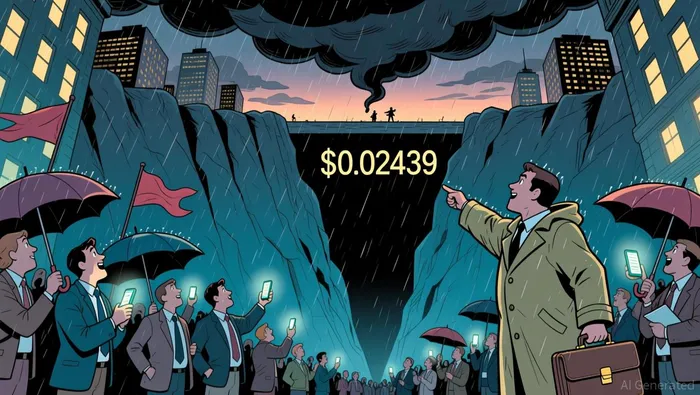
Kaspa’s recent performance has been marked by a sharp decline, with the price closing near $0.3000 and continuing to fall after a 22% loss last week. This downward movementMOVE-- is supported by a descending wedge pattern on the daily logarithmic chart, with the price approaching a critical support trendline near $0.02439.
The broader cryptocurrency market has experienced a significant downturn, driven in part by the Fear and Greed Index hitting an extreme fear level of 15. This has led to increased selling pressure and reduced leverage usage. The ongoing decline in crypto markets is further compounded by the nomination of Kevin Warsh as the next Federal Reserve Chair, a move that has raised concerns among investors.
Technical analysis of Kaspa shows a continued bearish alignment, with the price significantly below the MA-20, MA-50, and MA-200. The nearest resistance is at the Ichimoku Kijun level of $0.0410, with no nearby support from the same indicator. Oscillators and momentum indicators confirm entrenched bearish sentiment, and despite oversold conditions, buyer dominance has not emerged.
What Is Driving Kaspa’s Current Decline?
Kaspa is experiencing increased selling pressure from miners, who must frequently sell newly emitted tokens to cover operational costs. This continuous creation of new KAS tokens has created a steady flow of sell pressure, exacerbating the downward trend. Additionally, Kaspa’s price is in a bearish phase, with most technical indicators predicting further declines. The RSI at 32.81 and key support levels at $0.037796, $0.036638, and $0.035348 are crucial in determining the asset's next move.
What Is the Market Sentiment and Investor Outlook?
The broader market sentiment is extremely bearish, with the Fear & Greed Index at 'Extreme Fear' level 20. This has led to increased selling pressure, with 25 out of 27 technical indicators predicting a decline. The market is also experiencing high volatility, with Kaspa expected to fall to $0.029398 by February 5, 2026, a potential -23.13% drop. The current price environment reflects sellers retaining control, with a narrow expected trading range for the coming week ($0.0315 to $0.0355) and a low probability of a significant upward reversal.
What Are the Broader Market Conditions Affecting Kaspa?
The broader crypto market crash is driven by the Fear and Greed Index hitting an extreme fear level of 15, combined with geopolitical tensions and potential changes in U.S. Federal Reserve leadership. This has led to increased selling pressure and reduced leverage usage. The ongoing crash reflects investor capitulation, with spot BitcoinBTC-- and EthereumETH-- ETFs shedding assets in January. Data shows that the 24-hour liquidations stood at over $735 million, while the open interest dropped by 5% to over $108 billion.
Bitcoin’s hashrate has also dropped by ~40% from its all-time high, signaling significant miner capitulation. This is a rare event since 2021 and could indicate a potential bottom in miner sentiment. The broader market dynamics and regulatory uncertainties are also weighing on investor confidence, with no visible support levels to reverse the current downtrend.
Overall, Kaspa’s performance is a reflection of the broader market conditions and technical indicators, with the asset showing no signs of immediate recovery. Investors should remain cautious as the market continues to experience high volatility and bearish momentum.

Blending traditional trading wisdom with cutting-edge cryptocurrency insights.
Latest Articles
Stay ahead of the market.
Get curated U.S. market news, insights and key dates delivered to your inbox.


AInvest
PRO
AInvest
PRO



Comments
No comments yet