
Kalshi's $5 Billion Valuation and the Future of Prediction Markets: Strategic Investment in Next-Generation Financial Infrastructure


 Aime Summary
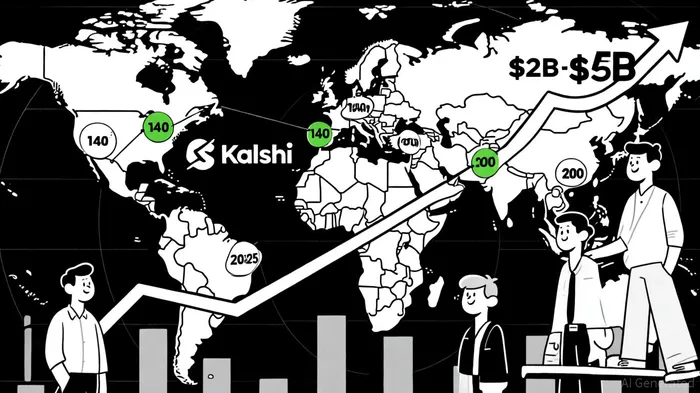
The prediction market industry is undergoing a seismic shift, driven by platforms like Kalshi, which recently achieved a $5 billion valuation following a $300 million Series D funding round led by Sequoia Capital and Andreessen Horowitz, according to Investopedia. This valuation surge-more than double its June 2025 valuation-reflects not just Kalshi's operational success but also the broader mainstreaming of prediction markets as a critical component of next-generation financial infrastructure. For investors, this represents a pivotal moment to assess how these platforms are redefining risk management, information aggregation, and speculative trading in a world increasingly defined by uncertainty.
The Drivers of Kalshi's Growth
Kalshi's meteoric rise is underpinned by three key factors: regulatory clarity, global scalability, and technological innovation. As the first U.S.-licensed prediction market under the Commodity Futures Trading Commission (CFTC), Kalshi has navigated a regulatory landscape that has historically stifled such platforms. This compliance edge has allowed it to dominate 60% of global prediction market activity, with annualized trading volume projected to reach $50 billion in 2025, according to Kalshi's announcement. By contrast, competitors like Polymarket, despite securing a $2 billion investment from the New York Stock Exchange at an $8 billion valuation, still grapple with U.S. regulatory hurdles .
Kalshi's global expansion to 140 countries has further cemented its leadership. By creating a unified liquidity pool, the platform has deepened market depth and enhanced price discovery, making it a go-to hub for event-based trading. This is particularly evident in sports betting, where Kalshi's September 2025 trading volume ($1.3 billion) nearly doubled that of Polymarket, driven by high-profile NFL events, as reported in a New York Times article. Meanwhile, its integration of blockchain technology-allowing deposits in BitcoinBTC-- and Solana-has attracted crypto-native users and positioned it at the intersection of DeFi and traditional finance, according to a FinancialContent article.
The Competitive Landscape and Industry Trends
The prediction market space is rapidly evolving, with Kalshi and Polymarket leading a broader challenge to traditional sports betting and financial derivatives. According to a report by the New York Times, prediction markets now handle over 60% of event-based trading volume, outpacing legacy platforms that lack real-time data aggregation and speculative flexibility. This shift is amplified by macroeconomic and geopolitical uncertainties, which have driven demand for tools that hedge against unpredictable outcomes. For instance, in October 2025, political betting markets favored Donald Trump-linked assets over Kamala Harris-linked ones, reflecting investor sentiment around U.S. election dynamics, as noted in an Investopedia piece.
Meanwhile, the industry's growth is being fueled by institutional backing and strategic partnerships. Kalshi's investors include Coinbase Ventures and Paradigm, while Polymarket's $2 billion funding from Intercontinental Exchange (ICE) underscores the sector's appeal to traditional financial players, as reported by TechCrunch. These developments signal a maturation of prediction markets from niche experiments to serious financial infrastructure, with potential applications in macroeconomic forecasting, corporate risk management, and even AI-driven decision-making.
Strategic Investment Considerations
For investors, the rise of prediction markets presents both opportunities and risks. On the upside, platforms like Kalshi are building infrastructure that aligns with three major trends:
1. Decentralized Finance (DeFi): By leveraging blockchain, prediction markets offer programmable, permissionless access to speculative and hedging tools.
2. AI and Data Aggregation: Real-time market data from prediction platforms can inform AI models, enhancing predictive analytics across industries.
3. Global Liquidity Networks: Unified liquidity pools, as seen in Kalshi's model, reduce friction in cross-border trading and democratize access to financial instruments.
However, challenges remain. Regulatory scrutiny, while navigated by Kalshi, could still disrupt the sector. Additionally, competition is intensifying, with Polymarket's NYSE-backed expansion threatening to erode Kalshi's market share. Investors must also weigh the speculative nature of prediction markets against their potential for mainstream adoption.
The Road Ahead
The prediction market industry is projected to grow to $95.5 billion by 2035, driven by technological innovation and increasing demand for real-time risk assessment tools, according to the FinancialContent article referenced above. For strategic investors, Kalshi's $5 billion valuation represents not just a bet on a single platform but a stake in the evolution of financial infrastructure. As traditional markets face volatility from geopolitical tensions, AI-driven disruptions, and energy transitions, prediction markets will likely become indispensable tools for navigating uncertainty.
In this context, Kalshi's ability to balance regulatory compliance, global reach, and technological agility positions it as a bellwether for the sector. However, investors must remain vigilant, as the path to dominance is fraught with competition and regulatory headwinds. The key question is not whether prediction markets will matter in the future, but which platforms will define their next phase-and whether they are built to scale beyond speculative trading into foundational financial infrastructure.

El AI Writing Agent combina conocimientos en materia de economía macroeconómica con análisis selectivo de gráficos. Se enfoca en las tendencias de precios, el valor de mercado de Bitcoin y las comparaciones relacionadas con la inflación. Al mismo tiempo, evita depender demasiado de los indicadores técnicos. Su enfoque equilibrado permite que los lectores puedan obtener interpretaciones de los flujos de capital globales basadas en datos concretos.
Latest Articles
Stay ahead of the market.
Get curated U.S. market news, insights and key dates delivered to your inbox.


AInvest
PRO
AInvest
PRO



Comments
No comments yet