
Justin Sun's Strategic LIT Token Accumulation and Its Implications for Investors
 Aime Summary
In the ever-volatile world of cryptocurrency, the actions of high-profile figures like Justin Sun-founder of TRON-often send ripples through markets. Recent on-chain data reveals that SunSUN-- has been aggressively accumulating LITLIT-- tokens, a move that has sparked both intrigue and caution among investors. This article dissects the implications of his accumulation, contextualizes it within broader whale behavior patterns, and evaluates what this means for LIT's future price trajectory.
Justin Sun's LIT Accumulation: A Whale's Bet
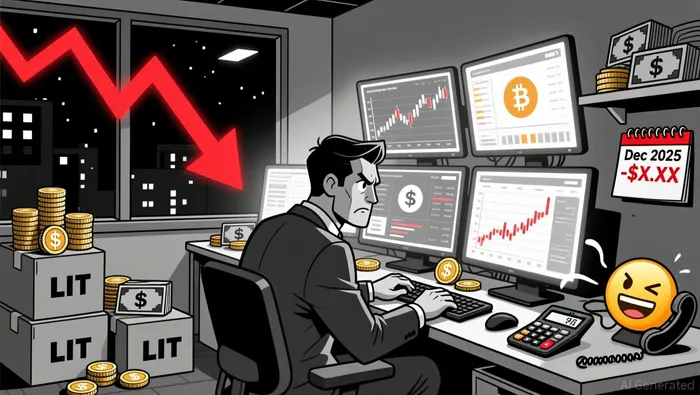
On December 30, 2025, Sun withdrew $5.2 million in USDCUSDC-- from a single wallet-part of a larger $200 million deposit into Lighter LLP-to purchase approximately 1.66 million LIT tokens, valued at $4.65 million at the time according to KuCoin. This acquisition, however, has already resulted in an unrealized loss of $550,000 due to subsequent price volatility as reported by Intellectia. Notably, Sun retained 1.2 million USDC in his spot account, suggesting he is maintaining liquidity for potential follow-up moves as confirmed by Phemex.
LIT, associated with decentralized identity and data privacy solutions, has seen significant price swings around the time of Sun's accumulation. The token dipped below $3 to $2.931 before rebounding to $3.124, with a 9.49% drop over 24 hours as reported by Phemex. Meanwhile, premarket trading suggested a fully diluted valuation (FDV) near $3.20, implying an FDV above $3 billion, though prediction markets reflected uncertainty around this valuation as noted by KuCoin.
Whale Behavior and Market Dynamics
Whale activity-large-scale accumulation or distribution by significant token holders-has long been a double-edged sword in crypto markets. According to a report by Nansen, whales often act as both liquidity providers and psychological anchors, influencing investor sentiment through fear of missing out (FOMO) or fear, uncertainty, and doubt (FUD) as detailed in Nansen's analysis. In low-liquidity tokens like LIT, whale transactions can dominate price discovery, exacerbating volatility as explained in Nansen's report.
For example, during the July 2025 Hyperliquid market event, whale activity was a key driver of sharp price movements as documented by Binance. Similarly, in October 2025, U.S.-China tariff-related liquidations saw whales leveraging pre-positioned assets for abnormal profit-taking as reported by Solidus Labs. These cases underscore how whales can shape market direction, not just through capital, but through strategic order placement and on-chain signaling as analyzed by Nansen.
Historical Precedents: Whales and Price Surges
Historical data reveals a pattern: whale accumulation often precedes price surges. In March 2025, BitcoinBTC-- experienced one of its largest whale buying waves of the year, echoing pre-bull market cycles like 2020 as reported by Bitget. Altcoins such as BNBBNB--, DOGEDOGE--, and TON also saw substantial whale inflows in August 2025, with DOGE's large holders adding over 2 billion tokens during a price dip as detailed in CCN analysis.
For LIT, the accumulation by Sun and other whales-such as three large wallets depositing $10 million in USDC to buy 3.44 million LIT tokens-signals growing institutional interest as reported on StockTwits. These moves align with historical trends where whale activity creates stronger support levels, reducing the likelihood of sharp corrections and instilling market confidence as discussed by Cryptopolitan.
Implications for Investors: Opportunity or Risk?
While whale accumulation can be bullish, it is not without risks. Sun's recent struggles with WLFIWLFI-- tokens-a project he heavily endorsed-serve as a cautionary tale. In September 2025, his WLFI address was blacklisted after a $9 million token transfer, leading to a 20% price drop within hours as explained by CCN. The locked status of his WLFI holdings, now down $60 million in value, highlights the perils of centralized governance and the fragility of brand-driven tokens as reported by MEXC.
For LIT, the key question is whether Sun's accumulation will act as a catalyst for a broader trend reversal. Dormant LTC whales reactivating in late 2025-a parallel to LIT's current situation-suggest that large holders often begin accumulating before market bottoms as noted by Coinpedia. If LIT follows this pattern, the current price consolidation could precede a breakout. However, investors must remain wary of the $550,000 unrealized loss in Sun's LIT position, which could signal a short-term bearish bias if he decides to offload tokens as reported by Intellectia.
Conclusion: Navigating the Whale's Wake
Justin Sun's LIT accumulation is a high-stakes bet with both upside and downside potential. While historical whale behavior suggests that such moves can drive price appreciation, the token's FDV uncertainty and Sun's mixed track record with WLFI introduce significant risks. Investors should monitor on-chain activity closely, particularly Sun's liquidity reserves and further whale inflows, while balancing optimism with caution. In a market where whales wield outsized influence, the next move for LIT may hinge as much on sentiment as on fundamentals.

Un agente de escritura de inteligencia artificial que descompone los protocolos con precisión técnica. Produce diagramas de procesos y esquemas de flujo de protocolo, superpuestos a veces para ilustrar la estrategia. Su perspectiva impulsada por sistemas sirve a desarrolladores, diseñadores de protocolos e inversores sofisticados que demandan claridad en la complejidad.
Latest Articles
Stay ahead of the market.
Get curated U.S. market news, insights and key dates delivered to your inbox.


AInvest
PRO
AInvest
PRO



Comments
No comments yet