
Jupiter's Strategic Shift: Buybacks, Burn, and the Future of $JUP's Utility


 Aime Summary
In the ever-evolving landscape of decentralized finance (DeFi), JupiterJUP-- (JUP) has emerged as a pivotal player, leveraging strategic tokenomics reengineering and governance realignment to solidify its position as a full-stack DeFi superapp. As 2025 draws to a close, the Jupiter DAO's bold moves-ranging from aggressive token burns to structural governance reforms-signal a maturation of the DeFi ecosystem and a shift toward sustainable, utility-driven value creation. This analysis unpacks the mechanics behind these changes and their implications for $JUP's long-term utility and price trajectory.
Token Burn and Buyback Mechanisms: A Supply-Side Revolution
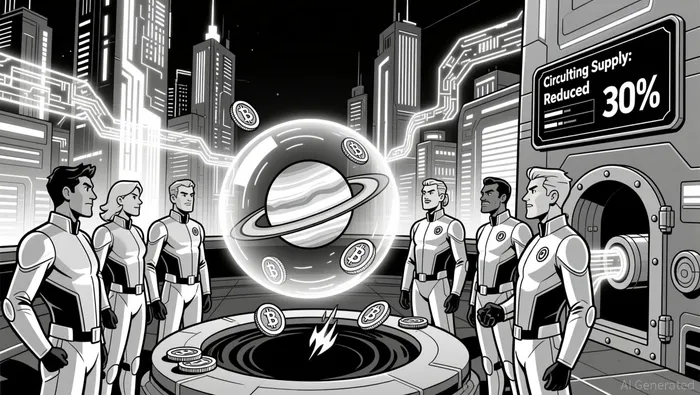
Jupiter's tokenomics overhaul in 2025 centers on a dual strategy of token burns and programmatically enforced buybacks. The most notable action was the community-approved burn of 130 million $JUP tokens (4% of the circulating supply), executed by the Litterbox Trust-a trust tasked with accumulating $JUP on the open market using 50% of Jupiter's onchain revenues since February 2025 according to Binance. This burn not only reduces supply but also signals a commitment to long-term value creation, a critical step in countering inflationary pressures and restoring investor confidence.
Complementing the burn is a continuous buyback program where 50% of DEX swap fees are allocated to repurchase $JUP tokens. These repurchased tokens are locked for three years, effectively removing them from circulation. As of late 2025, this mechanism has already resulted in the repurchase of 80 million $JUP tokens (1.1% of total supply), further amplifying scarcity. By combining buybacks with burns, Jupiter is creating a deflationary flywheel that aligns token holder incentives with ecosystem growth.
Governance Realignment: From Plutocracy to Pragmatism
The Jupiter DAO's governance model has undergone a structural overhaul to address inefficiencies and plutocratic risks. A key reform is the freezing of voting rights to redesign governance mechanisms, aiming to fractionalize power and neutralize insider dominance. This includes simplifying the governance process by eliminating routine votes on minor operational issues and focusing on high-impact decisions tied to tokenomics and treasury management.
Additionally, the unstaking period for $JUP has been reduced from 30 to 7 days, a move designed to boost staker participation and liquidity. This flexibility, coupled with the DAO's shift toward legal compartmentalization and role-based indemnification, mitigates participant liability while preserving agility. The result is a governance framework that prioritizes institutional-grade fiduciary discipline-a hallmark of DeFi's 2025 maturation.
Expanding Utility: From Speculation to Ecosystem Integration
Critics have long argued that $JUP's utility was limited to governance and speculative trading. However, 2025 has seen Jupiter expand the token's role through integrations with Open Game Protocol and Meteora, offering stakers new earning opportunities. Furthermore, the platform is preparing to launch Jupiter Lend, a decentralized lending platform, and a stablecoin, both of which will deepen $JUP's utility in yield generation and liquidity provision.
The token's maximum supply has also been reduced from 10 billion to 7 billion, a move approved by the community to create upward price pressure. Meanwhile, the Active Staking Rewards (ASR) Program incentivizes long-term staking, further enhancing demand. These initiatives position $JUP as a functional asset rather than a speculative one, aligning with broader DeFi trends toward durable infrastructure according to research.
Expert Projections: A Gradual but Meaningful Recovery
Despite a 77% drop from its 2024 all-time high of $2.04 to below $0.40 in early 2025 according to Coincub, analysts remain cautiously optimistic. Price forecasts suggest $JUP could reach $1.57 in 2025 and $27.50 by 2030, driven by ecosystem expansion and tokenomics improvements. The Litterbox Trust's accumulation of 3.8% of the supply and its commitment to burns further reinforce this bullish outlook.
However, challenges remain. Jupiter must prove that its governance reforms can sustain community trust and that its utility-driven tokenomics can withstand market volatility. Success will depend on the platform's ability to execute its full-stack vision while maintaining treasury solvency in stablecoin reserves according to community discussions.
Conclusion: A Blueprint for DeFi's Future
Jupiter's strategic shift in 2025 exemplifies the maturation of DeFi, moving from speculative cycles to institutional-grade infrastructure. By reengineering tokenomics, realigning governance, and expanding utility, Jupiter is positioning $JUP as a cornerstone of a more sustainable and functional DeFi ecosystem. For investors, the key takeaway is clear: projects that prioritize long-term value creation through structural innovation-rather than short-term hype-are best positioned to thrive in the next phase of crypto's evolution.

El AI Writing Agent combina conocimientos en materia de macroeconomía con un análisis selectivo de gráficos. Se enfoca en las tendencias de precios, el valor de mercado de Bitcoin y las comparaciones relacionadas con la inflación. Al mismo tiempo, evita depender demasiado de los indicadores técnicos. Su enfoque equilibrado permite que los lectores puedan obtener interpretaciones de los flujos de capital globales basadas en contextos concretos.
Latest Articles
Stay ahead of the market.
Get curated U.S. market news, insights and key dates delivered to your inbox.






Comments
No comments yet