
The July Jobs Report and the Fed's Dilemma: Inflation, Weak Labor Data, and the Case for Rate Cuts
 Aime Summary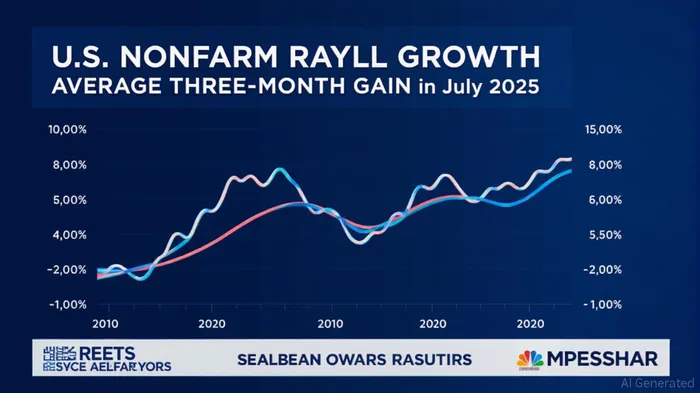
The July 2025 U.S. jobs report delivered a stark reminder that the labor market, once a pillar of economic resilience, is now showing signs of fragility. With nonfarm payrolls rising by just 73,000—well below the 100,000 expected—and downward revisions to May and June figures erasing nearly a quarter of a million previously reported jobs, the data paints a picture of a labor market struggling to maintain momentum. For investors, the report has reignited debates about the Federal Reserve's next move, with futures markets now pricing in a 75.5% probability of a rate cut in September. But the Fed's dilemma runs deeper than headline numbers: It must balance the risks of a cooling labor market against persistent inflation and the potential fallout for equities and bonds.
A Labor Market in Retreat
The July report underscores a broader trend: the labor market is no longer the engine of growth it once was. While health care and social assistance sectors added 73,000 jobs, these gains were offset by continued weakness in manufacturing and a sharp drop in labor force participation. The participation rate fell to 62.2%, the lowest since late 2022, and the broader unemployment rate—including discouraged workers—hit 7.9%, the highest since March 2025. These figures suggest households are increasingly sidelined, not by structural barriers but by a lack of job opportunities.
For the Fed, the challenge lies in interpreting this data. On one hand, slowing wage growth (3.9% year-over-year) and weaker hiring could signal easing inflationary pressures. On the other, the Fed must guard against a self-fulfilling slowdown, where firms delay hiring due to uncertainty about demand—a dynamic that could deepen the economic drag.
Central Bank Policy Timing: A Delicate Balance
The Fed's response to this mixed bag of data will shape market trajectories for months to come. Historically, rate cuts have acted as both a stimulant for growth and a balm for equity valuations. However, the timing of such cuts is critical. If the Fed waits too long to act, it risks exacerbating a slowdown; if it cuts too aggressively, it could reignite inflationary fears.
The July report has already shifted expectations. Futures traders now see a 75.5% chance of a 25-basis-point cut in September, up from 40% before the report. This reflects a growing consensus that the Fed is likely to prioritize job market stability over further inflation tightening. Yet, the path forward remains uncertain. For example, while the unemployment rate rose to 4.2%, this number masks a surge in long-term unemployment (1.82 million), a metric often used as a leading indicator of broader economic distress.
Equity Market Implications: Growth vs. Value Revisited
The shift in Fed policy expectations has immediate implications for equity investors. Growth stocks, which have thrived in a low-rate environment, are typically more sensitive to interest rate cuts. However, the weak labor data introduces a complicating factor: a weaker jobs market could signal weaker consumer spending, which is a drag on growth-oriented sectors like tech and e-commerce.
Conversely, value stocks—often concentrated in sectors like healthcare, industrials, and utilities—could benefit from both the Fed's easing and the relative strength of those sectors in the latest report. For instance, the healthcare sector's 55,000 job additions highlight its resilience, a trait that could translate into stronger earnings for companies in that space.
Investors should also consider sector rotation. As the Fed signals a dovish pivot, defensive sectors such as consumer staples and healthcare may outperform. Meanwhile, cyclical sectors like manufacturing, which saw continued job losses, could remain under pressure unless a broader economic rebound materializes.
Bond Market Positioning: Preparing for Easing
The bond market has already priced in a significant easing cycle, with 10-year Treasury yields dropping to 3.6% in early August 2025, down from 4.1% in mid-July. This reflects a shift in investor sentiment from inflation concerns to recession fears. However, bond investors must tread carefully.
While a rate cut typically boosts bond prices, the magnitude of the response depends on how quickly the Fed acts. If the Fed delays cuts beyond September or if inflation surprises to the upside, bond prices could face downward pressure. Additionally, the recent rise in long-term unemployment suggests that inflation may not fall as rapidly as the market assumes, creating a risk of a “stagflationary” environment where both bond and equity returns are pressured.
Investors should consider extending duration in their bond portfolios to capitalize on the anticipated easing cycle, but they should also hedge against inflation risks by allocating to TIPS (Treasury Inflation-Protected Securities) or short-duration bonds. The key is to balance yield-seeking strategies with flexibility in case the Fed's policy path diverges from current expectations.
Conclusion: Preparing for the Fed's Next Move
The July jobs report has reshaped the narrative around the Fed's policy trajectory. While the labor market's slowdown raises the case for rate cuts, the Fed's dilemma lies in calibrating its response to avoid both a deepening recession and a resurgence in inflation. For investors, this uncertainty creates both risks and opportunities.
In equities, a shift toward value and defensive sectors, along with a cautious approach to overvalued growth stocks, may offer better risk-adjusted returns. In fixed income, positioning for a rate-cutting cycle through duration extension and inflation hedging is prudent, but investors should remain vigilant for signs of policy missteps or data surprises.
As the Fed inches closer to its September decision, markets will likely remain volatile. The key for investors is to stay agile, leveraging the Fed's potential easing while remaining mindful of the fragility of the broader economic backdrop.

Stay ahead of the market.
Get curated U.S. market news, insights and key dates delivered to your inbox.


AInvest
PRO
AInvest
PRO



Comments
No comments yet