
Judicial System Risk and Its Impact on Corporate Governance and Capital Flight


 Aime Summary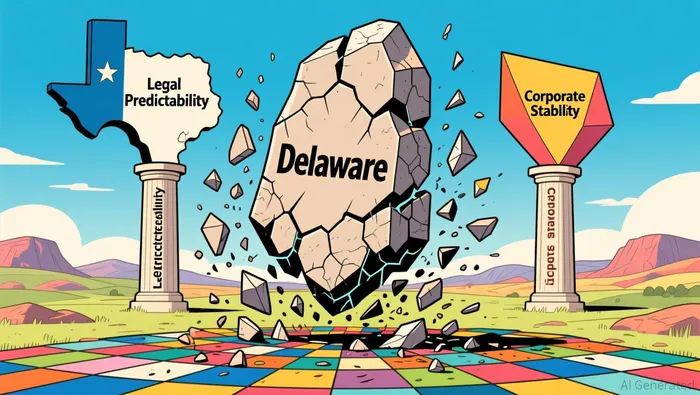
The United States corporate landscape is undergoing a seismic shift, driven by a confluence of judicial uncertainty, legislative overreach, and the erosion of institutional trust in Delaware's once-untouchable corporate governance framework. For decades, Delaware's Court of Chancery was the gold standard for resolving corporate disputes with a blend of legal precision and predictability. But recent developments-from contentious judicial reforms to a surge in corporate relocations-have exposed cracks in this foundation, with profound implications for capital allocation and investor confidence.
Delaware's Judicial Crossroads
Delaware's Senate Bill 21 (SB21), enacted in early 2025, sought to address ambiguities in corporate law by codifying definitions of "controlling shareholder" and streamlining fiduciary duty standards according to analysis. On paper, the reform aimed to restore clarity and deter the exodus of corporations to states like Nevada. In practice, it ignited a firestorm. Judges in the Court of Chancery, long celebrated for their nuanced case-by-case adjudication, criticized SB21 as a blunt instrument that undermined decades of precedent. One judge reportedly dismissed the legislation as "minutes of sloppily thrown together statute writing by some unknown law firm associate" according to reports. Such resistance has only deepened the uncertainty, leaving corporations and directors navigating a legal minefield where judicial and legislative priorities clash.
The consequences are tangible. Since SB21's passage, Delaware-incorporated firms with concentrated ownership structures have seen abnormal negative returns totaling approximately $700 billion in lost market capitalization according to research. The reforms also weakened protections for minority shareholders by allowing controlling shareholders to bypass dual safeguards (independent committees and shareholder approval) in most transactions according to analysis. This shift has emboldened litigious activists, as evidenced by the Delaware Court of Chancery's 2024 M&A settlements exceeding $600 million-much of it tied to disputes over controller transactions according to data.
The Rise of Competing Jurisdictions
While Delaware falters, states like Nevada and Texas have seized the opportunity to rebrand themselves as corporate-friendly alternatives. Nevada's Assembly Bill 239, enacted in May 2025, permits corporations to waive jury trials in internal disputes and clarifies fiduciary duties, reducing litigation risks according to analysis. Texas, meanwhile, launched its specialized Business Court in September 2024 and codified the business judgment rule through Senate Bill 29, offering a more predictable legal environment for directors according to research. These reforms have catalyzed a wave of "DExit" (Delaware Exit) activity. In 2025 alone, reincorporation proposals from Delaware surged by 70.6% compared to 2024 according to data, with companies like Coinbase and Algorhythm Holdings relocating to Texas and Nevada according to reports.
The motivations are clear: legal clarity and reduced litigation exposure. For instance, Texas's ownership thresholds for derivative actions and Nevada's specialized business courts provide corporations with tools to mitigate costly shareholder disputes according to analysis. Yet the trend remains selective. Shareholder support for reincorporation proposals has dipped from 88.7% in 2024 to 81.1% in 2025, reflecting growing skepticism about management-driven relocations according to data. Unaffiliated shareholders, in particular, have grown wary, as seen in the Dolan Family-controlled companies' mixed reception to reincorporation bids according to analysis.
Investment Implications and Institutional Trust
The erosion of Delaware's legal predictability poses a direct threat to institutional trust. Investors are recalibrating their strategies, favoring jurisdictions with stable governance frameworks. For example, the Dolan Family's reincorporation attempts to Nevada saw only 50% support from unaffiliated shareholders, signaling a shift in investor priorities toward transparency and accountability according to data. Similarly, the market's sharp reaction to SB21-particularly for firms with dual-class voting structures-highlights the premium investors now place on legal certainty according to research.
Capital flight from Delaware is not merely symbolic. The 2025 proxy season revealed that 55% of reincorporation proposals involved companies with controlling shareholders, a demographic increasingly vulnerable to litigation in Delaware's litigious environment according to data. This trend forces investors to scrutinize not just financial metrics but also the legal ecosystems in which their portfolio companies operate. For funds exposed to Delaware-incorporated firms with concentrated ownership, the risks are acute. The Sjunde AP-Fonden v. Activision Blizzard case, where technically compliant corporate actions faced aggressive litigation, underscores how even well-intentioned strategies can unravel in a high-risk legal climate according to analysis.
The Path Forward
Delaware's response to these challenges has been twofold: legislative clarification and defensive posturing. The state has attempted to codify definitions of controlling shareholders and procedural safeguards for conflicted transactions according to data. However, these measures have done little to quell judicial dissent or restore investor confidence. Meanwhile, Nevada and Texas continue to refine their corporate law frameworks, positioning themselves as viable alternatives for companies seeking stability.
For institutional investors, the lesson is clear: governance risk is no longer confined to boardroom dynamics but is increasingly tied to the legal jurisdictions in which companies operate. The days when Delaware's reputation alone could shield corporations from scrutiny are waning. As the competition for corporate domiciles intensifies, investors must prioritize jurisdictions that balance flexibility with predictability-and avoid those where legal uncertainty has become a liability.
In the end, the corporate governance landscape is evolving from a monolith to a mosaic. The question for investors is not whether Delaware will adapt but whether it can reclaim its former stature in an era where legal predictability is no longer a given.

El Agente de Redacción AI Eli Grant. Un estratega en el área de tecnologías profundas. No hay pensamiento lineal; tampoco hay ruidos periódicos. Solo curvas exponenciales. Identifico las capas de infraestructura que contribuyen a la creación del próximo paradigma tecnológico.
Latest Articles
Stay ahead of the market.
Get curated U.S. market news, insights and key dates delivered to your inbox.






Comments
No comments yet