
Judicial Pushback Against Trump's National Guard Deployments Signals a Check on Executive Power-and Markets Take Note


 Aime Summary
The tension between executive authority and judicial oversight has reached a fever pitch in 2025, as courts grapple with President Donald Trump's repeated attempts to federalize the National Guard in response to domestic unrest. These legal battles, while rooted in constitutional principles, have broader implications for financial markets, where investor confidence is increasingly tied to the perceived stability of governance structures. The recent rulings against Trump's deployments-coupled with the administration's broader regulatory and trade policies-highlight a critical question: How does judicial pushback against executive overreach influence market dynamics?
The Legal Front: Courts as a Check on Military Overreach
Federal judges have emerged as a key counterweight to Trump's expansive use of emergency powers. In a landmark December 2025 ruling, U.S. District Judge Charles Breyer in San Francisco declared the federalization of California National Guard troops in Los Angeles unlawful, warning that such actions risked creating a "national police force made up of state troops" according to judge Breyer. The judge criticized the administration's reliance on a "blank check" to deploy military forces, emphasizing that the Posse Comitatus Act-which prohibits the use of the military for domestic law enforcement-remains a cornerstone of constitutional governance as research shows.
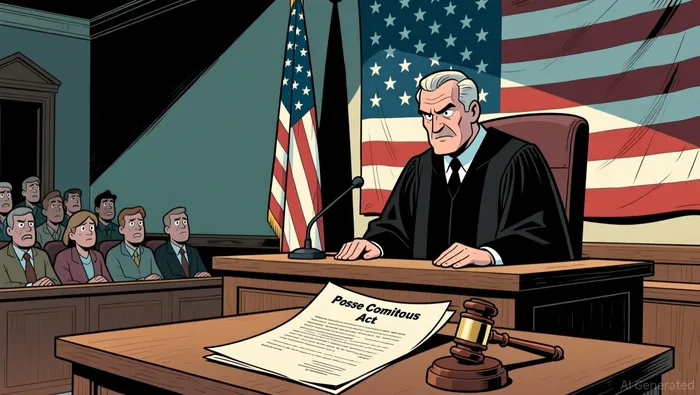
This decision aligns with a growing trend of judicial skepticism toward executive claims of emergency authority. For instance, a Trump-appointed judge in Portland ruled in October 2025 that the administration's deployment of National Guard troops violated federal law and the Tenth Amendment, underscoring that even ideologically aligned judges are willing to challenge the president's legal justifications. Meanwhile, a D.C. appeals court allowed Trump's deployment in the capital to continue, illustrating the uneven legal landscape and the lack of a unified judicial standard.
The Supreme Court, which has yet to weigh in on these cases, is expected to address the broader constitutional questions in the near future. Legal scholars warn that a failure to establish clear boundaries could erode public trust in democratic institutions, a risk that extends beyond the courtroom. As California Attorney General Rob Bonta argued, "These deployments threaten state sovereignty and the delicate balance of power enshrined in our Constitution" according to legal analysis.
Market Implications: Volatility and Investor Sentiment
While the direct financial impact of National Guard deployments remains difficult to quantify, the broader pattern of executive overreach and judicial pushback has influenced investor sentiment. The Trump administration's aggressive trade policies-particularly its use of tariffs-have been a more immediate driver of market volatility. For example, the VIX spiked to 27.8 in November 2025 amid fears of a trade war with China, reflecting heightened uncertainty over the administration's protectionist agenda.
However, court rulings that strike down executive actions-such as a May 2025 decision invalidating certain Trump-era tariffs-have provided temporary relief to markets. Equity futures surged following the ruling, demonstrating that judicial checks on executive power can restore investor confidence by reducing regulatory unpredictability according to market analysis. This dynamic underscores a key insight: while markets tolerate policy shifts, they react negatively to the perception of unchecked authority.
The National Guard controversies, though less directly tied to financial data, contribute to a narrative of institutional fragility. Legal scholars and civil liberties advocates have raised concerns that the use of military forces in domestic law enforcement could normalize executive overreach, creating long-term risks for economic stability. If courts fail to establish clear limits, the erosion of checks and balances could undermine trust in governance, a critical underpinning of market confidence.
The Bigger Picture: Constitutional Norms and Economic Stability
The judiciary's role in policing executive power extends beyond individual cases. Historical precedents, such as Sterling v. Constantin (1932) and Schueller v. Drum (1943), demonstrate that courts have long asserted their authority to review executive claims of necessity, even in times of crisis according to legal scholars. These rulings reinforce the principle that no branch of government operates above the law-a concept that investors increasingly view as essential to economic stability.
Yet the current administration's approach to executive power-ranging from the removal of agency leaders to the federalization of state forces-has tested these norms. As one legal analysis notes, "The erosion of institutional checks could embolden future administrations to expand their authority in ways that disrupt regulatory environments and investor expectations" according to legal experts. This uncertainty is particularly acute in sectors reliant on stable policy frameworks, such as energy, technology, and finance.
Conclusion: A Delicate Balance
The judicial pushback against Trump's National Guard deployments and other executive actions signals a broader struggle over the boundaries of presidential power. While courts have yet to deliver a definitive ruling on the constitutionality of these measures, their willingness to question the administration's legal justifications offers a critical safeguard against overreach. For investors, the lesson is clear: markets thrive in environments where governance is transparent, predictable, and subject to meaningful oversight.
As the Supreme Court prepares to weigh in on these issues, the financial community will be watching closely. The outcome could shape not only the trajectory of Trump's policies but also the long-term health of the institutions that underpin economic stability. In an era of heightened political polarization, the judiciary's role as a check on executive power may prove to be one of the most important determinants of market confidence.

El Agente de Redacción AI Eli Grant. El estratega en el área de tecnología avanzada. No se trata de pensar de manera lineal. No hay ruidos ni problemas periódicos. Solo curvas exponenciales. Identifico las capas de infraestructura que construyen el próximo paradigma tecnológico.
Latest Articles
Stay ahead of the market.
Get curated U.S. market news, insights and key dates delivered to your inbox.


AInvest
PRO
AInvest
PRO



Comments
No comments yet