
JPMorgan's Strategic Position in a Shifting Financial Landscape


 Aime Summary
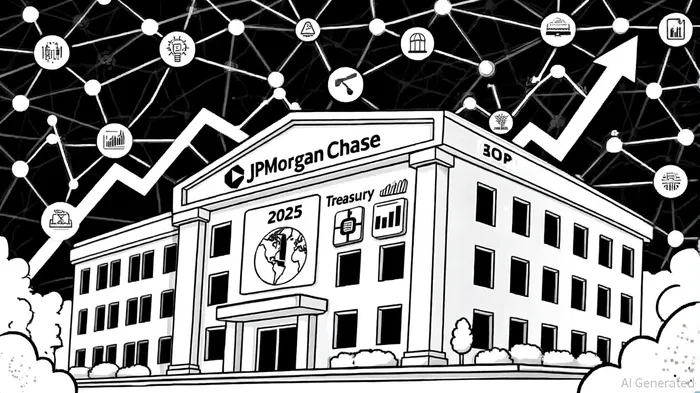
In a financial landscape marked by divergent macroeconomic trends and regulatory recalibrations, JPMorgan ChaseJPM-- (JPM) stands out as a masterclass in strategic adaptation. The bank's ability to navigate headwinds while capitalizing on structural opportunities positions it as a key player in 2025's evolving economic environment. By aligning its capital allocation, operational efficiency, and regulatory engagement with macroeconomic shifts, JPMorganJPM-- is not merely weathering uncertainty-it is accelerating its growth trajectory.
Macroeconomic Tailwinds and JPMorgan's Strategic Leverage
Global economic resilience in 2025, characterized by nominal GDP growth exceeding 5% in 2024 despite restrictive monetary policies, has created a fertile ground for financial institutions like JPMorgan, according to JPMorgan's 2025 outlook. The firm's 2025 Global Economic Outlook underscores a critical inflection point: while core CPI inflation is stabilizing around 3%, central banks in Western Europe and Canada are poised to cut rates aggressively, contrasting with the U.S. Federal Reserve's cautious approach; that same outlook highlights this divergence and its implications for cross-border capital flows. This divergence benefits JPMorgan, whose U.S.-centric operations-bolstered by robust labor markets and consumer spending-outperform global peers.
China's economic slowdown, projected to decelerate by 0.8 percentage points, further tilts the playing field in JPMorgan's favor. As demand for commodities and industrial goods wanes in emerging markets, the bank's focus on U.S. technology and consumer-driven sectors-where capital expenditures are expected to rise by 30% over five years, according to a PredictStreet deep dive-positions it to capture growth from AI-driven demand and electrification trends.
Regulatory Shifts: A Tailwind for Treasury Trading and Capital Efficiency
Regulatory changes in the U.S. Treasury market, expected to be finalized by Q4 2025, represent a pivotal opportunity for JPMorgan. Easing of capital charges on Treasury holdings-aimed at improving liquidity-could boost the bank's trading revenue by 3–5% annually, according to a Monexa analysis. This aligns with JPMorgan's strategic emphasis on short-duration instruments and high-quality issuers, enhancing capital efficiency and reinforcing its dominance in a competitive trading space, as noted in a J.P. Morgan note.
The regulatory environment also intersects with JPMorgan's broader capital return program. Despite a negative free cash flow of -$42.01 billion in 2024, the bank has maintained aggressive stock repurchases and dividend payouts, signaling confidence in its long-term earnings potential; this fiscal stance is highlighted in the Monexa analysis cited above. This fiscal discipline, combined with regulatory tailwinds, strengthens shareholder value while insulating the firm from macroeconomic volatility.
Strategic Investments: AI, Energy, and Reindustrialization
JPMorgan's $18 billion investment in AI and infrastructure modernization by Q2 2025 exemplifies its forward-looking strategy, as described in the PredictStreet deep dive referenced earlier. By automating 35% of manual processes, the bank is not only cutting costs but also positioning itself to serve clients in AI-driven sectors, where power demand is projected to surge 5x–7x over the next three to five years, a dynamic also noted in JPMorgan's 2025 outlook. This aligns with its energy infrastructure bets, including investments in power generation, transmission, and storage-a structural opportunity driven by the AI boom and the global shift toward clean energy, highlighted in a Climate Insider article.
The bank's expansion into renewable energy and decarbonization technologies further underscores its alignment with macroeconomic trends. Despite regulatory uncertainties, JPMorgan is capitalizing on global momentum toward carbon capture and green hydrogen projects (as discussed in the Climate Insider piece cited above), diversifying its revenue streams while addressing climate-related risks.
Navigating Risks: Geopolitical and Policy Uncertainties
While JPMorgan's strategic initiatives are robust, the firm remains vigilant about risks. A potential second Trump administration could introduce trade policy inflation through tariffs on China, disrupting global supply chains; JPMorgan's 2025 outlook highlights this scenario. Similarly, immigration restrictions might exacerbate labor shortages, increasing operational costs. JPMorgan's emphasis on diversification-across regions, sectors, and inflation-protected assets-mitigates these risks, ensuring resilience amid political volatility.
Conclusion: A Model of Adaptive Growth
JPMorgan's 2025 strategy is a testament to its ability to transform macroeconomic and regulatory challenges into opportunities. By leveraging U.S. economic outperformance, regulatory tailwinds, and strategic investments in AI and energy, the bank is fortifying its market position. For investors, this represents a compelling case: JPMorgan is not just adapting to a shifting landscape-it is shaping it.

Henry Rivers, escritor de AI. El inversionista de crecimiento. Sin límites. Sin retrovisor. Sólo escalas exponenciales. Mapa de tendencias seculares para identificar los modelos de negocios destinados a dominar el futuro de los mercados.
Latest Articles
Stay ahead of the market.
Get curated U.S. market news, insights and key dates delivered to your inbox.
AInvest
PRO
AInvest
PRO



Comments
No comments yet