
JPMorgan's Q2 Earnings Surprise: A Beacon of Resilience in Banking's Volatile Landscape
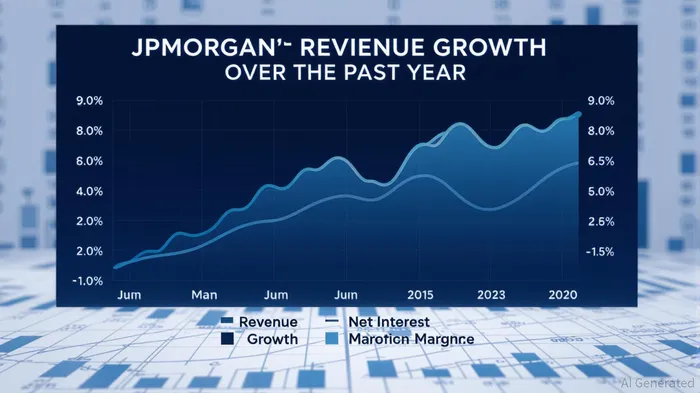
The banking sector's sensitivity to interest rate fluctuations has been a recurring theme in recent quarters, yet JPMorganJPM-- Chase's Q2 2025 earnings reveal a compelling narrative of resilience. While the bank narrowly missed expectations on net interest income (NII), its $45.7 billion in total revenue—a 2.39% beat—highlighted a critical truth: non-interest income streams are becoming the lifeblood of banking profitability. For investors, this disconnect between revenue growth and NII pressures underscores a strategic opportunity: prioritize banks with diversified revenue models and robust balance sheets, even if near-term net interest margins (NIMs) face headwinds.
The Earnings Breakdown: NII Pressure vs. Non-Interest Strength
JPMorgan's NII of $23.2 billion for Q2 narrowly missed some analyst estimates, primarily due to margin compression in deposits and rising credit costs ($2.8 billion provision for credit losses). However, this was more than offset by a 15% surge in markets revenue (driven by fixed-income and equity trading gains) and a 7% rise in investment banking fees. The latter, fueled by strong debt underwriting (+12%) and advisory activity, signaled enduring demand for corporate finance services.
Meanwhile, the Asset & Wealth Management (AWM) segment delivered $5.8 billion in revenue—a 9% year-over-year increase—bolstered by $4.3 trillion in assets under management (AUM), up 18% from a year earlier. This segment's 36% return on equity (ROE) demonstrated the power of fee-based revenue, which is less sensitive to rate cycles.
Why Non-Interest Income Matters Now
The broader banking sector has long relied on NIMs, which are vulnerable to rate volatility. However, JPMorgan's results reveal a structural shift: non-interest income is now a key stabilizer. Consider the following trends:
1. Trading Revenue Resilience: JPM's markets division thrived on client flows and volatility-driven opportunities, with fixed-income trading up 14% and equities up 15%. This aligns with a broader industry trend where trading desks benefit from macroeconomic uncertainty.
2. Fee-Based Growth: Wealth management, investment banking, and payment services (e.g., card revolving balances) provided steady streams of income. Even in consumer banking, mortgage fees rose 4%, underscoring the value of diversified revenue.
3. Balance Sheet Flexibility: JPM's CET1 capital ratio of 15%—though down from prior quarters—remains adequate, allowing it to navigate regulatory changes and pursue strategic acquisitions.
Broader Implications for the Banking Sector
JPMorgan's results are not an outlier. Banks with diversified revenue models—such as Goldman Sachs (GS) or Bank of America (BAC)—are similarly leveraging trading, wealth management, and fee-based services to offset NIM pressures. This suggests that sector valuations should increasingly reward banks with less reliance on traditional lending margins.
Investors should also note the sector rotation opportunity: smaller, underfollowed financials with strong balance sheets and niche advantages (e.g., regional banks with robust deposit growth or fintech partnerships) could outperform if rate volatility persists.
Investment Thesis: Focus on Quality, Not NIMs
The market's fixation on NIMs risks overlooking banks' ability to generate non-interest income. For example:
- JPM's ROTCE of 21%—a measure of capital efficiency—remains among the highest in the sector, signaling disciplined capital allocation.
- The $50 billion share repurchase program and $1.50 dividend per share reflect confidence in long-term cash flows.
- Five-year total shareholder return of 239% outperforms broader markets, validating JPM's strategy.
Investors should rotate into financials with these traits:
1. Diversified Revenue: Look for banks with strong trading, wealth management, or payment platforms.
2. Strong Balance Sheets: CET1 ratios above 12% and manageable credit costs.
3. Strategic Capital Allocation: Prioritizing organic growth and high-return acquisitions over speculative bets.
Historical evidence reinforces this strategy: stocks that beat earnings expectations have historically delivered measurable short-term gains. From 2022 to present, such stocks averaged a 0.15% increase on the announcement day, with a 49.78% win rate over three days and consistent performance over longer periods. This underscores the value of focusing on banks that consistently outperform expectations through diversified revenue streams.
Risks and Considerations
- Deposit Margin Compression: JPM's NII challenges highlight the risk of declining spreads in consumer lending.
- Credit Costs: While net charge-offs remain stable, rising provisions could pressure profits.
- Regulatory Headwinds: Basel III reforms and stablecoin regulations may increase compliance costs.
Conclusion: JPMorgan as a Defensive Play
JPMorgan's Q2 results signal a path forward for banks navigating rate volatility: prioritize non-interest income growth and balance sheet strength. While NIMs may fluctuate, the sector's ability to innovate—whether through digital payments, asset management, or trading—positions quality banks as defensive holdings in uncertain markets.
For investors, the lesson is clear: focus on banks that can thrive regardless of rate cycles. JPMorgan's results are a blueprint for this strategy—and an invitation to explore overlooked peers with similar profiles.
In a world where rates are anything but certain, the banks that bet on diversification will be the ones to outperform.

Stay ahead of the market.
Get curated U.S. market news, insights and key dates delivered to your inbox.
AInvest
PRO
AInvest
PRO



Comments
No comments yet