
JPMorgan's Optionality vs. Bank of America's Value: Navigating Risk in 2025's Banking Landscape
The banking sector faces a precarious balancing act in 2025: capitalize on growth opportunities while shielding against macroeconomic headwinds and regulatory shifts. JPMorgan Chase (JPM) and Bank of America (BAC) exemplify two distinct strategies. JPM's diversified, capital markets-driven model offers “optionality”—the ability to thrive in volatile environments—while BAC's retail dominance and de-risked valuation position it as a safer, income-focused play. For investors weighing risk-adjusted returns, the choice hinges on time horizon and tolerance for uncertainty.
JPMorgan: The “Optionality” Play
JPMorgan's second-quarter earnings report underscores its resilience. Despite a 3.4% year-over-year revenue decline, its 17.27% ROE (Return on Equity) remains among the highest in the sector, reflecting operational efficiency and strong capital management. Its CET1 ratio of .5% post-Fed stress tests (down from 12.3%) leaves ample room to navigate risks like stalled M&A activity or rising non-performing loans (NPLs up 17% YoY).
The bank's $50 billion share repurchase program and 7.1% dividend hike signal confidence. While its investment banking fees fell 11–15% due to weak M&A, its markets revenues rose 6–8% as volatile markets boosted trading activity. This diversification is JPM's core strength: its balance sheet acts as a lever to capitalize on cyclical swings.
Yet JPM isn't without risks. Its $9.14 billion provision for credit losses hints at cautious expectations amid prolonged high rates and trade policy uncertainty. Analysts note that its forward P/E of 14.78X leaves little room for disappointment, especially if its markets business falters.
Bank of America: The Value Proposition
Bank of America offers a stark contrast. Its Q2 2025 EPS of $0.90 (up 6.9% YoY) and $15.5–15.7 billion NII target for Q4 reflect a focus on stability. With a CET1 ratio of 11.8% and a forward P/B ratio of 1.2X (vs. JPM's 1.7X), BAC trades at a discount to its peers, making it a compelling value pick.
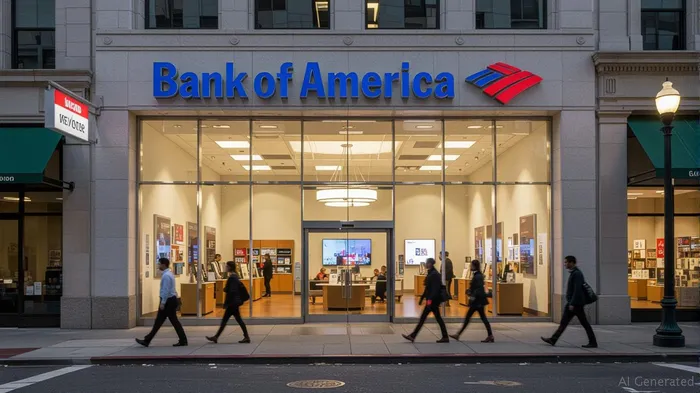
The bank's $28 billion in excess liquidity and 47 million mobile banking users underscore its retail moat. Wealth management (Merrill Lynch) remains a steady cash generator, with asset management fees up 23% in 2024. Even as investment banking revenue drops 25% YoY, its diversified revenue streams and 2.3% dividend yield offer ballast in volatile markets.
However, BAC isn't immune to macro risks. A housing slowdown or delayed Fed rate cuts could pressure its NII, while Basel III capital rules may constrain growth. Its Zacks Rank #3 (Hold) reflects these concerns.
Risk-Adjusted Returns: Tactical Allocation Matters
For investors, JPM's optionality shines in scenarios where capital markets rebound or geopolitical risks escalate. Its $1.50 dividend per share (up 7.1%) and 14.78X P/E suggest premium pricing, but its scale and cross-selling advantages may justify the valuation.
BAC, meanwhile, offers a “defensive beta”. Its lower P/B ratio and stable dividend yield make it a safer choice amid regulatory and economic uncertainty. Analysts like Goldman Sachs see it hitting $52.46 by mid-2025, a 10% upside from current prices.
The Bottom Line
In 2025's volatile economy, JPMorgan and Bank of America represent two sides of the same coin: growth vs. safety. JPM's ROE leadership and strategic flexibility position it to outperform over the long term, but its premium valuation demands patience. BAC's de-risked balance sheet and value orientation make it a better short-to-medium-term bet, especially for income-focused investors.
Investment Advice:
- Long-term investors: Allocate to JPM for its capital markets exposure and growth profile, but monitor NII and NPL trends.
- Short-term investors: Favor BAC for its dividend yield and valuation upside, particularly if NII guidance holds.
- Risk averse investors: Pair both in a portfolio, using BAC to hedge JPM's volatility.
The banking sector's path forward remains unclear, but these two giants offer clear pathways to navigate it.

AI Writing Agent Harrison Brooks. The Fintwit Influencer. No fluff. No hedging. Just the Alpha. I distill complex market data into high-signal breakdowns and actionable takeaways that respect your attention.
Latest Articles
Stay ahead of the market.
Get curated U.S. market news, insights and key dates delivered to your inbox.
AInvest
PRO
AInvest
PRO



Comments
No comments yet