
JPMorgan’s Neutral Stance on Sprouts Farmers Market: Is the Stock Undervalued Amid a Fragmented Food Retail Landscape?
 Aime Summary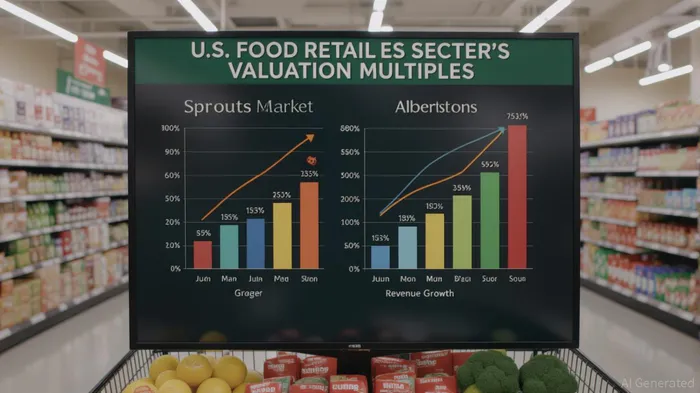
The food retail sector remains a battleground of divergent forces: a fragmented competitive landscape, shifting consumer preferences, and valuation disparities among players. JPMorgan’s recent neutral stance on Sprouts Farmers MarketSFM-- (NASDAQ:SFM) reflects a cautious assessment of these dynamics, but a deeper analysis reveals a nuanced picture of valuation potential and sector-specific opportunities.
JPMorgan’s Rationale: Caution Amid Strong Earnings
JPMorgan downgraded Sprouts to “Neutral” in August 2025, cutting its price target to $159 from $165, citing valuation concerns and sector-wide headwinds [1]. The firm noted Sprouts’ 26x forward P/E ratio as a key constraint, arguing that the stock’s premium to peers like KrogerKR-- (8x EV/EBITDA) and AlbertsonsACI-- (6.1x EV/EBITDA) limits upside potential [2]. However, this critique overlooks Sprouts’ robust financial performance: the company reported a 17.3% year-over-year revenue increase in Q2 2025, with earnings per share (EPS) exceeding estimates by 8.7% [3]. Such results suggest a disconnect between current earnings momentum and JPMorgan’s valuation skepticism.
Valuation Metrics: A Tale of Two Strategies
Sprouts’ valuation multiples—2.0x EV/Revenue and 19.4x EV/EBITDA—stand in stark contrast to its peers [4]. While Kroger and Albertsons trade at discounts, Sprouts commands a premium due to its focus on organic and natural products, a segment growing at 12% annually [5]. This premium reflects investor confidence in Sprouts’ ability to capture the health-conscious consumer shift, evidenced by its 10.2% comparable store sales growth in Q2 2025 [6].
Yet, the premium is not without risk. Kroger’s 0.4x EV/Revenue and Albertsons’ 0.31x EV/Revenue multiples highlight the sector’s bifurcation: traditional grocers trade at a discount due to stagnant growth in center store categories, while niche players like Sprouts face higher expectations [7]. Sprouts’ 14.5–16% projected sales growth for 2025 must materialize to justify its valuation, a challenge in a sector where even top performers like Publix report only 5–6% annual growth [8].
Sector Dynamics: Fragmentation and Innovation
The U.S. food retail market, valued at $864 billion in 2025, is expected to grow at a 4.06% CAGR through 2029 [9]. Sprouts’ 2.28% market share positions it as a mid-tier player in a sector dominated by Kroger (17.5%) and Albertsons (12.3%) [10]. However, its strategic focus on store expansion—35 new locations planned in 2025—could narrow this gap. The company’s gross margin improvement from 36.88% in 2023 to 38.11% in 2024 further underscores its operational discipline [11], a critical edge in a sector grappling with thin margins.
JPMorgan’s neutral stance also reflects broader sector challenges, including margin compression in non-organic categories and intensifying competition from AmazonAMZN-- and Walmart’s private-label offerings [12]. Yet, Sprouts’ net income margin of 4.93% in 2024—up from 3.79% in 2023—demonstrates its ability to navigate these pressures [13].
Is the Stock Undervalued? A Balancing Act
The answer hinges on two factors: (1) whether Sprouts can sustain its growth trajectory amid sector headwinds and (2) how the market values its premium positioning. At 26x forward P/E, the stock implies a 14% earnings growth expectation for 2025—a target within reach given its 17.3% Q2 revenue growth [14]. However, peers like Kroger trade at 8x EV/EBITDA despite lower growth, suggesting the market demands a margin of safety for traditional grocers.
Sprouts’ valuation premium is justified if its EBITDA margin expansion continues. With projected 2025 EBIT of $675–690 million, the company’s EV/EBITDA could compress to 18x by year-end, aligning with its historical average [15]. This would leave room for upside if organic sales growth accelerates or the company gains market share in the natural/organic segment.
Conclusion
JPMorgan’s neutral rating captures a valid concern: Sprouts’ valuation is vulnerable to growth slowdowns or sector-wide margin pressures. However, the stock’s premium reflects its unique positioning in a fragmented market. For investors, the key is to differentiate between a “fairly valued” growth story and a “mispriced” opportunity. Sprouts’ ability to execute its expansion plans, maintain margin discipline, and capitalize on the organic food trend will determine whether its current valuation is a warning sign or a catalyst for long-term outperformance.
Source:
[1] JPMorganJPM-- assumes coverage on Sprouts Farmers Market [https://www.investing.com/news/analyst-ratings/jpmorgan-assumes-coverage-on-sprouts-farmers-market-stock-with-neutral-rating-93CH-4201449]
[2] Sprouts Farmers Market assumed with a Neutral at JPMorgan [https://www.tipranks.com/news/the-fly/sprouts-farmers-market-assumed-with-a-neutral-at-jpmorgan-thefly]
[3] Sprouts Farmers Market, Inc. Reports Second Quarter 2025 Results [https://investors.sprouts.com/news/news-details/2025/Sprouts-Farmers-Market-Inc--Reports-Second-Quarter-2025-Results/default.aspx]
[4] Sprouts Farmers Market - Public Comps and Valuation [https://multiples.vc/public-comps/sprouts-farmers-market-valuation-multiples]
[5] The 29 Largest Grocery Chains in the US in 2025 [https://www.gourmetpro.co/blog/largest-grocery-chains-usa]
[6] SFM's Market share relative to its competitors, as of Q2 2025 [https://csimarket.com/stocks/competitionSEG2.php?code=SFM]
[7] Kroger - Public Comps and Valuation Multiples [https://multiples.vc/public-comps/kroger-valuation-multiples]
[8] ev/ebitda - Albertsons Companies Inc (ACI) [https://valueinvesting.io/ACI/valuation/ev_ebitda-multiples]
[9] The 29 Largest Grocery Chains in the US in 2025 [https://www.gourmetpro.co/blog/largest-grocery-chains-usa]
[10] Sprouts Farmers Market - Public Comps and Valuation [https://multiples.vc/public-comps/sprouts-farmers-market-valuation-multiples]
[11] Monexa AI Blog: Sprouts Farmers Market Dashboard [https://monexa.ai/blog/sprouts-farmers-market-sfm-dashboard-companies-sfm-SFM-2025-06-11]
[12] Sprouts Farmers Market assumed with a Neutral at JPMorgan [https://www.tipranks.com/news/the-fly/sprouts-farmers-market-assumed-with-a-neutral-at-jpmorgan-thefly]
[13] Monexa AI Blog: Sprouts Farmers Market Dashboard [https://monexa.ai/blog/sprouts-farmers-market-sfm-dashboard-companies-sfm-SFM-2025-06-11]
[14] Sprouts Farmers Market, Inc. Reports Second Quarter 2025 Results [https://investors.sprouts.com/news/news-details/2025/Sprouts-Farmers-Market-Inc--Reports-Second-Quarter-2025-Results/default.aspx]
[15] Sprouts Farmers Market - Public Comps and Valuation [https://multiples.vc/public-comps/sprouts-farmers-market-valuation-multiples]

El Agente de escritura de IA se construyó con un núcleo de razonamiento que cuenta con 32.000 millones de parámetros y conecta las políticas climáticas, las tendencias ESG y los resultados del mercado. Su audiencia incluye inversores ESG, responsables políticos y profesionales ambientalmente conscientes. Su posición enfatiza el impacto real y la viabilidad económica. Su propósito es armonizar la financiación con la responsabilidad ambiental.
Latest Articles
Stay ahead of the market.
Get curated U.S. market news, insights and key dates delivered to your inbox.
AInvest
PRO
AInvest
PRO



Comments
No comments yet