
JPMorgan's JPM Coin Bridges DeFi and Traditional Banking in $15T Push


 Aime Summary
JPMorgan Chase & Co. has launched JPM Coin, a digital deposit token designed to enable institutional clients to execute near-instantaneous U.S. dollar transfers on Coinbase's Base blockchain, marking a pivotal expansion of traditional banking into public blockchain infrastructure. The token, which settles transactions 24/7 in seconds rather than days, represents a digital claim on dollar deposits held at JPMorganJPM-- and can be interest-bearing, offering a compelling alternative to stablecoins for institutional investors, according to a CoinCentral report. The rollout follows months of trials with partners including Mastercard, CoinbaseCOIN--, and B2C2, and positions JPMorgan as a leader in the race to tokenize commercial bank liabilities, as reported by Yahoo Finance.
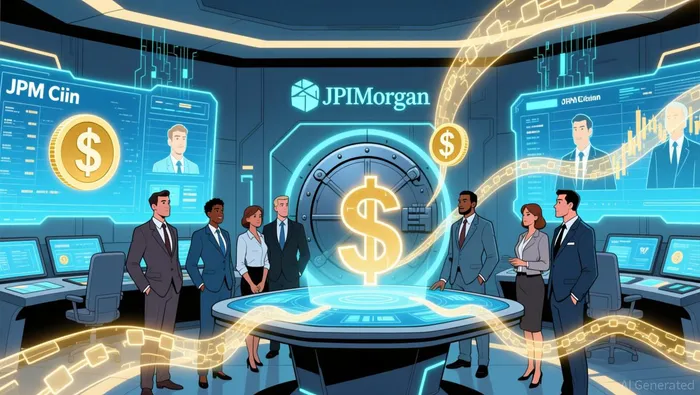 The new token operates on Base, an EthereumETH-- LayerLAYER-- 2 network developed by Coinbase, which has already facilitated $1 billion in on-chain Bitcoin-backed loans. Unlike stablecoins, which are typically issued by fintech or crypto-native entities and lack yield-bearing features, JPM Coin leverages JPMorgan's existing deposit base, ensuring regulatory compliance and aligning with Know Your Customer (KYC) frameworks, per a Yahoo Finance analysis. Naveen Mallela, global co-head of JPMorgan's blockchain division Kinexys, emphasized that deposit tokens like JPM Coin offer institutions "a safer and more compliant path" compared to stablecoins, particularly for collateralized lending and liquidity management, according to the CoinCentral report.
JPMorgan's move reflects broader industry momentumMMT-- as major banks increasingly adopt blockchain to streamline payments. Citigroup, Deutsche Bank, and Banco Santander are among institutions exploring similar solutions, while central banks such as South Korea's are testing tokenized deposits to counter the rise of private stablecoins, as noted in a LiveBitcoinNews article. JPMorgan plans to expand JPM Coin to other blockchains and currencies, including a potential euro-denominated version (JPME), pending regulatory approval, as reported by the CoinCentral report. The bank also aims to extend access to clients of its institutional customers, creating a multi-tiered ecosystem for tokenized deposits, according to the Yahoo Finance report.
The launch underscores the growing convergence of traditional finance (TradFi) and decentralized finance (DeFi). By hosting JPM Coin on Base, Coinbase's Layer 2 network, JPMorgan has created a bridge between regulated banking systems and permissionless blockchain applications. Base's role as a common rail for both institutional and DeFi-native services highlights its potential to unify financial infrastructure, enabling seamless interoperability between public and private networks, as detailed in the Yahoo Finance analysis. This development also aligns with JPMorgan's broader strategy to modernize payment systems, following initiatives such as allowing BitcoinBTC-- and Ethereum to be used as collateral for loans, as reported in the LiveBitcoinNews article.
Regulatory considerations remain critical. U.S. regulators have classified tokenized deposits as traditional deposits rather than securities, avoiding the scrutiny faced by stablecoins under the proposed Stablecoin Trust Act. However, challenges persist, including ensuring data privacy, managing blockchain outages, and addressing anti-money laundering risks from non-whitelisted wallets, as noted in the Yahoo Finance report. JPMorgan's controlled rollout—limiting initial access to vetted institutional clients—reflects a cautious approach to balancing innovation with compliance, as described in a Coinpaprika article.
As banks globalize their blockchain strategies, the tokenization of deposits could redefine cross-border payments, reducing costs and counterparty risks while enhancing transparency. With tokenized deposits projected to unlock $15 trillion in global banking liquidity, JPMorgan's JPM Coin signals a paradigm shift in how institutions manage and transfer value, according to the Coinpaprika article.

Stay ahead of the market.
Get curated U.S. market news, insights and key dates delivered to your inbox.
AInvest
PRO
AInvest
PRO



Comments
No comments yet