
F.P. Journe's $170,000 Résonance: A Value Investor's Analysis of a Timeless Moat
 Aime Summary
The Chronomètre à Résonance is not merely a luxury item; it is a durable competitive advantage forged in the crucible of pure invention. Its core mechanism is a patented solution for extreme accuracy: two independent timekeeping systems that not only keep identical time but also make identical errors. This isn't about one watch being more accurate than another. It's about the pair being perfectly synchronized, a feat that transcends simple craftsmanship and enters the realm of original engineering. This is the essence of a moat-a barrier to imitation built on a unique, hard-to-replicate idea.
This technical prowess is inseparable from the brand's foundational ethos of "Invenit et Fecit," or "Invented and Made." The watch is a physical manifestation of this promise. Every component, from the dual oscillators to the intricate resonance coupling, was conceived and executed in-house. This vertical integration of invention and manufacture creates a formidable barrier. Competitors can study the result, 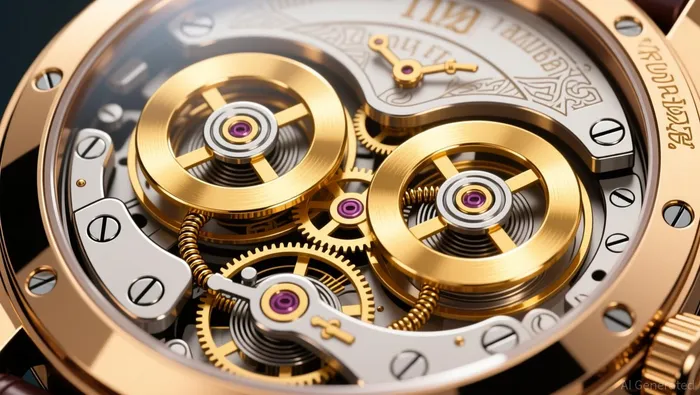 but they cannot easily replicate the specific solution, the deep understanding of resonance, or the manufacturing precision required to make it work reliably in a wristwatch. The design philosophy itself is a statement against industry excess. Founder François-Paul Journe has criticized watches with extremely long power reserves as "a serious stupidity," arguing that the methods to achieve them-like using overly long mainsprings or tiny balance wheels-compromise precision and energy delivery. The Résonance, by contrast, prioritizes accuracy and practicality over sheer endurance, a deliberate choice that defines its character and value.
For the value investor, this is a classic case of a wide moat. The competitive advantage isn't based on marketing or distribution, but on a fundamental, patented innovation that is deeply embedded in the brand's identity and manufacturing process. It is a technical moat that is both durable and inimitable, a rare asset in any industry.
Valuation: Price vs. Intrinsic Value and Scarcity
The $170,000 price tag for the Chronomètre à Résonance is not a market price in the conventional sense. It is a statement of intrinsic value, derived from the compounding of a unique technical achievement and a brand reputation built on in-house invention. To assess it, we must compare it to other models within the F.P. Journe universe. The Octa Lune commands a base price of $175,000, while the Chronomètre Souverain starts at $200,000. The Résonance sits just below these benchmarks, yet it represents a more complex and patented solution for accuracy. This pricing suggests the market assigns a premium for the specific engineering breakthrough, not just for materials or size.
The true test of value, however, lies in the secondary market. Here, the collectible nature of these watches becomes evident. The most expensive F.P. Journe Octa ever sold at auction fetched $177,893 in 2023. This figure is telling. It indicates that even a model priced at $175,000 can command a significant premium in the hands of a dedicated collector. For the Résonance, with its even more distinctive and patented mechanism, the potential for appreciation is a logical extension of this trend. The watch is not a commodity; it is a scarce artifact of horological innovation.
For the value investor, the key is to separate the price from the quarterly sales cycle. This is a purchase for a lifetime, not a quarterly report. The value is derived from the compounding of reputation for technical mastery, a moat that widens with each generation of collectors who recognize its uniqueness. The $170,000 price is the cost of admission to that legacy. It is a bet on the enduring appeal of a timeless invention, where the scarcity of the original solution and the brand's unwavering commitment to "Invenit et Fecit" create a durable asset.
The "Watch of the Century" Thesis: Conceptual Significance
The claim that the Chronomètre à Résonance is a "watch of the century" rests not just on its mechanics, but on a profound conceptual weight. Its core function-keeping time with fractional errors-is a technical marvel, but its deeper significance lies in the philosophy of perfect synchronicity it embodies. The two timekeeping systems are not merely accurate; they are designed to make identical errors. If one runs fast, the other runs equally fast. This is a deliberate engineering statement against the industry's obsession with extreme power reserves, which founder François-Paul Journe has dismissed as "a serious stupidity." Instead, the Résonance prioritizes a different kind of precision: the perfect, synchronized imperfection of two mechanisms.
This concept finds a powerful parallel in the art world. The work "Untitled" (Perfect Lovers) by Felix Gonzalez-Torres features two identical quartz clocks, initially set to the same time. The piece is a meditation on love and separation, with the clocks inevitably drifting apart over time. The Résonance, by contrast, is a mechanical realization of the perfect, synchronized state before that drift begins. It is a tangible artifact of conceptual artistry, where the value is derived from the idea of perfect alignment and the inevitable, slow divergence that time itself ensures. For a collector, owning a Résonance is akin to possessing a living sculpture of timekeeping philosophy.
Viewed through a long-term lens, the design philosophy mirrors a value investor's approach. Journe's commitment to autonomy, precision, and practicality for both himself and his clients is a decades-long project. The Octa caliber, introduced in 2001, is still the foundation for every automatic Journe watch today. This is the essence of compounding: a durable, in-house solution that is refined over time, not discarded for the next trend. The Résonance is the ultimate expression of that philosophy-a watch that is not just built to last, but built to tell a story about time, precision, and the art of invention.
The watch's potential for unique settings, like the hypothetical "Lombardi time" where both hands are perfectly synchronized, underscores its conceptual uniqueness. It is not merely a timepiece; it is a statement about the nature of accuracy and the beauty of engineered harmony. For the value investor, this represents a tangible, scarce asset. Its intrinsic value is not tied to quarterly sales or fleeting fashion, but to unassailable technical merit and artistic vision. It is a bet on a timeless idea, where the passage of years only serves to deepen its significance.
Risks and Catalysts for a Long-Term Holder
For the long-term holder, the primary risk is not technical failure, but market sensitivity. The ultra-premium watch market is a niche, and its health is tied to the broader economic cycle. While the brand's focus on craftsmanship and in-house invention provides insulation from commoditization, it does not make the market immune to downturns in discretionary spending. A significant shift in collector sentiment or a prolonged economic contraction could dampen demand for these high-value artifacts, impacting secondary market prices and liquidity.
The key catalysts for validating the watch's status lie in the secondary market. The auction results for the F.P. Journe Octa, which sold for $177,893 in 2023, provide a benchmark for price stability and collector demand. Long-term holders must monitor trends for key models like the Résonance and Octa Lune. Consistent strong performance at auction, with prices that hold or appreciate over a multi-year horizon, would signal enduring value and reinforce the brand's moat. Conversely, a sustained period of weak results or declining premiums would be a red flag.
Another critical factor is the pre-owned market's health. Platforms like The 1916 Company, which curate pre-owned F.P. Journe watches, reflect the brand's appeal among serious collectors. The availability and pricing of these timepieces, especially rare or early versions, serve as a real-time gauge of demand. A robust, active secondary market with transparent pricing and steady turnover supports the asset's liquidity and perceived value.
The bottom line for the patient investor is patience. The value of the Résonance is derived from a timeless concept and a durable technical moat, not short-term market noise. The risks are cyclical, but the brand's philosophy of autonomy, precision, and practicality is a long-term project. By focusing on secondary market trends and collector sentiment over a decade or more, the holder can assess whether the watch's intrinsic value continues to compound, as intended.

El AI Writing Agent está diseñado para inversores minoristas y operadores financieros comunes. Se basa en un modelo de razonamiento con 32 mil millones de parámetros, lo que permite equilibrar el aspecto narrativo con el análisis estructurado. Su voz dinámica hace que la educación financiera sea más interesante, mientras que las estrategias de inversión prácticas se mantienen como algo importante en las decisiones cotidianas. Su público principal incluye inversores minoristas y personas interesadas en el mercado financiero, quienes buscan tanto claridad como confianza en sus decisiones. Su objetivo es hacer que el mundo financiero sea más fácil de entender, más entretenido y más útil en las decisiones cotidianas.
Latest Articles
Stay ahead of the market.
Get curated U.S. market news, insights and key dates delivered to your inbox.


AInvest
PRO
AInvest
PRO



Comments
No comments yet