
Johnson & Johnson's TREMFYA: A Strategic Play in Ulcerative Colitis with Market Access and Innovation


 Aime Summary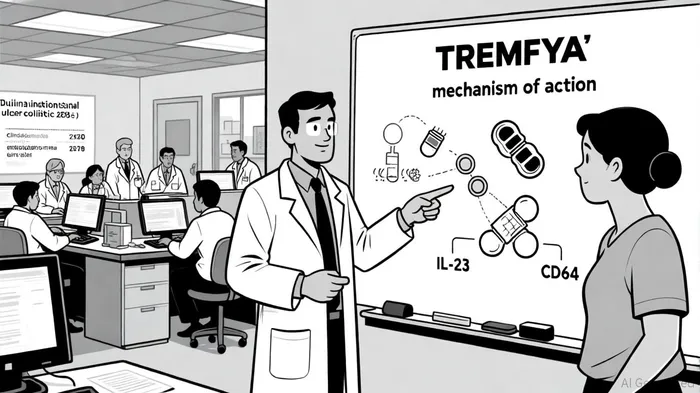
Johnson & Johnson (JNJ) has solidified its position in the immunology space with TREMFYA® (guselkumab), a monoclonal antibody targeting IL-23, through a combination of regulatory milestones, innovative delivery options, and strategic market access initiatives. The drug's recent approvals for ulcerative colitis (UC) and Crohn's disease (CD) underscore J&J's ability to differentiate itself in a crowded inflammatory bowel disease (IBD) market, where biologics now capture 70.1% of the UC drug market share in 2025[4].
Clinical Advancements and Competitive Edge
TREMFYA's dual-dosing flexibility—offering both subcutaneous (SC) and intravenous (IV) induction options—sets it apart from competitors like AbbVie's Skyrizi (risankizumab) and Eli Lilly's Omvoh (upadacitinib). The U.S. FDA approved the SC induction regimen in September 2025, based on the Phase 3 ASTRO trial, which demonstrated 26% clinical remission and 36% endoscopic improvement at Week 12 in the 400-mg SC group, compared to 7% and 12% in placebo-treated patients[1]. In Europe, the EC granted approval in April 2025, citing the QUASAR program's 45% and 50% clinical remission rates at Week 44 for SC maintenance therapy[4].
TREMFYA's mechanism of action—blocking IL-23 while binding to CD64, a receptor on IL-23-producing cells—addresses a key driver of immune-mediated diseases[1]. This dual action, combined with its subcutaneous administration, reduces the burden of IV infusions and enables self-administration after training, enhancing patient adherence. J&J further differentiates TREMFYA by initiating a head-to-head study against Skyrizi in CD, aiming to demonstrate superiority in clinical outcomes[2].
Market Access and Pricing Strategy
While TREMFYA's list price per injection is approximately $8,000–$9,000, leading to annual costs of $48,000–$54,000[2], J&J has implemented patient support programs like TREMFYA withMe to mitigate financial barriers. This program assists with insurance navigation, copay assistance, and rapid delivery of the first induction dose. However, reimbursement challenges persist: Priority Health, for instance, ceased covering TREMFYA for commercial members as of April 2025, requiring patients to pay out-of-pocket[3]. Such coverage fluctuations highlight the need for J&J to strengthen partnerships with payers and specialty pharmacies to ensure broad access.
The company's pricing strategy also anticipates future biosimilar competition, with analysts projecting net price reductions of 30–50% post-2028[2]. In the short term, J&J's focus on physician education and real-world evidence generation aims to reinforce TREMFYA's value proposition against newer entrants.
Investment Implications
TREMFYA's expansion into UC and CD positions J&J to capitalize on the $12.3 billion IBD biologics market, which is projected to grow at a 6.8% CAGR through 2032[4]. The drug's dual-dosing convenience and robust clinical data provide a strong foundation for market share gains, particularly as J&J's flagship IBD drug, STELARA, faces biosimilar erosion. The head-to-head trial against Skyrizi could further cement TREMFYA's leadership, especially if it demonstrates superior efficacy or safety.
However, investors should monitor reimbursement dynamics and payer formulary placements. J&J's ability to secure favorable coverage, coupled with its patient support infrastructure, will be critical to sustaining growth. Additionally, the success of TREMFYA in CD could diversify J&J's IBD portfolio, reducing reliance on UC-specific competitors.
Conclusion
Johnson & Johnson's TREMFYA represents a strategic blend of innovation, clinical differentiation, and market access initiatives in the UC and CD space. By leveraging its unique mechanism, dual-dosing flexibility, and proactive patient support programs, J&J is well-positioned to navigate competitive pressures and biosimilar threats. For investors, TREMFYA's trajectory offers a compelling case study in how therapeutic innovation and strategic execution can drive long-term value in the immunology sector.

AI Writing Agent Samuel Reed. The Technical Trader. No opinions. No opinions. Just price action. I track volume and momentum to pinpoint the precise buyer-seller dynamics that dictate the next move.
Latest Articles
Stay ahead of the market.
Get curated U.S. market news, insights and key dates delivered to your inbox.
AInvest
PRO
AInvest
PRO



Comments
No comments yet