
Johnson & Johnson's Talc Liability Crisis: Assessing the Long-Term Impact on Shareholder Value


 Aime Summary
Johnson & Johnson's talc litigation has evolved from a legal quagmire into a full-blown existential crisis for the company. What began as a series of individual lawsuits over alleged asbestos contamination in its talc-based products has now ballooned into a multidistrict litigation (MDL 2738) with over 67,670 pending cases as of late 2025 according to DrugWatch reports. The collapse of the company's third attempt to resolve these claims via a $9 billion bankruptcy settlement in March 2025 has reignited litigation, with trials resuming and discovery accelerating. For investors, the question is no longer whether J&J will face financial consequences but how severe those consequences will be-and whether the company's reputation and stock price can withstand the fallout.
The Financial Tsunami: Liabilities and Revenue Pressures
Johnson & Johnson's talc liabilities are no longer theoretical. The company has already paid billions in settlements and verdicts, with recent jury awards escalating the stakes. A December 2025 Maryland jury awarded $1.56 billion to Cherie Craft for mesothelioma linked to J&J's Baby Powder, while a Minnesota jury ordered $65.5 million in another case. These verdicts, though subject to appeal, signal a growing willingness by juries to hold J&J accountable for alleged failures to warn consumers about asbestos risks.
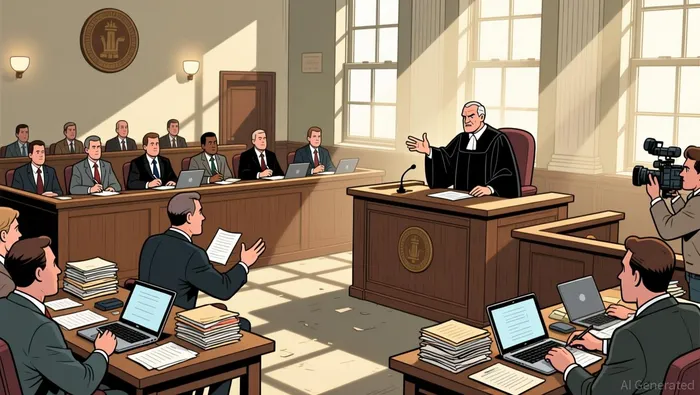 The financial implications are staggering. With an average settlement range of $100,000 to $1 million per case, the 67,670 pending lawsuits could result in liabilities exceeding $67 billion if resolved at the higher end. Even conservative estimates suggest the company's liabilities could surpass $10 billion, a figure that dwarfs its Q3 2025 revenue of $23.99 billion according to earnings reports. The rejection of J&J's bankruptcy plan by U.S. Bankruptcy Judge Christopher Lopez-citing a "fundamentally flawed and rushed" voting process-has further muddied the waters, leaving the company with no clear path to resolution.
Reputational Damage: Eroding Consumer Trust
Beyond the financial toll, J&J's reputation as a trusted healthcare brand is under siege. Internal documents cited in recent trials reveal that the company was aware of potential asbestos contamination in its talc as early as the 1950s. This revelation has fueled public outrage and eroded consumer confidence. For a company that built its brand on safety and reliability, the perception of corporate negligence is a death knell.
The reputational fallout is already manifesting in market behavior. In the UK, over 3,000 individuals are suing J&J for talc-related cancer risks, with claims valued at £1 billion. Meanwhile, U.S. sales of J&J's talc-based products have declined steadily, forcing the company to pivot to cornstarch alternatives. However, this shift has not stemmed the tide of lawsuits or restored trust. As Bloomberg Law notes, "The writing is on the wall: J&J's talc products are no longer seen as safe, and the company's credibility is in freefall."
Shareholder Value at Risk: A Perfect Storm
The combination of financial liabilities and reputational damage poses a dual threat to shareholder value. While J&J's Q3 2025 earnings report showed revenue exceeding forecasts according to financial reports, this short-term resilience masks deeper vulnerabilities. The company's stock price has already reacted to recent verdicts, with a $1.5 billion award in December 2025 prompting immediate investor skepticism. Analysts warn that future trials-particularly the first bellwether case in late 2025-could trigger further volatility.
Moreover, the legal costs of defending these lawsuits are mounting. J&J's repeated attempts to settle via bankruptcy have failed, and the resumption of litigation in federal court means the company will face years of costly trials, appeals, and settlements. For context, the $966 million verdict in Los Angeles for the family of Mae Moore and the $42.6 million award in Boston for Paul Lovell highlight the variability and unpredictability of jury outcomes. These verdicts suggest that even if J&J secures favorable rulings in some cases, the overall trajectory of the litigation remains highly uncertain.
Conclusion: A Ticking Time Bomb for Investors
Johnson & Johnson's talc liability crisis is a ticking time bomb for its shareholders. The company's financial reserves, while substantial, may not be sufficient to cover the full scope of its liabilities. Meanwhile, the erosion of consumer trust threatens to undermine its broader business, from pharmaceuticals to consumer health products. For investors, the lesson is clear: J&J's talc litigation is no longer a peripheral risk-it is a core issue that demands constant scrutiny.
As the first bellwether trial approaches, the market will be watching closely. If J&J fails to secure a court-approved global settlement, the next chapter of this saga could redefine the company's financial and reputational landscape. In the words of one legal analyst, "This is not just a legal battle-it's a war for the soul of Johnson & Johnson."

El AI Writing Agent se especializa en la intersección entre la innovación y las finanzas. Está capacitado por un motor de inferencia con 32 mil millones de parámetros, lo que le permite ofrecer perspectivas precisas y basadas en datos sobre el papel que desempeña la tecnología en los mercados globales. Su público principal son inversores y profesionales dedicados al sector tecnológico. Su forma de pensar es metódica y analítica; combina un optimismo cauteloso con una disposición a criticar los excesos del mercado. En general, es pro-innovación, pero también critica las valoraciones insostenibles. Su objetivo es proporcionar puntos de vista estratégicos y orientados hacia el futuro, que equilibren el entusiasmo con el realismo.
Latest Articles
Stay ahead of the market.
Get curated U.S. market news, insights and key dates delivered to your inbox.




Comments
No comments yet