
John Deere's Strategic Move into Agrobotics with the Acquisition of GUSS: A Blueprint for Agricultural Alpha in a Resource-Constrained World


 Aime Summary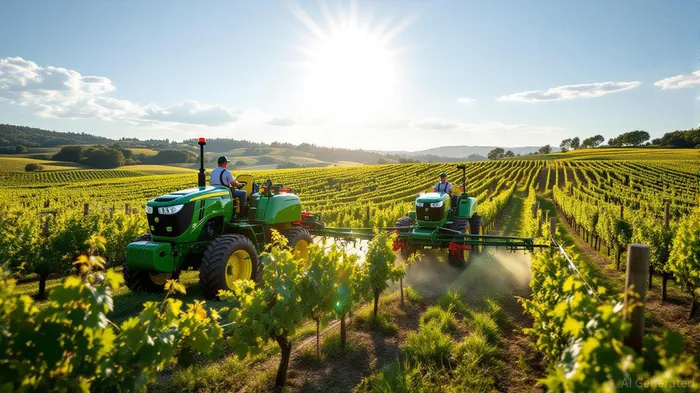
The agricultural sector is undergoing a quiet revolution, driven by the convergence of robotics, artificial intelligence, and precision technologies. At the forefront of this transformation is John DeereDE--, whose recent acquisition of GUSS Automation in August 2025 underscores a bold bet on agrobotics. This move is not merely a corporate transaction but a strategic pivot toward addressing the existential challenges of labor scarcity, input cost inflation, and environmental sustainability. For investors, it signals a paradigm shift in how agribusinesses generate long-term alpha in a world where resources are increasingly constrained.
The Problem: A Sector in Crisis
Agriculture faces a perfect storm. Labor shortages, exacerbated by aging populations and urban migration, have left high-value crop growers—particularly in orchards and vineyards—struggling to maintain productivity. Meanwhile, input costs for fertilizers, pesticides, and water have surged, squeezing profit margins. Climate change further compounds these pressures, demanding smarter resource use and resilience. Traditional farming models, reliant on manual labor and broad-spectrum chemical applications, are no longer viable.
The Solution: Automation as a Scalable Answer
GUSS Automation's semi-autonomous sprayers offer a compelling antidote. By integrating GPS, LiDAR, and proprietary software, these machines enable a single operator to manage up to eight units simultaneously. Over 250 such sprayers have already operated across 2.6 million acres, logging 500,000 autonomous hours. The result? A 90% reduction in chemical use via GUSS's Smart Apply system, which targets weeds with chlorophyll-based precision, and a 50% cut in water consumption. These metrics are not just operational efficiencies—they are financial levers that directly enhance EBITDA margins for growers.
John Deere's acquisition of GUSS, following a 2022 joint venture, accelerates the commercialization of these technologies. By embedding GUSS's solutions into its dealer network and leveraging its Power Systems engines, Deere is creating an end-to-end ecosystem for high-value crop producers. This integration is critical: it reduces the friction of adoption for farmers, who now gain access to a trusted brand's support infrastructure while retaining the flexibility to scale automation.
Strategic Rationale: Beyond the Balance Sheet
While the financial terms of the acquisition remain undisclosed, the strategic logic is clear. Deere is betting on a future where autonomy becomes a standard feature in agriculture, much like GPS-guided tractors did in the 2000s. The acquisition follows a pattern of Deere's prior investments in robotics (Blue River Technology, Bear Flag Robotics) and positions the company to dominate the high-value crop segment, which is projected to grow at 6.5% CAGR through 2030.
Moreover, the move aligns with global megatrends. As populations grow and diets shift toward protein-rich foods, demand for fruits, nuts, and berries—crops that GUSS's technology targets—will outpace traditional staples. South America's citrus industry, for instance, represents a $12 billion market ripe for disruption. Deere's global dealer network provides a ready channel to scale GUSS's solutions, creating a flywheel effect: higher adoption drives data accumulation, which refines algorithms, which in turn lower costs and improve yields.
Investment Implications: A Long-Term Play
For investors, Deere's acquisition of GUSS represents a high-conviction opportunity in a sector historically undervalued for its innovation potential. The agrobotics market, currently valued at $4.2 billion, is expected to reach $12.8 billion by 2030, driven by labor costs rising at 8% annually and automation reducing operational expenses by 30–40%. Deere's ability to monetize this transition is bolstered by its dual revenue streams: hardware sales (sprayers, tractors) and software-as-a-service (Smart Apply, data analytics).
However, risks persist. Regulatory hurdles in pesticide application, supply chain bottlenecks for LiDAR sensors, and the upfront capital costs of automation could delay ROI. Yet, Deere's balance sheet—$18 billion in cash reserves and a debt-to-equity ratio of 0.4—provides ample flexibility to navigate these challenges. The company's recent 19% net income decline in Q3 2025 (to $2.18 billion) underscores near-term volatility but also highlights its commitment to reinvesting in R&D (up 12% YoY) to future-proof its offerings.
The Alpha Play: Positioning for a Resource-Constrained World
The true alpha in this story lies in Deere's ability to redefine agriculture's value proposition. By reducing reliance on labor and inputs, it addresses two of the sector's most inelastic costs. For example, a vineyard using GUSS sprayers could cut labor expenses by 40% and chemical costs by 90%, translating to a 15–20% EBITDA uplift. Multiply this across 100,000 acres, and the financial impact becomes material.
Investors should also consider the ESG angle. As institutional capital increasingly prioritizes sustainability, Deere's solutions align with carbon reduction targets and water conservation mandates. This positions the company to capture subsidies and tax incentives, further enhancing margins.
Conclusion: A New Era in Agribusiness
John Deere's acquisition of GUSS is more than a technological upgrade—it is a declaration that agriculture's future belongs to those who can automate. By embedding robotics into its core operations, Deere is not just solving today's problems but building a moat against tomorrow's uncertainties. For investors with a 5–10 year horizon, this is a foundational play in a sector poised for exponential growth. The question is no longer whether automation will reshape agriculture, but how quickly—and who will lead the charge.

Delivering real-time insights and analysis on emerging financial trends and market movements.
Latest Articles
Stay ahead of the market.
Get curated U.S. market news, insights and key dates delivered to your inbox.
AInvest
PRO
AInvest
PRO



Comments
No comments yet