
John Deere's $20 Billion Bet: A Blueprint for Industrial Dominance in an Uncertain World
John Deere's recent announcement of a $20 billion U.S. manufacturing investment over the next decade marks a pivotal strategic realignment for the agricultural and construction equipment giant. Far from a defensive reaction to whispers of domestic plant closures, this move signals a bold play to solidify its position as a leader in industrial resilience, agtech innovation, and sustainable machinery. By anchoring its supply chain in American soil and doubling down on advanced manufacturing, DeereDE-- is positioning itself to thrive in an era of geopolitical volatility and technological disruption. Here's why this is a landmark moment for investors.
From Rumors to Reality: A $20B Counterpunch
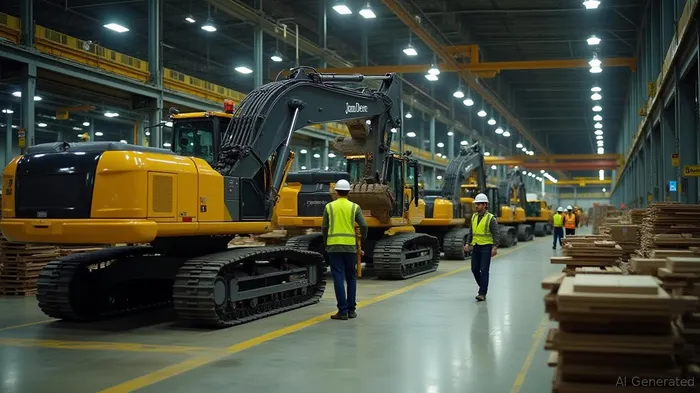
Recent speculation about Deere scaling back U.S. operations—sparked by temporary layoffs and a Mexico factory expansion—has now been decisively countered. The $20 billion allocation is a concrete rebuttal to such fears, emphasizing the company's long-term faith in American manufacturing. The investment will fund projects like a 120,000-square-foot remanufacturing expansion in Missouri, a new excavator factory in North Carolina, and upgraded assembly lines for its flagship 9RX high-horsepower tractors in Iowa. These facilities aren't just about building tractors and excavators; they're about reengineering supply chains to withstand global shocks.
Geopolitical Risk Mitigation: The Domestic Supply Chain Play
Deere's strategy is a masterclass in supply chain resilience. With 93% of its complete goods and 92% of components sourced from North America or Europe, the company is minimizing exposure to volatile regions like Southeast Asia. By centralizing production in the U.S., Deere reduces reliance on cross-border logistics, tariffs, and geopolitical tensions. This self-reliance is critical in an era of trade wars and semiconductor shortages.
The data shows Deere's ability to outperform peers in cyclical downturns, a trend this investment will likely amplify. A stronger domestic footprint could also insulate margins from currency fluctuations and raw material price swings.
Agtech and Sustainability: The Invisible Edge
While the $20 billion commitment focuses on manufacturing infrastructure, Deere's broader vision for agricultural technology (agtech) and sustainability is deeply woven into its DNA. Consider its Sentera acquisition, which integrates aerial field-scanning drones into its precision farming toolkit, or its ExactShot fertilizer technology, which reduces waste by up to 80 pounds per acre. These innovations, while not directly funded by the $20B, are enabled by the same engineering prowess and data analytics cultivated in U.S. factories.
The new Missouri remanufacturing facility, for instance, isn't just about rebuilding engines—it's about recycling materials and reducing carbon footprints, aligning with global sustainability mandates. Meanwhile, the 9RX tractor's autonomous capabilities (via its Blue River Technology subsidiary) tackle labor shortages while boosting efficiency. This trifecta of precision agtech, sustainability, and automation positions Deere not just as a machinery manufacturer but as an enabler of next-generation farming.
Investment Thesis: A Growth Anchor in Cyclical Industrials
For investors, Deere's move underscores its transition from a cyclical stock to a strategic growth story. The $20 billion investment is a vote of confidence in U.S. demand for industrial and agricultural equipment, while its tech and sustainability bets future-proof its product line. Key metrics to watch:
Stock Performance:
A stable dividend yield (~2.5%) offers downside protection in downturns, while its 10-year average P/E ratio of 18 suggests it's undervalued relative to peers.Market Share: Deere's dominance in high-margin agtech products (e.g., autonomous tractors) and its 80% U.S. sales dependency on domestic manufacturing creates a moat against competitors like CNH Industrial.
Geopolitical Tailwinds: U.S. infrastructure spending and farm subsidies, paired with global food security concerns, could supercharge demand for Deere's machinery.
Risks and Considerations
No investment is risk-free. Deere faces headwinds like farm income volatility (due to commodity prices) and solar panel shortages impacting construction equipment demand. However, its U.S.-centric strategy and diversified portfolio (agriculture, construction, forestry) offer natural hedges.
Conclusion: A Foundation for the Future
John Deere's $20 billion bet isn't just about factories—it's about building a future where American manufacturing and agtech innovation go hand in hand. In an era of supply chain fragility and climate urgency, this investment solidifies Deere's role as an industrial titan capable of navigating both cycles and crises. For investors seeking resilience in industrials, Deere's blend of defensive stability and growth catalysts makes it a compelling long-term play. The question isn't whether to bet on Deere—it's how much.

Delivering real-time insights and analysis on emerging financial trends and market movements.
Latest Articles
Stay ahead of the market.
Get curated U.S. market news, insights and key dates delivered to your inbox.
AInvest
PRO
AInvest
PRO



Comments
No comments yet