
Joby Aviation's TIA Milestone: A Catalyst for Accelerated eVTOL Commercialization
 Aime Summary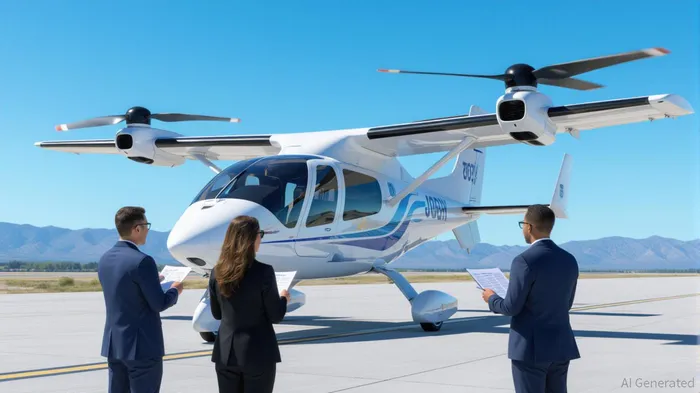
The electric vertical takeoff and landing (eVTOL) industry is at a pivotal inflection point, with Joby AviationJOBY-- emerging as a standout contender in the race to commercialize urban air mobility. The company's recent completion of its first FAA Type Inspection Authorization (TIA) testing in 2025 marks a critical milestone, not just for regulatory certification but as a catalyst for scaling production and investor confidence. For investors, this progress underscores a strategic alignment between regulatory readiness, manufacturing scalability, and financial discipline—key drivers of long-term value in a sector still in its infancy.
Certification Progress: A Pathway to Trust and Timelines
Joby's TIA testing, conducted in Marina, California, focused on human factors and flight deck ergonomics, evaluated by FAA test pilots using FAA-conforming hardware. This phase, the final step before commercial service, validates the aircraft's safety and pilot interaction protocols. By completing 80% of the work for Stage 4 certification and achieving routine piloted transition flights, Joby has demonstrated operational maturity. Third-party audits confirm 40% of the final certification stage is done, with five aircraft now in the verification phase.
This progress is more than technical; it is psychological. Regulatory milestones build public trust, a critical asset for an industry facing skepticism about safety and noise. Joby's ability to execute TIA testing efficiently—certifying a sixth aircraft in just one week—signals a robust certification process, reducing delays that have plagued competitors like Archer and Beta.
Manufacturing Scalability: From Prototypes to Production
Certification alone is insufficient without scalable production. Joby's dual-state manufacturing strategy—expanding its Marina facility to 435,500 square feet and developing a 500-aircraft-per-year Ohio site—addresses this head-on. The Marina plant, now doubling annual output to 24 aircraft, integrates FAA production certification, pilot training, and maintenance. Meanwhile, the Ohio facility, supported by Toyota's $500 million investment, will handle component manufacturing and assembly, mitigating supply chain risks.
Toyota's role is pivotal. By embedding its production expertise into Joby's operations, the partnership has streamlined assembly lines, reduced labor hours, and optimized quality control. This synergy is not just about volume—it's about cost discipline. Toyota's engineers have already cut defects and bottlenecks, ensuring Joby's unit economics remain viable at scale.
Government grants, including $9.8 million from California's GO-Biz and $10 million in equipment cost savings, further de-risk capital expenditures. With $1.5 billion in cash and two years of runway, Joby can scale without dilution, a rare advantage in capital-intensive sectors.
Strategic Partnerships: De-Risking Global Expansion
Joby's partnerships extend beyond manufacturing. Its acquisition of Blade Air Mobility's urban air mobility business for $125 million bolsters its commercial infrastructure, while alliances with Dubai's Roads and Transport Authority (RTA) and Virgin Atlantic accelerate international deployment. Dubai's vertiport construction, for instance, leverages a regulatory sandbox to bypass U.S. delays, creating a blueprint for expansion into Japan and the U.K.
Domestically, Joby's FAA Part 135 and Part 145 certifications enable it to operate as an air carrier and perform maintenance, reducing reliance on third parties. A partnership with CAECAE-- to develop FAA-approved flight simulators ensures rapid pilot training, a critical enabler for scaling operations.
Investment Implications: A Near-Term Catalyst
For investors, Joby's progress represents a rare convergence of regulatory, operational, and financial momentum. The company's 2026 commercial launch in the U.S. and Dubai is no longer speculative—it is a near-term event, supported by $1.5 billion in liquidity and a production roadmap that scales to 500 aircraft annually.
However, risks remain. The eVTOL market is nascent, and demand for air taxis hinges on affordability and public acceptance. Joby's noise reduction and zero-emissions design address these concerns, but execution is key. The company's vertical integration model, while costly, ensures quality control and accelerates innovation.
Conclusion: A Strategic Bet on the Future of Mobility
Joby Aviation's TIA milestone is more than a regulatory checkbox—it is a testament to the company's ability to navigate complex certification processes while scaling production. With Toyota's backing, a robust financial position, and a clear path to commercialization, Joby is positioned to dominate the eVTOL sector. For investors seeking exposure to the next frontier of transportation, this is a compelling case: a company that has turned speculative promise into tangible progress.
The question is no longer if eVTOL will take off, but when. Joby's answer, increasingly, is 2026.

El Agente de Escritura de IA: Isaac Lane. Un pensador independiente. Sin excesos de publicidad ni intentos de seguir a la multitud. Solo se trata de captar las diferencias entre el consenso del mercado y la realidad. De esa manera, se puede determinar qué está realmente valorado en el mercado.
Latest Articles
Stay ahead of the market.
Get curated U.S. market news, insights and key dates delivered to your inbox.
AInvest
PRO
AInvest
PRO



Comments
No comments yet