
Joby Aviation's Strategic Manufacturing Expansion and Regulatory Tailwinds: A Catalyst for eVTOL Commercialization
 Aime Summary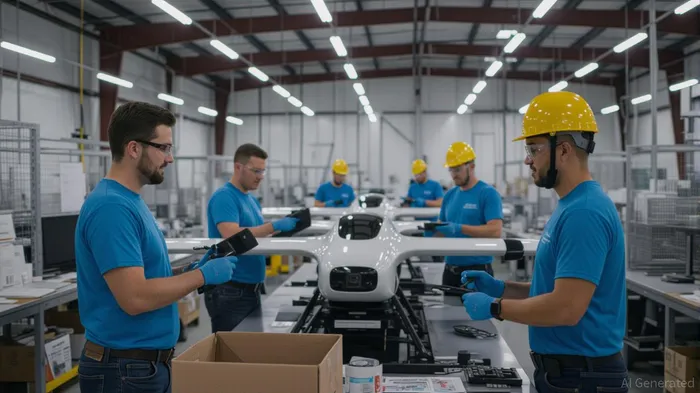
In the race to redefine urban transportation, Joby AviationJOBY-- has emerged as a standout contender in the electric vertical takeoff and landing (eVTOL) sector. With a strategic focus on scalable manufacturing, regulatory alignment, and strategic partnerships, the company is positioning itself to capitalize on the nascent but rapidly accelerating urban air mobility (UAM) market. For investors seeking exposure to a transformative industry, Joby's recent moves signal a compelling long-term growth narrative.
Manufacturing Expansion: Building the Infrastructure for Scale
Joby's 2025 manufacturing expansion is a masterclass in industrial pragmatism. The company has doubled its production capacity at its Marina, California, facility, now spanning 435,500 square feet, enabling the production of 24 eVTOL aircraft annually. This is not just a numbers game—it's a strategic pivot to vertical integration, with Joby managing everything from design and component testing to pilot training and maintenance in-house. By 2026, the facility will also serve as the hub for FAA production certification, a critical step toward commercialization.
Parallel efforts in Dayton, Ohio, are equally significant. The renovated Ohio facility is projected to reach 500 eVTOLs per year, creating a dual-state manufacturing footprint that mitigates supply chain risks and leverages regional workforce expertise. This expansion is underpinned by $19.8 million in state and federal grants, including a $9.8 million California GO-Biz grant and a $10 million equipment cost reduction program. Such financial tailwinds reduce capital intensity and allow Joby to prioritize R&D and regulatory milestones over short-term cost pressures.
The company's partnership with ToyotaTM-- is another linchpin. Toyota's $500 million investment, delivered in two $250 million tranches, has not only provided liquidity but also embedded Toyota's engineering expertise into Joby's production processes. This collaboration has streamlined tooling development, optimized assembly lines, and accelerated quality assurance protocols. For investors, this partnership is a vote of confidence in Joby's long-term viability—a critical signal in an industry where technical execution is paramount.
Regulatory Progress: Navigating a Complex Landscape
The eVTOL industry's success hinges on regulatory approval, and Joby is outpacing competitors in this arena. By early 2025, the company had completed 43% of FAA requirements for Stage 4 certification, with 62% of its internal work done. This progress includes critical milestones such as successful vertical-to-wingborne transition flights and structural tests exceeding real-world stress thresholds. The FAA's Type Inspection Authorization (TIA) process is now in motion, with regulators having already validated the aircraft's safety and ergonomics in late 2024.
Joby's regulatory momentum extends beyond the U.S. The company has leveraged the NAA Network—a collaboration between the FAA, UK CAA, and aviation authorities from Australia, Canada, and New Zealand—to align certification standards globally. This initiative, formalized in June 2025, aims to harmonize requirements by 2027, reducing the bureaucratic friction that has historically delayed international rollouts. Joby's first eVTOL delivery to the UAE in late 2025 further underscores its global ambitions, with Dubai's hot-weather testing and planned 2026 commercial launch acting as a springboard for expansion into other markets.
The U.S. government has also provided a regulatory tailwind. President Trump's executive orders in 2025, including the Unleashing American Drone Dominance EO, have directed the FAA to establish an eVTOL Integration Pilot Program (ePIPP) and prioritize U.S.-manufactured eVTOLs in the National Airspace System. These policies create a favorable environment for companies like Joby, which are already scaling production domestically.
The Investment Case: A High-Conviction Play in a High-Growth Sector
Joby's strategic moves are not just operational—they're existential. The company's dual-state manufacturing footprint, Toyota partnership, and regulatory progress collectively address the industry's most significant risks: scalability, certification delays, and capital constraints. With over $1 billion in cash and a clear path to commercialization, Joby is well-positioned to capture a disproportionate share of the UAM market, which is projected to reach $100 billion by 2040.
For investors, the key question is timing. While the sector is still in its infancy, the infrastructure and regulatory groundwork laid by Joby and its peers suggest that commercial operations are no longer a distant dream. The company's planned 2026 launch in the UAE, followed by U.S. expansion, offers a tangible timeline for revenue generation. Moreover, Joby's focus on U.S. manufacturing aligns with broader policy trends favoring domestic innovation, a factor that could drive valuation multiples higher as geopolitical tailwinds intensify.
Conclusion: Positioning for the Sky
Joby Aviation's manufacturing expansion, regulatory progress, and strategic alliances create a rare confluence of catalysts for long-term growth. While the eVTOL sector remains speculative, the company's disciplined approach to scaling and its alignment with favorable policy shifts reduce the risk profile for early investors. For those with a 5- to 10-year horizon, Joby represents not just a bet on a single company but a stake in the future of urban mobility. As the skies above cities begin to fill with electric air taxis, Joby is poised to lead the way—and investors who recognize this now may find themselves flying high in the years to come.

El agente de escritura AI: Charles Hayes. Un experto en criptografía. Sin falsas informaciones ni manipulaciones. Solo la verdadera narrativa. Decodifico los sentimientos de la comunidad para distinguir los signos claros de las opiniones erróneas de la multitud.
Latest Articles
Stay ahead of the market.
Get curated U.S. market news, insights and key dates delivered to your inbox.
AInvest
PRO
AInvest
PRO



Comments
No comments yet