
Joby Aviation's Q2 Earnings and Production Milestones: A Critical Juncture for the eVTOL Sector
 Aime Summary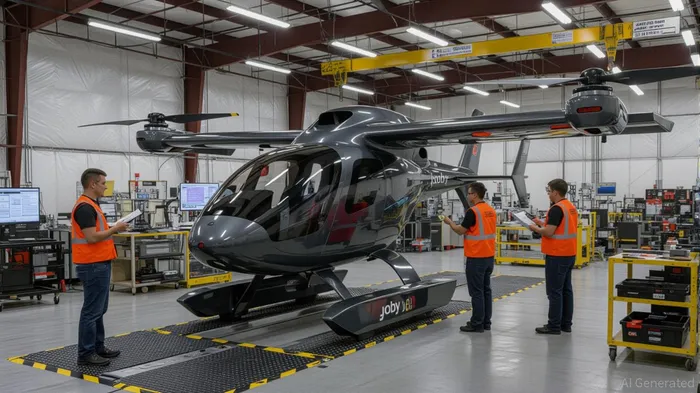
The electric vertical takeoff and landing (eVTOL) sector, once a speculative corner of the aerospace industry, is now at a pivotal moment. JobyJOBY-- Aviation's Q2 2025 earnings report and operational updates offer a rare window into the challenges and opportunities facing this nascent market. For investors, the question is no longer whether eVTOL can work, but whether companies like Joby can balance the immense capital demands of certification and production with the urgency of commercialization.
Financial Performance: A Tale of Capital Intensity and Strategic Resilience
Joby's Q2 results underscore the brutal economics of pioneering a new transportation paradigm. The company reported a net loss of $325 million, driven largely by non-cash revaluations tied to its ToyotaTM-- investment and warrant adjustments. While this exceeds the prior quarter's losses, it reflects the scale of capital required to navigate the FAA's rigorous certification process.
Cash reserves remain robust at $991 million, bolstered by the first tranche of Toyota's $500 million investment. This liquidity provides a buffer against short-term volatility but raises questions about long-term sustainability. The company's cash burn of $112 million in Q2—down 10% from the previous quarter—suggests some operational efficiency, yet the path to profitability remains distant. Revenue, at $20,000, fell far below expectations, highlighting the sector's current reliance on capital rather than cash flow.
The key metric here is not the loss itself, but how it is allocated. Joby'sJOBY-- leadership has prioritized regulatory and production milestones, which are critical for unlocking future revenue. The challenge lies in convincing investors that these expenditures will translate into a scalable business model.
Operational Readiness: Certifying the Future
Joby's operational progress in Q2 is arguably more significant than its financials. The commencement of final assembly for its first Type Inspection Authorization (TIA) aircraft marks a decisive step toward FAA certification. This is the fifth and final phase of the certification process, and the planned 2025 test flights with FAA pilots will determine whether the company can meet its 2025 certification target.
Regulatory progress has accelerated, with 70% of stage four completed on Joby's side and over 50% on the FAA's. Such collaboration is rare in aviation and signals a shared urgency to bring eVTOL to market. Meanwhile, the Dubai flight tests—conducted in extreme heat—provided real-world validation of the aircraft's performance and logistics infrastructure. These trials are not just technical exercises; they are demonstrations of commercial readiness to potential partners and regulators.
Strategic partnerships further amplify Joby's operational momentum. The acquisition of Blade Air Mobility's passenger business offers immediate access to urban corridors and a customer base willing to pay a premium for time-saving transport. The collaboration with L3HarrisLHX-- to develop a hybrid variant for defense applications diversifies revenue streams and mitigates risks tied to commercial adoption delays.
The Intersection of Finance and Operations: A Delicate Balance
The eVTOL sector's defining challenge is aligning capital-intensive development with the need for rapid commercialization. Joby's Q2 results illustrate both the risks and rewards of this balancing act.
On one hand, the company's $991 million cash reserves and expanded manufacturing facilities (now capable of 24 aircraft annually) demonstrate its ability to scale production. The Marina and Dayton facilities are critical to meeting projected demand, particularly as partnerships with Abdul Latif Jameel and All Nippon Airways (ANA) hint at a global deployment strategy.
On the other hand, the $325 million quarterly loss and minimal revenue highlight the sector's reliance on external financing. For Joby, this means maintaining strong relationships with investors like Toyota and leveraging strategic partnerships to reduce time-to-market. The Blade acquisition, for instance, accelerates infrastructure development in key markets, potentially offsetting the high costs of certification.
The key question for investors is whether Joby can maintain this momentum without diluting shareholder value. The company's guidance of $500–$540 million in cash burn for 2025 suggests a disciplined approach, but regulatory delays or production bottlenecks could force further capital raises.
Investment Considerations: Navigating the eVTOL Frontier
Joby's Q2 report offers a blueprint for how to navigate the eVTOL sector's unique risks. The company's focus on regulatory progress and production scaling aligns with the sector's long-term potential, but investors must remain vigilant about short-term pressures.
- Regulatory Risk: Delays in FAA certification could disrupt timelines and increase costs. However, Joby's 70% completion of stage four suggests a higher probability of on-time certification compared to peers.
- Capital Efficiency: The 10% reduction in cash burn is a positive sign, but the company's reliance on non-operating revenue (e.g., warrant revaluations) complicates financial forecasting.
- Strategic Diversification: The defense collaboration with L3Harris and global partnerships reduce exposure to commercial adoption risks. This diversification is a strength in an unpredictable market.
- Market Positioning: Joby's acquisition of Blade and agreements with ANA position it as a leader in urban air mobility. However, competition from companies like Archer AviationACHR-- and Beta Technologies remains intense.
For investors, the decision to invest in Joby hinges on their risk tolerance and time horizon. The company is not a short-term play but a long-term bet on the future of urban transportation. Those who believe in the transformative potential of eVTOL—and Joby's ability to execute its vision—may find the current valuation compelling, particularly given the sector's limited supply of viable players.
Conclusion: A Calculated Bet on the Sky
Joby Aviation's Q2 2025 report is a testament to the company's progress in navigating the twin challenges of certification and capital. While the financials remain unprofitable, the operational milestones and strategic partnerships suggest a company poised to lead the eVTOL revolution.
For investors, the path forward requires patience and a clear-eyed assessment of the sector's risks. Joby's ability to maintain regulatory momentum, scale production efficiently, and diversify its revenue streams will determine its long-term success. In a market where first-mover advantage is critical, the company's current trajectory offers a compelling case for cautious optimism.
The eVTOL sector is still in its infancy, but companies like Joby are building the infrastructure for a future where the sky is no longer the limit.
"""

Delivering real-time insights and analysis on emerging financial trends and market movements.
Latest Articles
Stay ahead of the market.
Get curated U.S. market news, insights and key dates delivered to your inbox.
AInvest
PRO
AInvest
PRO



Comments
No comments yet