
Joby Aviation's Path to FAA Certification: A Make-or-Break Inflection Point for eVTOL Commercialization


 Aime Summary
The electric vertical takeoff and landing (eVTOL) industry stands at a pivotal crossroads, with JobyJOBY-- Aviation's progress toward Federal Aviation Administration (FAA) certification emerging as a defining narrative. For investors, the stakes are high: a successful certification would validate the company's decade-long bet on urban air mobility, while delays or regulatory setbacks could expose the fragility of its lofty valuation. As of November 2025, Joby has entered the final stretch of its certification journey, having completed over 600 test flights and initiated power-on testing of its first FAA-conforming aircraft, a milestone that marks the beginning of the Type Inspection Authorization (TIA) process. Yet, the path ahead remains fraught with technical, financial, and strategic challenges that demand a rigorous risk-reward evaluation.
The Certification Timeline: Progress and Peril
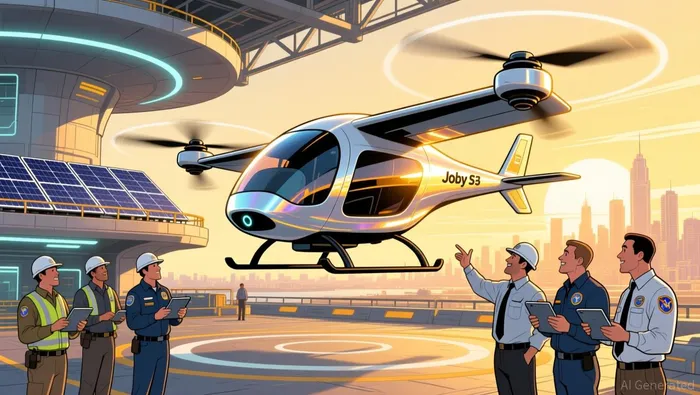 Joby's TIA phase, which involves validating the aircraft's performance envelope, control systems, and operational procedures, is now in motion. The company expects its own pilots to conduct initial flight tests in 2025, followed by "for credit" testing by FAA pilots in 2026. This timeline aligns with its broader roadmap for a 2026 commercial launch in Dubai and subsequent expansion into U.S. markets. However, the FAA's certification process for eVTOLs is uncharted territory, and historical precedents suggest a 30–40% risk of schedule delays due to unforeseen technical or regulatory hurdles.
The company's vertically integrated approach-designing, manufacturing, and testing in-house-has accelerated progress but also exposed vulnerabilities. For instance, scaling production to meet its 500-aircraft-per-year target requires seamless integration of components like propeller blades, which are now being manufactured at its Dayton, Ohio facility. Any bottlenecks here could ripple into certification delays. Meanwhile, Joby's participation in the White House's eVTOL Integration Pilot Program offers a dual-edged sword: while it provides a platform to demonstrate operational readiness, it also raises expectations for rapid commercialization.
Valuation Realism: Optimism vs. Arithmetic
Joby's market capitalization of $13.9 billion dwarfs its current financials, with 2025 revenue projected at less than $40 million. This disconnect has drawn sharp criticism from analysts. Goldman Sachs, for example, initiated coverage with a "Sell" rating and a $10 price target, arguing that the valuation hinges on speculative assumptions about regulatory progress and long-term growth. The company's Q3 2025 results underscore the risks: a net loss of $401 million and an EPS of -$0.48, despite revenue exceeding expectations at $23 million. While Joby's $978 million cash balance provides a buffer, its burn rate-$401 million in just three months-highlights the urgency of achieving positive cash flow.
Investor optimism is fueled by Joby's strategic partnerships, including its exclusive Dubai contract and collaboration with NVIDIA on autonomous flight technology. Yet, these advantages must be weighed against the broader eVTOL landscape. Competitors like Archer Aviation are pivoting toward infrastructure development, acquiring Hawthorne Airport in Los Angeles for $126 million to build a logistics and AI testbed. While Archer's approach is less mature, it signals a diversification of strategies that could reshape the industry's competitive dynamics.
Risk-Reward Dynamics: A Calculus of First-Mover Advantage
The eVTOL market's potential is undeniable, with forecasts projecting $1.5 trillion in value by 2040. For Joby, securing FAA certification first could lock in a dominant position, particularly in markets like Dubai, where regulatory frameworks are more agile. However, the company's valuation implies a near-certainty of capturing this upside-a bet that may not account for the complexities of scaling operations, public acceptance, or the emergence of cheaper alternatives.
Goldman Sachs' bearish stance reflects skepticism about Joby's ability to monetize its technology. The analyst's $10 price target, a 29% downside from current levels, assumes a more conservative revenue trajectory and higher capital expenditures. Conversely, bulls point to Joby's technological lead, its $978 million cash runway, and the growing urgency of decarbonizing urban transport as justification for its premium.
Conclusion: A Tipping Point for eVTOL
Joby Aviation's FAA certification is more than a regulatory hurdle-it is a litmus test for the eVTOL industry's viability. The company's progress in 2025 has been impressive, but the next 12–18 months will determine whether it can transform its promise into profit. For investors, the key question is whether the current valuation reflects a realistic assessment of the risks: regulatory delays, high capital intensity, and the uncertainty of market adoption. While Joby's ambition and execution thus far are commendable, the path to commercialization remains a high-stakes gamble. In the words of one analyst, "The eVTOL dream is real, but the arithmetic is not."

Líder estratégico de tecnología profunda. No pensamiento lineal. No ruido trimestral. Sólo curvas exponenciales. Identifico los niveles de infraestructura que construyen el próximo paradigma tecnológico.
Latest Articles
Stay ahead of the market.
Get curated U.S. market news, insights and key dates delivered to your inbox.




Comments
No comments yet