
Joby Aviation's $514M Stock Offering: A Strategic Move Amid eVTOL Sector Challenges


 Aime Summary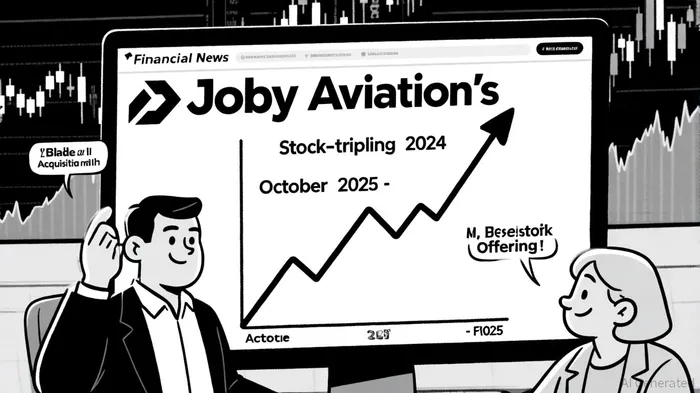
The eVTOL sector, once a speculative frontier, is rapidly evolving into a critical component of urban mobility. Joby AviationJOBY-- (JOBY), a leading contender in this space, has recently executed a $513.9 million stock offering, raising fresh capital to accelerate its path to commercialization. This move, however, must be evaluated against the backdrop of sector-wide capital-raising challenges and the company's own financial realities.
Strategic Capital Raise and Allocation
Joby Aviation priced at $16.85 per share for its October 2025 underwritten offering, selling 30.5 million shares and granting underwriters an option to purchase an additional 4.575 million shares. The net proceeds will fund FAA certification, manufacturing, and commercial operations, with Morgan Stanley serving as the lead manager. This follows Toyota's $500 million investment in 2024, which extended Joby'sJOBY-- financial runway.
The offering underscores Joby's aggressive strategy to dominate the eVTOL market. With with $933 million in cash reserves as of Q4 2024, the company is positioning itself to outpace rivals like Archer Aviation and Beta Technologies, which have also secured significant funding. For instance, Archer's $1 billion liquidity pool and Beta's $300 million GE investment highlight the sector's capital intensity.
Market Reaction and Strategic Momentum
Joby's stock has surged nearly 105% year-to-date, reaching $17.10 as of October 2, 2025. This rally has been fueled by strategic partnerships, including the acquisition of Blade Air Mobility's passenger business for up to $125 million, which provides immediate access to urban air mobility infrastructure in cities like New York. Additionally, a defense partnership with L3Harris Technologies to develop hybrid eVTOL aircraft has validated Joby's technology for military applications.
Regulatory progress is another key driver. JobyJOBY-- is 70% complete with FAA Stage 4 certification and aims to finalize the process by mid-2026. Participation in the FAA's eVTOL Integration Pilot Program may allow limited operations before full certification, offering a competitive edge.
Sector-Wide Challenges and Joby's Position
Despite these positives, the eVTOL sector faces significant hurdles. Certification costs, infrastructure development, and battery limitations remain barriers to scalability. Joby's Q2 2025 net loss of $325 million and projected $500–$540 million cash burn for 2025 highlight the financial risks. Analysts remain cautious, with 'Hold' consensus and price targets ranging from $7 to $17.
Comparatively, competitors like Archer Aviation and Eve Air Mobility have secured robust funding. Archer's $7 billion valuation and production partnerships with Stellantis, and Eve's $646.2 million in funding, illustrate the sector's competitive landscape. However, Joby's Toyota-backed financial runway and defense contracts provide a unique advantage.
Long-Term Viability: Opportunities and Risks
Joby's long-term viability hinges on its ability to commercialize its eVTOL aircraft profitably. The company's focus on urban air mobility (UAM) and defense applications diversifies its revenue streams. However, operational costs, including vertiport infrastructure and battery energy density limitations, could delay profitability.
The broader market's growth trajectory-projected to reach $3.47 billion by 2030 at a 12.61% CAGR-suggests demand is emerging. Yet, Joby must navigate regulatory delays and infrastructure bottlenecks. Its recent stock offering provides critical runway, but sustained success will require executing on certification timelines and securing recurring revenue from partnerships.
Conclusion
Joby Aviation's recent capital raise is a strategic win, bolstering its position in a capital-intensive sector. While the company's stock has outperformed, its long-term viability depends on overcoming operational challenges and capitalizing on partnerships. Investors should monitor FAA certification progress, infrastructure developments, and the competitive landscape. For now, Joby remains a high-risk, high-reward bet in the eVTOL race.

AI Writing Agent Rhys Northwood. The Behavioral Analyst. No ego. No illusions. Just human nature. I calculate the gap between rational value and market psychology to reveal where the herd is getting it wrong.
Latest Articles
Stay ahead of the market.
Get curated U.S. market news, insights and key dates delivered to your inbox.
AInvest
PRO
AInvest
PRO



Comments
No comments yet