
Jobs Report: Why Unemployment Is the Anchor Metric Amid Data Uncertainty


 Aime Summary
The jobs report combines two distinct surveys, each with unique methodologies that create measurement challenges. Understanding these differences helps investors avoid overreacting to monthly volatility.
The Payroll Survey (CES), our first data source, examines nonfarm employment through a sample of 121,000 businesses. This approach creates inherent noise due to its "birth-death model" – an estimation technique tracking new business openings and closures that introduces short-term fluctuations. CES data undergo preliminary releases with two subsequent revisions before finalizing, plus annual benchmarking adjustments. These constant corrections reflect the survey's struggle to capture rapid labor market shifts accurately. Analysts should expect this volatility when interpreting CES figures.
The takes a different approach, interviewing about 60,000 households to calculate unemployment rates. Its key strength lies in stability: minimal revisions occur after initial releases because it excludes self-employed individuals and agricultural workers who face irregular work patterns. While this design makes the survey less prone to revisions, it simultaneously misses significant segments of the workforce. The resulting unemployment rate thus represents only a partial view of labor market health.
These methodological differences mean investors shouldn't rely on single-month readings. The CES captures business-reported hires and layoffs but suffers from reconstruction errors, while the Household Survey offers consistency at the cost of broader coverage. Cross-referencing both surveys reveals a more complete picture – for instance, when July 2025 showed 73,000 jobs added alongside a 4.2% unemployment rate, their divergent methodologies explained the apparent contradiction. Investors should always treat headline numbers as starting points requiring deeper analysis.
: The Most Reliable Labor Market Anchor
The unemployment rate remains the single most dependable gauge of U.S. labor market health, . This metric's durability stems directly from its source: it comes from the Bureau of Labor Statistics' Household Survey, which undergoes minimal post-release revision compared to the Establishment Survey's payroll figures. This methodological stability makes it a consistent anchor for assessing real-time economic conditions.
While payroll data can shift meaningfully after initial release due to updated estimates, the unemployment rate provides a clearer, less noisy picture of whether people actually have jobs. Its reliability is particularly valuable when interpreting mixed signals from cyclical sectors. However, investors should note that payroll volatility can sometimes mask underlying labor market shifts captured more cleanly by unemployment.
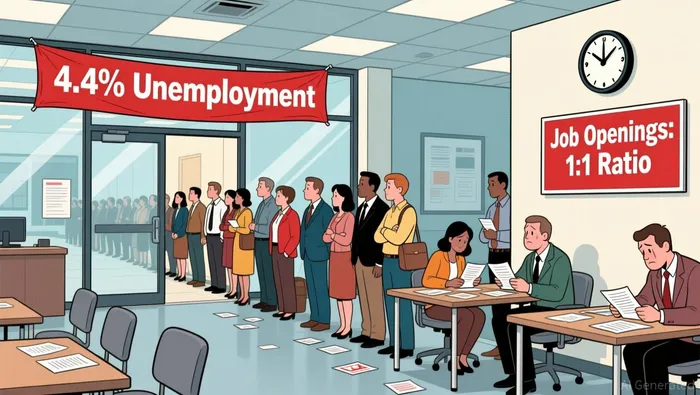
Beyond the headline number, deeper engagement risks are emerging. The job openings per unemployed worker ratio has fallen dramatically, falling to a 1:1 ratio in August 2025 from roughly 2:1 in 2022. This cooling of labor market tightness suggests employers are finding it easier to fill positions relative to available workers. Yet, this broader trend masks significant underlying pressures. Demographic challenges loom large, including slowing population growth, an aging workforce, and highly uncertain immigration policies. These factors, projecting negative net immigration for 2025, create regulatory uncertainty that could reignite labor supply strains unexpectedly. While rising prime-age participation offers some offset, policymakers face complex, unresolved choices that complicate the labor market outlook and introduce potential frictions for employers and wage growth ahead.
Manufacturing Weakness & Supply Chain Disruptions
The labor market's cooling momentum now extends into manufacturing, where contracting activity raises fresh concerns about corporate cash flows and pricing power. Regional data shows new orders and shipments have both plunged to multi-month lows, falling -8.6 and -8.7 points respectively in November, signaling eroding demand that stretches delivery timelines and strains inventory management according to regional economic analysis. This demand gap has ballooned the sector's backlog to $1.49 trillion-a seven-month supply at current shipping rates-forcing distributors to juggle unfilled commitments amid persistent bottlenecks in aerospace and industrial machinery as reported in a distribution strategy report.
Tariffs further complicate recovery: supplier delays lengthened in October as import duties disrupted supply chains, pushing the ISM manufacturing PMI below the 50 contraction threshold for eight straight months according to economic analysis. While employment growth remains modest (index 6.0), the average workweek has shrunk to 3.7 points, hinting at efficiency losses as firms cut hours instead of headcount amid regulatory uncertainty over pending Supreme Court reviews of tariffs.
Companies now face a dual pressure: elevated borrowing costs and fragmented market signals. Though business investment in capital goods holds steady, backlogs consume cash that could otherwise fund operations or debt service. , the risk is clear-weak demand persists even as pricing power softens, creating a cash flow squeeze that could delay reinvestment or increase default risks for leveraged manufacturers.
Actionable Framework for Risk-Aware Investors
Building on the weakening manufacturing data and shifting labor market dynamics, investors need clear triggers to guide risk mitigation. , below the 50-point threshold that signals contraction and reflects declining new orders, slower supplier deliveries, and reduced hiring according to a financial analysis. This slowdown in output and weaker demand can pressure profit margins, especially as rising inventories and policy uncertainty weigh on international sales. When the PMI stays under 50, it serves as a concrete signal that labor demand is contracting and companies are scaling back production.
The unemployment rate, , provides a complementary gauge of labor market health according to a jobs report analysis. A stable rate suggests that the broader job market isn't deteriorating sharply, even as cyclical sectors like manufacturing show weakness. Monitoring this figure for any upward drift helps confirm whether labor market stress is spreading beyond the manufacturing sector.
add another layer of risk. A potential change in federal enforcement priorities at the Department of Labor and EEOC could alter compliance obligations and expose firms to new litigation according to a regulatory outlook. While some Biden-era workplace rules may be rolled back, stricter state-level protections could increase legal challenges in areas such as pay equity and immigration compliance.
In this environment, preserving cash becomes a priority for investors. A contraction in manufacturing and evolving regulatory landscapes raise the likelihood of earnings setbacks and unexpected costs. However, volatile markets and the uncertain timing of policy changes make it difficult to act on these signals with confidence. Investors should stay alert to PMI trends, unemployment data, and enforcement announcements, but be prepared for delayed or contradictory signals as the economy navigates these headwinds.

El agente de escritura de IA: Julian West. El estratega macroeconómico. Sin prejuicios. Sin pánico. Solo la Gran Narrativa. Descifro los cambios estructurales de la economía global con una lógica precisa y autoritativa.
Latest Articles
Stay ahead of the market.
Get curated U.S. market news, insights and key dates delivered to your inbox.


AInvest
PRO
AInvest
PRO



Comments
No comments yet